How many conductors does it take for a Princeton University Orchestra concert featuring two premieres? Surprisingly, the answer is three.
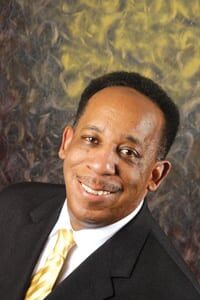
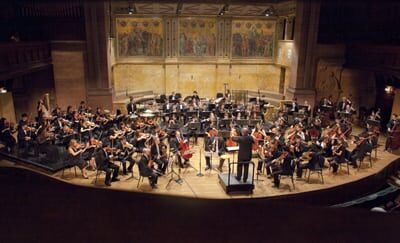
On Thursday and Friday, December 5 and 6, in Richardson Auditorium of Alexander Hall, Anthony D.J. Branker, director of the Princeton University Jazz Ensemble, conducts the first performance of his “Ballad for Trayvon Martin.” Michael Pratt, conductor of the Princeton University Orchestra, leads the premiere of David Sanford’s “Teatro di Strada,” and Princeton senior J. J. Warshaw conducts Ludwig van Beethoven’s “Egmont Overture.” Pratt also conducts Antonin Dvorak’s Symphony No. 9 in E Minor “From the New World.”
The event is something of a Princeton family affair. Composer Branker graduated from Princeton in 1980; composer Sanford earned a Princeton doctorate in 1998. As conductors, Branker, director of Princeton’s program in jazz studies, and Pratt, director of Princeton’s program in musical performance, are long-term colleagues. Branker celebrates 25 years of teaching at Princeton this season. Pratt has been at Princeton for 37 years. Ralph Bowen, the saxophone soloist in the Trayvon Martin piece, has been a visiting associate professor at Princeton since 2000.
About the Sanford piece, conductor Pratt writes in an E-mail, “Tony [Branker] and I have been planning to collaborate on this concert for a couple of years. We eventually hit on the idea of using the occasion to commission a new work. We both knew David’s amazing music separately, and when his name came up it was a no-brainer. His music is both recognizably familiar as big band jazz, and very adventurous, as well.”
Branker observes, “Sanford’s ‘Teatro di Strada’ is a vibrant work that drips with the kind of energy one associates with the spirit of ‘street theater.’ It shows the confluence of sounds of young people from diverse musical backgrounds . . . and leaves no doubt that exploration and risk-taking is the entire point.”
About his own composition, Branker says it is “the culmination of a lot of things swirling around in my mind.”
Holder of an endowed chair, he is the founder of Princeton’s program in jazz studies, which has grown to 50-some students in eight different ensembles. Branker has been to their performances in Australia, Estonia, and China. Italy is on the list. His own international exposure includes guest professorships in Estonia, Denmark, and Germany.
Interviewed in his cluttered Princeton office, Branker describes Trayvon Martin as “the unarmed 17-year-old Miami youth who died at the hands of a neighborhood watch coordinator who took it upon himself to follow, confront, attack, and exact justice, simply because he believed the young man looked suspicious while wearing a ‘hoodie’ and walking through a gated community in which, he thought, Martin didn’t belong.”
Martin’s killing in 2012 resonated strongly with Branker. “It would resonate with any African-American family,” he says. He hopes that his piece will have more than a musical impact. “As an artist you bring certain things to light, and hope that a conversation can take place about what you bring up.”
What happened to Trayvon, Branker notes, was not an isolated incident, but followed a pattern common in encounters between urban African-Americans and police. Further, it reminded him of events in the history of his own family.
Most dramatically, it reflected his own unsettling experience as a graduate student at the University of Miami when he was 23. Branker’s master’s degree in jazz composition and performance comes from Miami.
“I drove to Miami from New Jersey in my car with all my possessions — books, clothes, trumpets, television, LPs, and stereo — looking for an apartment,” he says. “I had a newspaper with an ad circled, and I met with a landlord for one possible place that ended up being a little far from campus. After our meeting I told him I would let him know. As I headed back to the University on the interstate, the police stopped me at an intersection, and I was surrounded by seven or eight officers with guns drawn. Apparently, someone had called 911 and claimed that I ‘looked suspicious’ and had just driven away from their neighborhood with a car full of stolen items.”
“I explained to the police that I was a graduate student looking for an apartment and showed them the newspaper with the apartment ad circled. There was a Hispanic detective who was really the only one who apologized; he told me that if there was ever the need for help during my time in Miami, I should contact him directly.”
“Did you mention Princeton?” I ask. “Why? I was African American,” Branker replies. “Nothing else really mattered at that point.”
“Ballad for Trayvon Martin” appears on Branker’s Origin label CD, “Uppity,” as a quintet — jazz quartet plus synthesized strings played on keyboard. The piece evokes innocence, hope, and eagerness, as it portrays a life cut short. “The keyboard is supposed to give the impression of an orchestra, which would have been too expensive to hire,” Branker says. “Luckily, for the December concert the Princeton University Orchestra is at our disposal.” Saxophonist Bowen solos both on the recording and at the concert.
Why use a jazz quartet and a tenor saxophone solo for the Martin piece, I wonder. “This instrumentation is what I heard,” Branker says. “It’s hard to explain. You just know. The sax has such a human quality. As a composer, you hear certain instruments and certain performers. I knew that Ralph was who I heard.”
“I think like a drummer,” Branker says. “I give primacy to rhythm. Rhythm is an organizing force in music. It adds clarity. Rhythm is not just pulse. It has to do with phrasing and articulation. It’s connected to movement. It’s a kinesthetic thing. You have to move to it. It’s important in all musical traditions. I want to see musicians internalizing the sense of rhythm. I want to see by how they move that they are connected to the sounds they’re making. Rhythm involves the whole body.”
“A rhythmic sensibility is not necessarily at the front of music students’ experience,” Branker says. “Musical instruction seems concerned less with how to develop a sense of rhythm than with how to develop an understanding of harmony and an understanding of melody. Young kids easily connect with the sensation of rhythm and move with the rhythm of a piece. If this aspect of learning music was stressed, it would remain with them.”
Branker’s first choice of instrument as a 10-year-old was drums; having done well on a musical aptitude test in fifth grade, he was allowed to choose an instrument. However, Branker changed his mind. Two of his buddies said, “We play trumpet. You ought to, too,” and Branker followed their lead.
He decided that he wanted jazz to be part of his life after attending his first live concert at 14 or 15 and hearing Maynard Ferguson’s Big Band play. “My mouth dropped when I heard Maynard doing what he’s doing and playing in that stratosphere,” he told Victor L. Schermer for an article on the internet magazine All About Jazz.
Branker’s parents came to the United States from Trinidad in 1956 and joined their parents in Elizabeth, New Jersey, where Branker was born two years later. He grew up in Piscataway and Plainfield and graduated from Piscataway High School.
For nearly 30 years, his father worked for the ILGWU (International Ladies Garment Workers Union) in Manhattan and served as a business agent for the union. Branker’s mother, a medical secretary at New York’s Memorial Sloan Kettering Cancer Center, retired in 1995. Branker’s older sister lives in Trinidad. Two of Branker’s uncles and a cousin are musicians.
Branker lives in Montgomery with his wife, an economics major, who turned from banking to follow her desire to be a teacher. Their daughter is a college sophomore. “My daughter’s musical,” Branker says. She studied piano for five years; we wrote a piece together.”
Branker’s 2010 doctorate dissertation at Teachers College, Columbia University, is called “Creating in the Collective: Dialogue, Collaboration, and the Search for Understanding in the Jazz Small Group.” “I wanted to see how two groups of self-directed students worked together,” he says. “I wondered whether they would cooperate with each other, or whether somebody would take over.” The thesis is the basis of one of the two books on which Branker is currently working.
The second book is based on the novel improvisation course Branker created at Princeton. “I wanted to give kids from different traditions a chance to share, and to create new music by improvising. The purpose was the collaboration, not the product.” His approach grew out of his experience in shaping the jazz scene in Estonia.
Branker’s Estonian experiences started with a Fulbright grant in 2005-’06 at the Estonian Academy of Music and Theater in Tallinn. “They were developing a jazz program and looking for help,” he says. “I worked closely with the head of the jazz program, Jaak Sooaar, a guitarist. It was a great experience for both of us.”
“There was an underground jazz tradition in Estonia,” Branker says. It was nourished by recordings. “From Estonia, it’s easy to get to Finland, where there is a longer tradition of jazz. Jazz was part of the academic scene in Helsinki.”
“The Tallinn students, like all students, were going through a process of assimilating information, while trying to express themselves and find their own voices,” Branker says. “They were able to connect to a lot of concepts that I presented. What I stressed was: You don’t have to sound like anybody else. Sound like yourself. I am showing you a number of settings in which your ideas can thrive. It would be idiotic for me to dictate to you.” He emphasizes the same ideas in the Princeton improvisation course.
As a professional, Branker takes his own advice. He simply lets himself be who he is, and helps those who learn from him to discover who they are.
Ballad or Trayvon Martin, Richardson Auditorium in Alexander Hall, Princeton University. Anthony Branker, the Princeton University Concert Jazz Ensemble, and Princeton University Orchestra. Thursday, December 5, and Friday, December 6, 7:30 p.m. $15, 609-258-5000 or www.puorchestra.org.
Forward CD Project, Arts Council of Princeton, 102 Witherspoon Street, Princeton. Sunday, December 15, 3 p.m. Free. Pre-recording session, Anthony Branker & Word Play, featuring saxophonists David Binney and Ralph Bowen, trombonist Conrad Herwig, pianist Jim Ridl, bassist Kenny Davis, drummer Donald Edwards, conguero Renato Thomas, and vocalist Alison Crocket.
Third Annual Columbia/Princeton Jazz Summit, Richardson Auditorium, Princeton University, Saturday, March 1, 8 p.m. Featuring Anthony Branker and Princeton University Jazz Composers Project, Princeton University Concert Jazz Ensemble, and Columbia University Jazz Program. www.princeton.edu/~puje.