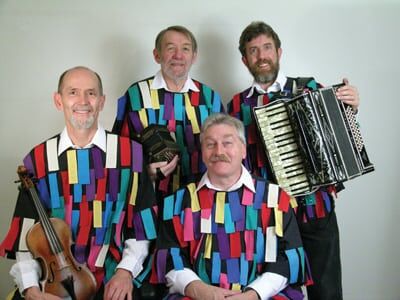
Nowell Sing We Clear’s rousing holiday pageant of carols, stories, and a mummers’ play — drawn from English-language folk traditions — will be performed at Christ Congregation Church, 50 Walnut Lane, in Princeton, Friday, December 20. This event is part of the Princeton Folk Music Society’s eclectic concert calendar, and is an audience favorite.
The pageant of song and story presented through blended voices counteracts winter darkness and looks ahead to longer, brighter days and the green of spring.
Based in Vermont, the group joyously celebrates the season with religious and pagan-inspired songs and stories from centuries-old British and North American traditions. Their program recounts the events and characters involved in the Christmas story and details the customs and rituals that make up the 12 days following the return of the light at the winter solstice.
Many of these ancient customs live on in today’s holiday, such as visiting and feasting, gift-giving, carol singing from door to door, and decorating houses and churches with garlands of evergreen.
“This is our 38th year of touring with the (yuletide) show, which is organized such that the first half tells the story of the Holy Family and their supporting ‘cast of characters,’ such as the shepherds, the angels, the wise men, King Herod, and whatnot,” says Nowell founder Tony Barrand, speaking from his home in Brattleboro, Vermont. “We tell their stories through songs from the largely English-language folk song traditions. A mummers’ play completes the first half, and then the second half consists of songs and stories about the visiting customs of the old 12 days (of Christmas) following the 25th.”
“The pageant includes an adaptation of a 1920s Kentucky mummers’ play, a folk drama that portrays the death of the land at midwinter and its rebirth in spring,” he adds. “There’s always an image of something dying and then being brought back to life, reflecting on the turn of the season. This one has Father Christmas and his wife arguing, and ends up with the woman character being killed. But then, a doctor comes in and brings her back to life. Plays like this were, and still are, very common in Europe and Britain.”
In addition to Tony Barrand, Nowell Sing We Clear features John Roberts, who, along with Barrand, is well known for his lively presentations of English folk songs. Rounding out the quartet are Fred Breunig and Andy Davis, renowned in New England as dance callers and musicians.
While much of the singing is unaccompanied, the pageant is also energized with the dance band sound of fiddle, button accordion, electric piano, drums, and concertina. The audience will be supplied with song sheets and encouraged to sing along, though after three decades of touring in New England and the mid-Atlantic, Barrand says, a whole generation has grown up with these songs and carols and sings along from memory.
“Some ‘new,’ or should I say ‘different,’ songs and carols are introduced every year,” Barrand says.
Anyone who has lived in Philadelphia, has family roots there, or has visited Philly on New Year’s Day, might wonder if the British and European mummers are anything like Philadelphia-based mummers, large groups that dress up flamboyantly and parade up Broad Street on New Year’s Day, accompanied by bands of saxophones, banjos, and accordions. They seem like a far cry from their European and British counterparts, who donned disguises, visited peoples’ homes, and entertained their hosts with silent plays.
These Old Country New Year high jinks seem more akin to a sub-category of the Philadelphia mummers — the comical “wenches” of the traditionally blue-collar neighborhoods around Second or “Two” Street in South Philadelphia. These are working men disguised in whiteface and other makeup, dressed in ruffled, oversized frocks, wearing wigs with long braids, and carrying matching ruffled parasols. Then there are their “golden slippers,” commonly work boots that have been spray-painted gold, and sometimes also adorned in glitter.
These wenches and other comic characters dance the mummers’ strut, with raised arms, waving those parasols, stoked by New Year’s exuberance and, most likely, generous quantities of libations. The best-loved, traditional song for the New Year in Philadelphia is “O, Them Golden Slippers.” That would explain the gold-painted Timberlands.
“The Philadelphia Mummers did evolve from the same kind of dramatic death-and-resurrection plays,” Barrand says. “I have some fragments of text from Philadelphia plays of as late as the 1890s. The Mummers were so successful, however, that the play part couldn’t be heard because the crowds got too big. So, the instrumental and costume parts were expanded to fit in with the processional aspect.”
“(Mummers’) plays were also well-known in nearby Delaware, and can be seen at the Winterthur Museum’s Christmas display (in Wilmington),” Barrand adds. “There mummer figures wear straw masks like those you can still see worn by mummers and ‘Strawboys’ in Ireland.”
Barrand was born and raised in Gainsborough, Lincolnshire, England. His father was an inventor/engineer, designing new machines and creating his own prototypes, and his mother was the cook at the local high school. His musical background comes out of his father’s family, who were all involved with the Salvation Army. The elder Barrand sang in local theater musicals, played trombone in the Salvation Army band, and also played concertina and button accordion.
Barrand came to the United States to study experimental psychology in graduate school at Cornell University, earning a PhD in visual perception. While at Cornell, he met and began singing with Roberts, “with whom I have sung for 44 years, including 39 years with Nowell Sing We Clear,” Barrand says. “We then went to Marlboro College in Brattleboro, Vermont, to teach a program in psychology and the arts. That led me to focus on story-telling with ballads, tales, and seasonal dance customs, and so I became a folklorist. All my publications concerned artistic expression in a cultural setting, including books, recordings, and video archives. When I came to Boston University, the most comfortable place for me was in the anthropology department.”
Married and eventually raising five children, Barrand stayed at B.U. for 28 years, commuting from Brattleboro, teaching primarily in the University Professors Program, where undergraduate and graduate students designed their own course of study.
“It was a situation I loved,” he says. “When the program was ended by a new university president, I retired. Now I do all the same things, singing with John and with Nowell Sing We Clear, except I no longer drive to Boston.”
We all know the song “The Twelve Days of Christmas,” but some wonder why we have “Twelve Days of Christmas.” Barrand’s explanation is as plausible as the other theories. He notes that the “calendar” of the old, pagan ways was based on the moon.
“So one of the theories is that there is a difference of about 12 days between the twelve cycles of the moon and one cycle of the sun,” he says. “The tradition is that there are 12 days of feasting, waiting for the year to catch up with itself.”
Mostly, the feasts, plays, songs, and dances of Yuletide and New Year’s were a way to get through the bleakest time of the year.
“In the northern hemisphere, it was traditional to do things in the ‘mid-winter’ (winter solstice),” Barrand says. “The gypsies called it ‘the terror time,’ the darkest time of the year. Everywhere the festivals are very much about light. In the Anglo-Celtic traditions, we light bonfires and sing songs like, ‘Light the bonfires/gather friends around you.’ There are also traditions in Asia celebrating with fire, to light the way. In the southern states in the U.S., they go out with old firearms, recite a poem wishing for good luck, then fire off the guns to scare away evil spirits.”
“There’s a lot in the various traditions about getting rid of the old spirits that were bothering you in the previous year, and getting ready for the new and better to come in,” he continues. “Sometimes you burn the bad spirits away. My mom would send us kids around to the neighbors with pieces of wood and coal, hoping both would do us good. There is also the tradition of getting invited in — that is, a stranger crossing the threshold is good luck and helps to get everyone in that home through the winter.”
Nowell Sing We Clear, Christ Congregation Church, 50 Walnut Lane, Princeton. Friday, December, 20. Doors open at 7:30 p.m.; show starts at 8:15 p.m. Sponsored by the Princeton Folk Music Society. For this special event, only advance tickets will be available. Tickets: $20 for members of the Princeton Folk Society, $25 for non-members. Mail checks, payable to PFMS, to S. White, 111 Silver Tail Lane, New Hope, Pennsylvania 18938. www.princetonfolk.org or 609-799-0944.