A free event celebrating one of New Jersey’s most famous crops is set for Saturday, August 12. Festomato, the annual August event organized by farmers from the Northeast Organic Farmers Association of New Jersey, will be ripe for the picking at Ironbound Hard Cider Farm in Asbury, Hunterdon County.
In a state where the average age of conventional farmers is just about most regular people’s “retirement” age of 65, the 400-plus members of the Northeast Organic Farmers Association’s New Jersey Chapter are a breath of fresh air. They meet each year in New Brunswick at Douglass College and collaborate, exchange information to improve their bottom lines, and have a good time together at their annual Winter Conference.
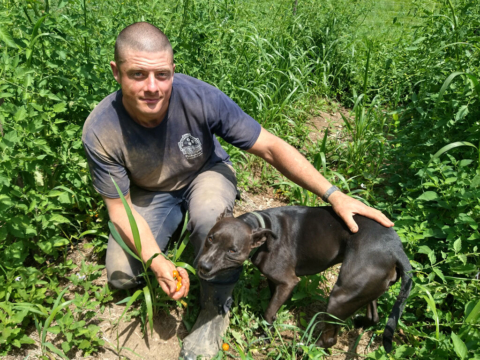
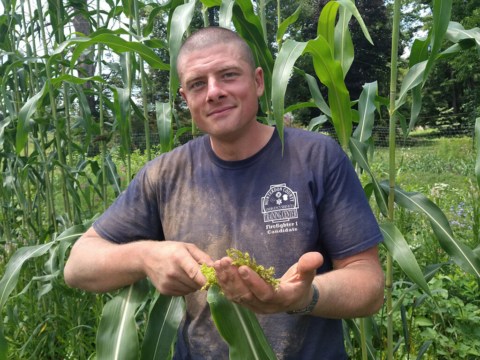
Devin Cornea is the newly installed executive director of NOFA-NJ, and he lives on a six-acre leased farm off of Lambertville Headquarters Road in Stockton.
He calls his place Hungry Work Organic Farm and shares it with girlfriend Morgan Taylor, owner of Country Chic clothing store in Frenchtown.
Like many others involved in organic farming, he is a second career farmer and even considers himself part-time, given his new responsibilities as executive director.
Cornea, 30, was raised in Egg Harbor Township. A good public speaker and unusually diplomatic and polite, Cornea pursued a criminal justice degree at Atlantic County Community College and worked as a hospital police officer in South Carolina before returning to New Jersey and getting hooked on organic, restorative farming.
Cornea’s father, Bill, repairs and installs cash counting machines in the back offices of Atlantic City casinos. His mother, Bridget, worked in doctor’s offices prior to having her two sons. Cornea has a younger brother, Austin, who is running the Tuckahoe Inn, just south of Ocean City.
“I was mostly a miserable kid, didn’t want to be in school. I did well in school, and it got me into college, but even in college, they had great programs, but it didn’t really engage me,” he says in his five-acre backyard near several old barns. His dog, Marley, is at his side.
“If I could be a part-time policeman and part-time farmer, then game over, I could go to the beach on my days off and that would be ideal,” he adds.
“We’re lucky in New Jersey because we’re able to farm part-time,” or have a full-time job and farm full-time, he says. For farmers in other rural parts of the U.S., where off-the-farm jobs aren’t so plentiful, farmers aren’t so lucky, one reason suicides are still a big concern in the nation-wide agricultural community.
To be sure, conventional farming is a tough way to make a living, even in a state like New Jersey with 9 million potential customers and several hundred distinct soil types. To grow vegetables and fruits organically, without minimum applications of pesticides, herbicides, and fungicides, is even tougher.
Asked about the viability of organic farming or farming in general, Cornea says, “I think it’s hard to say if anything in farming is viable because everything is so dependent on the context the farmer is working within. You can compare yourself to any number of farmers but some of these farmers inherited land or they inherited tractors or some had a wealthy backer and some have a very wealthy demographic market all around them, so they can sell whatever they want to.”
He says that the viability of farming and the profits from all that hard work is really all about the combination of factors.
While some individuals farm as a second career or a second income, others enter in different ways.
For example, he says, “Some farmers run into somebody with land, and that person gives it to them for free. Or they got help with the purchase of equipment they needed, or they’re surrounded by wealthy individuals interested in local food.”
But that is just the start. As Cornea says, “So, if they have all the right luck and they hire the right people they make all the right moves it all can work out.”
But it’s also very easy to go just the opposite way.
“It’s not black and white, it’s a multitude of factors that go into the success of a given farm,” he says.
But one thing he is certain about is that a farmer pay “attention to what’s making them money and what’s not making them money. Are they paying attention to what their customers want and what they’re going to want a year from now? Are they paying attention to trends, opportunities to get [federal and state] grants and other forms of support? You have to take advantage of everything that’s out there to support you.”
Cornea agrees with the notion that some farmers can do a bit of everything and do them all well: a retail roadside stand, agritourism, an on-farm you pick operation and corn mazes, wholesaling crops, and going to municipal farmers markets like the ones in Pennington, Hopewell, and Princeton.
“If you can do all of that, I’m impressed. But for most other people you’ve got to pick your lane and you’ve got to go deep instead of wide. You’ve got to pick your niche,” Cornea says.
That’s similar to the lesson that keeps coming up at NJ Farm Bureau annual meetings at the Westin Hotel in West Windsor and at the annual Vegetable Growers Association of New Jersey convention in Atlantic City in February: Find the market first for what you’re planning to grow, then go ahead and do the sweating.
But, as Cornea adds, farming is viable if you’re a good marketer and you’re creative and flexible.
“The marketing side of farming is so huge and all-encompassing. A farmer can be an amazing farmer in the field Monday through Friday, but if he doesn’t know how to sell and if he can’t market what he grows” — that includes thinking of immigration and new markets for foods from native countries — he won’t be successful financially.
He also argues that farmers “have to leverage opportunity. I think it’s rare for somebody to just bulldoze through and grind and grind the same way they have for years and years. You’ve got to be smart. You can’t just grow corn, tomatoes, and peppers or corn, tomatoes and eggplant, or if you are, you’d better be watching your cash flow. You better be on the ball, you better be ready to adapt to change. Your likelihood of success grows as you work smarter and more efficiently.”
About his own practices, Cornea grows a wide range of herbs and root vegetables at his half-acre farm across the street from where he lives and farms another half-acre just yards from his house.
He uses no black plastic for his rows of vegetables, but is very heavy on wood chips and mulch to control weeds in between rows. He gets horse manure and wood chips delivered from a friend who knows how to find clean fill, and then he uses cut grass from the spacious lawn on his rented property for additional mulch.
He also uses all his past experiences at Sandbrook Meadow Farm, Brew 362 in Pittstown, several area wineries, the Basil Bandwagon market in Lambertville, and training he’s had at NOFA conferences to grow the exquisite green beans, specialty tomatoes, herbs, and finger fruits he does.
He has plans to plant an orchard on part of the property, and another section will be reserved for chickens and other livestock, as all that manure amounts to extremely low-cost fertilizer that keeps the soil healthy.
Speaking for the other NOFA-NJ farmers, Cornea hopes to get Princeton-Trenton area people to the August 12 festival at Ironbound Hard Cider Farm.
Part of the reason is that it has Princeton-Trenton area connections. The first Festomato gathering was organized in 2018 as a free event held on the plaza in front of Princeton Public Library. It was spearheaded by NOFA-NJ’s former director, Adrian Hyde, who owns Dunwald Farm in Hopewell.
Another is for people to visit Ironbound Farm, which he calls “the premiere farm-to-table destination in New Jersey. They’re growing and producing so much of what they serve and they’re also sourcing local. They’re doing the local food hub aggregator better than almost anyone else, and they’re putting their money where their mouth is.”
But it really comes down to this: “There will be plenty of local food, a bunch of nonprofit partners with engagement stations, we’ll have kids’ face painting, live music all day, (and) a giant tomato tasting with dozens of varieties of tomatoes.
Additionally, entrance is free. “You only pay for what you buy once you’re there.”
Festomato, Ironbound Farm, 360 County Road 579, Asbury. Saturday, August 12, 11 a.m. to 7 p.m. Free.
Music schedule is as follows: Ruby West, 1 p.m.: Black Radish, 2:30 p.m.; Tony and the Trees, 4 p.m.; and Nick Dunbar and Sad Cowboys, 6 p.m. 908-940-4115 or www.NOFANJ.org.
For more tomato fun, Rutgers University, the New Jersey Agricultural Experiment Station, and Rutgers Cooperative Extension will present the Snyder Research and Extension Farm Open House and Tomato Tasting on Wednesday, August 30, 1 to 7 p.m.
Activities include taste testing 50 plus tomato varieties, wagon tour learning sessions, and opportunities to talk to Rutgers agriculture faculty and Master Gardener volunteers. Rutgers Snyder Research and Extension Farm, 140 Locust Grove Road, Pittstown.