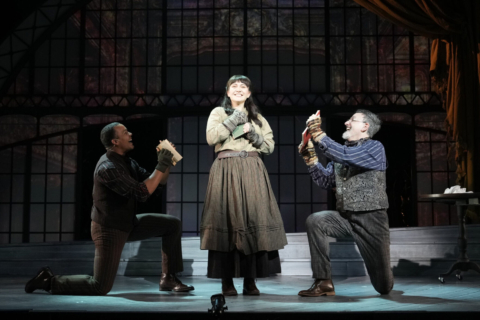
Eric Rosen’s production of “Anastasia” at New Hope’s Bucks County Playhouse is entertainingly engaging throughout, but it shines in crucial dramatic moments when characters have something monumentally serious to discuss or need to reach a difficult personal decision.
For these sequences, such as when the dowager empress of Imperial Russia, a Romanov, mother of the executed Tsar Nicholas II, and grandmother to his slain children, Anastasia being the youngest, reaches her verdict on Anastasia’s authenticity, Rosen quiets down the brisk, almost merry tone of his production to foment intensity, depth, and impact.
Such passages become moving. Even if you know the story Terrence McNally’s book tells and Lynn Ahrens and Stephen Flaherty’s score illuminates, Rosen and company create suspense, Lyda Jane Harlan (Anya/Anastasia) and Christine Toy Johnson (the Empress Maria, a Dane by birth, who lives to be age 80) providing anticipation that gives the scene weight and texture. It’s as if they were removed from a musical and placed in a tension-fraught drama with a thrilling denouement.
This climactic passage is not the first time Rosen and cast build to this riveting pitch. The opening scene, between Toy Johnson and Alex Caldwell as the child Anastasia, establishes that Rosen intends to reinforce the more emotional and human moments in McNally’s script. Mason Reeves, as the cunning Dmitry, the Pygmalion-like architect of Soviet street-sweeper Anya’s arrival in Paris as Anastasia, almost magically moves from being offhand and gleefully shady to being charming or emotionally affected by some happenstance within seconds. Roe Hartrampf, as the Soviet agent assigned to thwart Anastasia’s emergence by any means necessary, neatly marries a dedicated commissar’s duty with his character’s romantic feelings for Anastasia, or more accurately, street-sweeper Anya’s. On a different note, Kate Marilley, as the empress’s lady in waiting, Countess Lily, brings bright spirit and Russian emigre zest to the proceedings as McNally, Ahrens, Flaherty, and especially choreographer Al Blackstone take us to a lively Paris nightclub that is the social refuge of the nobles who fled St. Petersburg and Soviet tyranny.
Isolating, humanizing, and even, as Blackstone does, enlivening key scenes and production numbers is important because “Anastasia” was written as an animated movie musical, a cartoon, with children prime among its targeted audience. Without concentrating on its genuinely dramatic passages and endowing them with some heft that elevates them from cartoon to touchingly realistic, “Anastasia” could seem flimsy and dismissed as a light truffle.
Rosen does a fine job in realizing “Anastasia” as a complete show with balance between comic sequences with attendant jokes and hijinks and the serious business of a grandmother being reunited with a supposedly murdered granddaughter, a potential hoax of all hoaxes, various visible levels of romance, and a discarded empire inching towards possible restoration, at least in exile, by the appearance of its most rightful heir.
He doesn’t do it alone. The Playhouse’s “Anastasia” has a nimble, personable cast in which even members of the chorus, such as Devon McCleskey, stand out for their dancing and deftness in bit parts.
Al Blackstone helps to establish and maintain Rosen’s balance by giving most scenes the flowing motion of a city, St. Petersburg or Paris, and its constant activity while creating dance numbers in a variety of styles that denote the tsar’s court, Russian folk dancing, a bustling and celebratory Paris nightclub, and a formal ballet.
The movement Blackstone provides is important because it allows each sequence to elide gracefully into the next, creating the idea of constant motion and giving the audience something to watch as scenes shift from city streets to railway stations or from St. Petersburg/Leningrad to Paris.
“Anastasia” is also fortunate in its casting, all the leads and major support characters coming through vividly and knowing when to be broadly musical or comic and when to settle into those book scenes that register so well.
Mason Reeves cannot help catch one’s eye no matter what he does as Dmitry/Dima, the one who conceives to create an Anastasia that will persuade the dowager empress Maria she is actually the favorite granddaughter she left behind when she traveled to Paris before the Soviet intrusion.
Reeves is amazingly versatile and lightning quick in showing the many sides of Dmitry, sometimes several at once.
Watching him, I saw a gifted actor who can excel in any role. There were expressions Reeves made when he was angry that made me, in my mind, automatically cast him as Cory Maxson in some future production of August Wilson’s “Fences.”
Reeves can be the ultimate conman, then show a warm side. He can be crude one minute then rise to his role as the one reintroducing the thought-slain Anastasia to her rightful place by her grandmother’s side.
Reeves always lets you see what Dmitry is thinking, whether it’s how to get out of a tough, possibly defeating situation or his growing affection for Anya, especially as she embraces the hauteur and dignity that comes with being Anastasia.
Reeves is the kind of performer you want to see again because as much as he showed in Rosen’s “Anastasia,” you know there’s more potential to his artistry.
Christine Toy Johnson embodies the elegance, regality, disappointment, and majesty of the dowager empress.
You see in her posture how weary she is of women who arrive in Paris everyday to claim they are her granddaughter, Anastasia, rumored to have survived the Soviet slaughter of the Romanovs.
You also see the abandonment of hope the empress would prefer to preserve if evidence didn’t argue so soundly towards the contrary.
Toy Johnson, with her visible but suppressed emotions, builds the tension in scenes between the empress and Anya/Anastasia. There is always a frisson of hope amid the expectation of disheartening regret. There is also the tearful joy that comes when the empress sees a prop that encourages her she may at last have found a living grandchild.
Lyda Jane Harlan is a great partner to both Reeves and Toy Johnson as Anastasia.
Harlan is as clever as her castmates in maintaining a touch of the proletariat even as Anya passes tests that might establish her as Anastasia. Even when she is gowned or about to receive the sanction of the empress, Harlan keeps the sense of an ordinary girl in an extraordinary situation in her carriage and attitude.
This retained tie between the street-sweeper and the Grand Duchess makes McNally’s ending more plausible and suited to the amazing events that ensue in Paris.
Roe Hartrampf is moving in what could be a thankless role. From his entrance as Gleb, a member of the Russian police assigned to the quarter of St. Petersburg in which Anya sweeps streets, Hartrampf lets you see kindness that belie his role as tough enforcer of Soviet policy, especially when it involves anything to do with the executed Imperial family.
Hartrampf doesn’t wait to show the favoritism and romantic feeling he has for Anya, even before she is recruited for Dmitry’s scheme. This emotion informs his entire performance and provides texture in a role that could easily be relegated to one note.
Erik Lochtefeld is a solidly entertaining sidekick and co-conspirator for Dmitry. A discredited noble, Lochtefeld gets to deliver McNally’s archest lines and he does so with wit that shows both his breeding and roguish disposal of it.
If Lochtefeld brings comic relief, Kate Marilley lights up the New Hope stage as an Imperial lady in waiting who can demonstrate the power of that role while, blessedly, leading the audience on a tour of a lively Russian court in exile.
Marilley never missed the texture of a line. She provides fresh air when it’s needed, especially when she takes the lead in Al Blackstone’s brilliant dance at the emigres’ nightclub.
Jack Magaw’s excellent set is dominated by a series of projections, designed by Michael Salvatore Commendatore, that not only illustrate “Anastasia’s” various settings but gives the flavor of Paris emerging on the horizon or the propaganda poster of Lenin’s early Soviet Union.
Jess Gersz and Ricky Lurie provide fitting costumes for various classes and occasions. Wheeler Moon’s lighting adds texture to the projections. Sam Kusnetz’s sound design blessedly lets you hear every word of Ahrens’ lyrics.
Anastasia the Musical, Bucks County Playhouse, 70 South Main Street, New Hope, Pennsylvania. Through Sunday, January 5. Showtimes are 7:30 p.m. Tuesday and Thursday through Saturday and 1:30 p.m. Wednesday, Thursday, Saturday, and Sunday. $32 to $86. www.bcptheater.org or 215-862-2121.