David Ives not only manages to mingle two interesting plays, the one we’re seeing and one being rehearsed, in his 2010 comedy, “Venus in Fur.” He also weaves myriad ideas, some contradictory, in his wise, canny, entertaining script.
Ives loves to juxtapose fashionable notions and political mores with the reality of a situation. He shrewdly asks what is genuine and what is the popular belief of a time, adding layer after layer of context as “Venus in Fur” examines the present, in which the rehearsed play is set, and 1870s Europe, in which the story told by the play occurs.
The glee derived from watching this smart, well-crafted piece is enhanced by Ken Kaissar’s perceptive production for Bristol Riverside Theatre, continuing through November 10, where each nuance Ives provides comes through clearly.
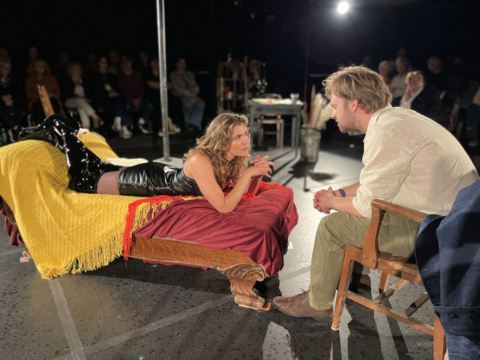
Best of all, Kaissar brings forth Ives’ playful ideas by never overdoing but by establishing the right balance between potentially disparate elements. He lets Ives’ sharp satire shine through while keeping the scene before us matter-of-fact, satire becoming the incidental it should be. He introduces today’s prevailing trend towards political interpretation of art while showing how such practice can be impinging or whimsical at times and legitimate at others. He sounds the right dramatic notes in tricky sequences where aspects of romance, fetish, sexuality, and kinkiness blur so that one or all could be in play. He deftly sets in motion the crucial, ongoing man-woman power play that seesaws between the author-director (Atticus Shaindlin) of the play being rehearsed, also “Venus in Fur,” and the actress (Lea DiMarchi) who bursts in at the last minute to audition for and land the lead role.
Kaissar presents “Venus in Fur” in all of its scope, foxiness, and detail while never letting you see the seams. All unfolds naturally while firmly revealing everything Ives packed into his piece.
This is a particular triumph for Kaissar, who has an active theatrical mind and constantly comes up with multiple ideas, all of which he usually tries to cram onto his stage. One often admires his fertile imagination while wishing he’d let less be more.
“Venus in Fur,” like the musical, “Big,” at the end of Bristol’s last season, shows Kaissar has found the discipline that allows him to be creative and bring out the most in pieces he directs while never sacrificing the heart and thought inherent in those pieces.
In “Venus in Fur,” he adroitly and engagingly nails everything with expert precision. Kaissar does this without forcing laughs or exaggerating the play’s more torrid passages. He trusts Ives to tell a complex yet easy-to-follow helix of stories. He doesn’t need to make Ives funnier than he is. The humor of “Venus in Fur” is built-in via witty lines and hilarious ripostes. He doesn’t need to make “Venus in Fur” more tension-fraught or sex-oriented than it is. Those components are also a given. He just needs to let what Ives created take the field, and Kaissar accomplishes that with intelligent aplomb.
David Ives may not be as well-known or lauded as other playwrights. He has been prolific, and plays such as “All in the Timing” and “New Jerusalem” have gotten brisk bookings on the regional theater circuit, but his sense of humor and ready intelligence make his works a welcome addition to any theater season.
In “Venus in Fur,” Ives combines a lot. The show’s setting is one in which Ives would be immediately familiar. It’s a theater in which a playwright is dismayed because he’s held a long day of auditions for his new play, “Venus in Fur,” an adaptation of Leopold von Sacher-Masoch’s 1870 novel, and no suitable actress has emerged who could handle the play’s lead. (Notice the last part of the author name, add “ism” to Masoch, and you see what that novel wrought.)
Rain-soaked and frantic, the auditioner, Vanda (DiMarchi), comes in hours past an appointment the author, Thomas (Shaindlin), cannot find in his book and persuades Thomas to let her read. He wants to go home for dinner with his fiancee, but Vanda is insistent and persistent, dressing as she begs into a costume she has fashioned from somehow knowing Thomas’ unreleased script.
Her ploy works. Vanda gets her chance, and Thomas is excited. He may have found the actress who has eluded him.
Lea DiMarchi could make any director change his mind in her favor.
Ives’ dialogue is riddled with jokes about the theater. One that resounded with me was Thomas complaining about how ingenues today tend to have high Minnie Mouse voices they make worse by sounding as if they’ve breathed in helium.
DiMarchi’s Vanda, on first hearing, seems guilty of Thomas’ scorn. Her voice is reedy and has no tone. You don’t think there is a late 19th century sensibility hiding in that actress.
Then, again to goad Thomas into giving her a full audition, Vanda launches from memory into a speech from Thomas’ play, one spoken by a mysterious, elegant woman the male character meets by chance in a hotel.
All of a sudden, Lea DiMarchi, or her character, Wanda — see what Ives did there —turns into Ingrid Bergman.
Right before our eyes, our ears take in a well-modulated chest voice perfect for the period of Masoch’s novel and Thomas’s play.
DiMarchi has been transformed, and she maintains that ability to surprise, change gears, and evolve throughout the rest of Kaissar’s production.
Atticus Shaindlin goes through a similar metamorphosis. He starts with the premise that Thomas is a playwright who is only directing because he’s tired of other stagers mangling his work beyond his recognition.
When he first humors Vanda by reading scenes with her, he does it in that speedy, toneless way actors do when they’re just feeding cues to colleagues to help them memorize lines.
Once Thomas sees Vanda’s talent, he follows her cue to take more interest in the role of a wanderer with unusual tastes in sex. Ives, Kaissar, Di Marchi, and Shaindlin are then ready involve us in an interesting war of wills that contrapuntally refutes then illustrates one sex’s desire to have power over another. Or, since we’re dealing with masochism, one’s willingness to be overpowered.
As sexual tensions grow, and sexual politics comes more pronouncedly to the fore, Bristol’s “Venus in Fur” becomes more intense, adroitly showing the struggle that derives from Masoch’s novel and is inherent in Thomas’ adaptation of it.
The actors and Kaissar are excellent at building that tension, focusing you on their characters and what is happening in a play that has made a lot of comments on sex, power, misogyny, dominance, and even sex as a game vs. a serious relationship with unusual rules and understanding, and now puts the culmination of all that was said before your eyes.
The blatant sex scenes and the frank, at times passionate discussion, of sexual politics is an advancement for Bristol Riverside, which with “Venus in Fur,” is challenging its audience in a new way.
The important thing is the tough scenes and a tougher ending are the logical and necessary culmination of comic byplay by Thomas and Vanda about the way anything sexual, and particularly anything masochistic, is discussed in today’s theater, serious conversation between Thomas and Vanda about the social dynamics suggested by Masoch’s novel and Thomas’ play, and Ives’ rich texturing of his play by mocking some trendiness while acknowledging some comment might be warranted. Ives also has thoughtful fun with literary references that underpin his play, especially those regarding the playful, humanlike nature of Greek gods.
Kaissar and his cast do an excellent job of presenting all Ives provides to the Bristol stage.
A definite but entertaining debate ensues incidentally as Thomas and Vanda explicate, not explain, “Venus in Fur.” Ives is a critic, practical playwright, and man who recognizes the foibles of his time all at once. I particularly enjoyed Thomas working in early sequences to refute any intended sexual politics or social statement, arguing for the matter-of-fact notion of a story being a story and one story among many at that, only for Vanda to counter that both in 1870 and the 21st century, the general tension between man and woman is being presented.
Bristol Riverside is currently in exile, housed in a converted fire hall while its main stage is renovated. Both Amy and Ken Kaissar have been clever to choose a pair of excellent two-handers, “The Gin Game” and “Venus in Fur,” to present in a relatively confined space.
Lea Di Marchi and Atticus Shaindlin fill that space with the range of intellect of thoughtful actors who know how to shift gears quickly between characters, emotions, and plot twist, and who create a couple of interesting characters who keep us engrossed through every transition, nuance, and perfectly delivered line.
Linda B. Stockton no doubt had fun thinking of, finding, or designing the various outfits Vanda pulls from a large bag to clothe her and Thomas. Melissa Dembski-Sullivan’s lighting made the intimate stage space larger when necessary and honed in on specifics when warranted. It enhanced Kaissar’s production.
Venus in Fur, Bristol Riverside Theatre at the Regency Room, Goodwill Hose Fire Station, 190 Mifflin Street, Bristol, Pennsylvania. Through Sunday, November 10. Showtimes are 7:30 p.m. Wednesday and Thursday, 8 p.m. Friday and Saturday, 2 p.m. Wednesday and Saturday, and 3 p.m. Sunday. Tickets are $45. www.brtstage.org or 215-785-0100.