Two sides to every story?
Hah!
In a series of plays, including “Fires in the Mirror,” enjoying an absorbing, thought-provoking production at Bristol Riverside Theatre, Anna Deavere Smith is a true researcher in addition to being a sterling playwright. For her plays about pivotal events that affected neighborhoods or regions, Deavere Smith interviews people central to the situation, eyewitnesses, politicians, activists, community leaders, participants, victims, and people who live amid whatever conflict, conflagration, and controversy is being depicted.
She turns this documentary journalism into theater by putting various people among those she has interviewed on stage, speaking their own words in their own voices.
It’s like a theatrical precursor to a podcast.
Except because it is theater, it is more immediate, more vibrant.
Deavere Smith’s characters offer a range of viewpoints. Subjective, objective, contradictory, or corroborating, the stories they tell, the opinions they have, and the interpretations of reality they offer create complexity. The story that unites them can’t be confined to two sides. It involves a mass of information, collected by Deavere Smith and placed in dramatic form to show how complicated life, or a single incident is, once it’s discussed.
As the audience, we can form our own opinions, perhaps influenced by our general leanings, but the figures in Deavere Smith’s plays, particularly “Fires in the Mirror,” which has an interesting structure, do not make it easy to come to a single conclusion. Just when you think you understand the situation at hand, the clash between Lubavitcher Jews and African-Americans in Brooklyn’s Crown Heights of 1991 (a much different place now, as much of Brooklyn is), some character says something that moves you in another direction or challenges you to reconsider a verdict or stance.
“Fires in the Mirror” requires close listening. There is a lot to hear, as in the first act of the play, people, including some who are well-known, speak in general about identity, race, religion, and the intersection of ideas while in the second half, people more closely connected with a racial clash that erupted following a fatal car accident talk specifically about that event.
In the first act, you hear from familiar figures, including the theater’s Ntozake Shange and George C. Wolfe and activism’s Angela Davis and the visitor of all scenes of controversy, Rev. Al Sharpton.
Most importantly, you hear from Phyllis Johnson, an actress with the chameleon-like ability to change expressions, accents, moods, and personality with mercurial ease.
She may have scarves, wigs, and props to help her in her transformations from one Deavere Smith character to another, but at Bristol Riverside, Johnson’s outstanding gift to move quickly from one fully defined figure to the next is on display.
Johnson impresses in general, but you understand how gifted she is at being true to a character at hand when you hear how well she finds their cadences and idiosyncratic modes of speaking.
The first character she portrays in “Fires in the Mirror” is poet and playwright Shange. As one who heard Shange speak several times and had some private conversations with her, I was both taken and amused with how accurately Johnson included vocal patterns that were uniquely Zake’s.
Johnson makes you pay attention to Shange and to every character that follows her.
She and director Amy Kaissar move as quickly as they can from one sequence to the next to keep the flow going and the variety of ideas, opinions, and facts fresh in your mind.
On opening night, you could see the pacing needed to gel a bit, particularly when Johnson had to change costume or don a sheitl (a wig worn by married Orthodox Jewish women), a yarmulke, or Ntozake Shange’s signature scarf.
As Kaissar’s production wends into this and next week, that pacing should be fully set, and Bristol’s “Fires in the Mirror,” with its wealth of material and Johnson’s fine set of more than 25 individual performances (Sharpton and another character shows up twice), should make Deavere Smith’s piece more compelling.
The matter at hand in “Fires in the Mirror” is an auto accident in which two African-American children are injured, and one killed, by a car driven while acting as an escort to the Lubavitcher Rebbe in 1991, Menachem Schneerson, who always had bodyguards protecting him when he left his home or shul.
The accident triggers hard feelings, including some overtly anti-Semitic or blatantly racist (in both directions) as expressed by Deavere Smith’s speakers, and causes a riot in which a young Jewish scholar from Australia is killed by a mob blocks from where the auto mishap occurred.
Deavere Smith reveals the dynamics of a community while, by extension, depicting what might be a reality in the world.
Many of the characters, Jewish, African-American, and Hispanic, talk about how most people just want to get along and share a neighborhood while not exactly wanting to mingle on a regular basis.
More political figures rail against anti-Semitism or what some consider preferential treatment for the Jews of Crown Heights, in particular the Rebbe (who was during his lifetime an influential figure in international religion).
You also hear of instigation from outside, as when one man talks about agitators from outside Crown Heights whom he says Al Sharpton brought in to stage a riot and cause mayhem.
The contrapuntal testimony between characters becomes fascinating.
In a program note, Amy Kaissar says she expects at least one of the 30ish sequences in “Fires in the Mirror” to offend someone in the audience and other segments to earn immediate approval from one segment of the audience or another.
I agree with her. Deavere Smith is careful to include every side of the story, including contradictory accounts or assertions, to show how much a tug of war co-existing in one small space can be. She does so by letting disparate characters speak their individual minds, revealing prejudices, fears, and common surmises that complicated human existence in general.
Kaissar and Johnson do a sharp, smart job of mounting the melange of thoughts inherent in “Fires in the Mirror.” The important thing it to take in Deavere Smith’s play as a whole and not pause to dwell on an occasion of pique or disagreement.
Believe, as with the recent “Here There Are Blueberries” at Princeton’s McCarter Theatre, that there will be plenty of time in the car ride home, and days after, to parse the various ideas expressed in “Fires in the Mirror.” Deavere Smith’s characters, and Johnson’s portrayal of them, offer sentiments and emotions that stay with you beyond your hours at the theater.
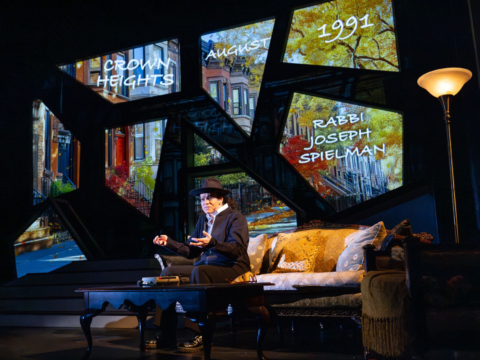
Britton Mauk’s set is very creative. It has several surfaces set at angles so nothing seems settled or totally secure, an apt metaphor for the Crown Heights Deavere Smith depicts. Furnishing seem equally appropriate for an American home, whoever might occupy it. Oddly angled parallelograms and polyhedrons act as caption boxes in which Kaissar announces the name of the person speaking and his or her theme and, more poignantly, isolates key quotes that add to the production’s lasting quality.
Linda B. Stockton and Gina Andreoli creatively use coats, hats, tallit, wigs, and draping fabric to differentiate characters.
Jessica Drayton’s projector providses a concrete sense of time and place while Omer More’s sound design offers atmospheric reinforcement to everything from blaring car horns and the sound of a mob to solemn quiet. Yael Lubetsky’s lighting provides texture to various settings, from cozy homes to public settings of recent chaos.
Fires in the Mirror, Bristol Riverside Theatre, 120 Radcliffe Street in Bristol, Pennsylvania. Through Sunday, February 23. Wednesday and Thursday, 7:30 p.m.; Friday and Saturday, 8 p.m.; Wednesday and Saturday, 2 p.m.; and Sunday, 3 p.m. $52 to $62. 215-785-0100 or www.brtstage.org.