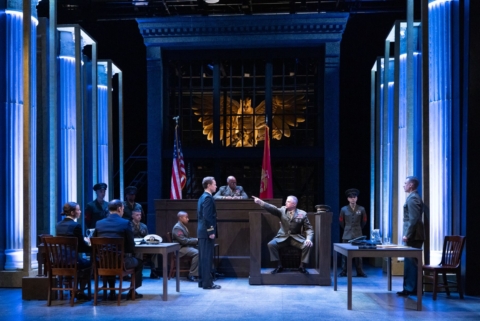
“A Few Good Men” boasts one of the most quoted and imitated lines in movie history, “You can’t handle the truth,” intoned famously by Jack Nicholson in the 1992 film.
Before “A Few Good Men” hit the screen, it was a successful Broadway play by Aaron Sorkin, best known for the TV series “The West Wing,” the current stage adaptation of “To Kill a Mockingbird,” and the recent movie “Being the Ricardos.”
Sorkin’s 1989 script holds up well in a solid, straightforward production directed by Ken Kaissar for Bristol Riverside Theatre, where the show plays through Sunday, May 22.
Kaissar pretty much lets Sorkin’s tight construction and innate drama do the job it was built to do. The show never soars, but it stays on an even keel that engages and keeps your attention and involvement with a plot concerning a death during a hazing at a U.S. Marine base.
The base is Guantanamo Bay, Cuba, but “A Few Good Men” is 33-years-old and contains no reference or relationship to today’s Guantanamo, most famously as a prison for Gulf War combatants.
Sorkin’s story has lots of threads and leaves lots of room for characterization. In addition to unraveling the truth that allegedly cannot be handled about the fatal beating of a young Marine, it deals with two Navy lawyers, one of whom wants to coast through the time he is obligated to serve so he can justify the Navy paying for his law degree and one who approaches her job with unyielding earnestness.
It all makes for an interesting stew that offers a good measure of mystery tempered by characters going through personal adjustments and Sorkin’s depiction of stern military life.
In particular, it’s a life of unquestioningly following orders and sticking to a Marine code, at least as practiced at Sorkin’s Guantanamo, whether codified in a Marine handbook or mandated by Marine tradition and the base officers’ strict adherence to some internal disciplinary procedures the handbook doesn’t mention.
Sorkin hits home with showing the dangers of obeying orders that might knowingly lead to dubious outcomes. “A Few Good Men” is an exposure of the consequences of blindly doing what the person above you in a chain of command tells you to do. The playwright is especially canny in showing why a young, ambitious Marine who might have been reluctant or have known better than to conduct the depicted hazing proceeds despite his possible doubt.
He also knows how to relieve the pressure of an investigation and courtroom drama that could become intense by developing his characters so we see, in ways ranging from comic to confrontational, how they mature through collaboration and experience.
“A Few Good Men” is a taut piece of theater, and Kaissar keeps it moving with the precision of a military drill. His direction is sharp and clean. Sorkin’s play unfolds enjoyably, provoking thought while never quite reaching a point at which it rivets you to the stage.
Performances, though generally good and meshing well in ensemble, tended a bit towards the self-conscious side. Some of the actors needed to be pruned back a little while others could have been prodded to do more.
Most impressive among the performances was James Lee’s as one of the teenage Marines being court-martialed and facing the possibility of life in prison.
Lee conveys the posture and attitude of the soldier who wants to please his officers by exemplifying perfection. His stance is consistently rigid and firm, his movements crisp and precise. When he delivers his lines, it’s in the direct military bark of one responding loud and clear to an officer.
Lee never lets his character show human frailty, even when he receives news that upsets his idea of the future he expected before he became involved in the fatal hazing. In spite of never losing composure or giving into emotion, Lee lets you see the interior of his character by the disdain with which he occasionally addresses his defense team or by a single flinch when he understands that what he wanted least will be his lot.
Lee’s character’s co-defendant, played by Maddox Moffitt-Tighe, matches him in sustaining military poise, but Moffitt-Tighe has less to say and doesn’t have the chance to register as strongly as Lee. The same is true of Christian Boswell, who is admirably diligent as the court’s sergeant-at-arms.
On the opposite jauntier side is Bobby Underwood’s turn as the third wheel on the accused Marines’ defense team. While defense leader Dan Kaffee (Sean Davis) is balancing his prep time for the case with managing a Navy softball team, and fellow defender Joanne Galloway (Erika Strasburg) makes sure everything goes by the book, Underwood’s Sam Weinberg works to make Kaffee more businesslike and Galloway more flexible. He does this being relaxed, applying more perspective, and cracking lousy jokes that are really quite good when you take a second to think them over.
Underwood conveys Weinberg’s appropriate seriousness and his attitude that his work as a lawyer is, after all, only a job to be balanced with family life and more cases to come in a lifetime of practice.
The cross between Lee and Underwood is Damon Bonetti who, as the prosecuting attorney facing Kaffee’s unorthodox style and Galloway’s certainty, is the picture of the professional who knows his job, assesses his opponent, respectfully acknowledges when the defense has made a salient point, and works to keep all on an efficient plane while never losing his sense of humor or humanity.
Jay Aubrey Jones, as the court-martial judge, conveys the magnitude of an officer who will maintain order in his court while having the instinct to let Kaffee have some leeway for unusual tactics.
Sean Davis obviously enjoys the cavalier ways of Dan Kaffee, especially when Kaffee gets to be a smart aleck, teases Galloway, or shows how his way of handling a case can be more effective than if he went strictly by the book. Davis’s performance grows as his character’s development does. He seems a little too loose when the play begins but becomes more focused at the same time Kaffee gets more serious as a defender.
Erika Strasburg has taken Sorkin’s description of Joanne Galloway literally and keeps the character straight-laced with eyes totally on the ball scrutinizing everything for accuracy and adherence to regulation. There are times when you want to whisper to Strasburg to breathe, but in the long run, she is keeping with the character of Galloway, who says, and has said about her, she doesn’t give an inch in maintaining order and keeps herself above all frivolity or sarcasm concerning the law.
Kurt Zischke, Christopher Alexander Chukwueke, and Richard B. Watson do well as the officers upholding Guantanamo discipline and tradition. Watson is to be congratulated for doing a fresh reading of Nicholson’s “You can’t handle the truth.” At the same time, he is the only character who pronounces Kaffee’s name with a long rather than a short “a.”
Andrew Deppen’s set is a stunner in ways. Linda Bee-Stockton, Ryk Lewis, and Minjoo Kim all enhance Kaissar’s production with their costume, sound, and lighting design.
A Few Good Men, Bristol Riverside Theatre, 120 Radcliffe Street, Bristol, PA. Through Sunday, May 22, Wednesday and Thursday, 7:30 p.m., Friday and Saturday, 8 p.m., Saturday, 2 p.m., and Sunday, 3 p.m. $46 to $53. 215-785-0100 or www.brtstage.org.