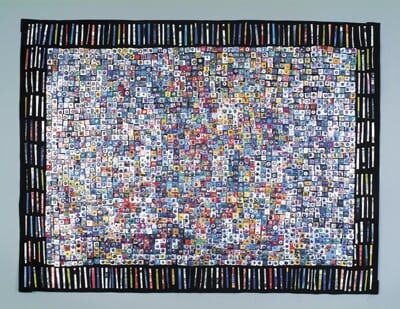
Several years ago, when the Arts Council of Princeton was located in the conTEMPORARY Center in the Princeton Shopping Center, Maria Evans, Madelaine Shellaby, Rebecca Kelly, and other artists organized a “Swap-O-Rama Rama,” a clothing swap and series of do-it-yourself workshops that creatively repurposed old clothing. Participants brought a bag of worn garments to share, sewing machines were set up on long tables throughout the large open space, and the happy stitchers worked at cutting up sleeves and dresses to make new garments. “People left with two or three . . . I wouldn’t want to call them outfits, but new pieces to add to their wardrobe,” says Evans, artistic director at the Arts Council.
Shellaby led a workshop in crocheting from discarded blue plastic newspaper bags. Evans and Shellaby, former colleagues on the art faculty at Stuart Country Day School in Princeton, recall developing a bond as they made puppets together and have continued their collaborations and passion for contemporary fiber art.
Each is now curating a fiber art exhibition this season. “Thread Bare,” curated by Evans, features five artists who use textiles to preserve and protect their personal cultural perspective. The exhibit is on view at the Paul Robeson Center for the Arts through Saturday, November 23.
Shellaby is curating “A View Within: A Collaboration Between Two Fiber Artists,” which runs at Gallery Art Times Two at the Princeton Brain and Spine Care Institute from Friday, November 15, through Friday, April 25, with a reception on Friday, December 6, 5 to 7 p.m.
Evans is excited about the first textile exhibit ever to take place in the Robeson Center. “I’ve always been into fabrics and textiles and making my own clothes,” she says. “I love to see how people recycle fiber, such as in upcycled sweaters. That’s what my grandmother was doing in Ohio 40 years ago.” Evans’ grandmother not only taught her to sew but conducted a small industry in her home. “She pickled, canned, made quilts. Nothing was ever wasted. Old clothing was turned into tablecloths, blankets, and pot holders.” While growing up in Michigan, Evans spent a lot of time in Ohio with her grandmother, in the kitchen and at the sewing machine.
Beginning at age eight, the devoted granddaughter started stitching quilts on big frames set up in her grandmother’s dining room. “I thought she was the smartest person I ever met. She taught me to embroider,” she says. Later on, “I got very excited when I saw artists making quilts. My grandmother had an enormous influence on my thinking. No artistic task was impossible — there was always a way to figure it out.” This resourcefulness helps when budgets are tight, adds Evans, who earned her bachelor’s degree from Humboldt State in Arcata, California, and attended graduate school in sculpture at the University of Alabama while her husband (then her boyfriend) was earning an MFA in book arts.
Another source for her inspiration was fiber artist Marie Watt. While teaching in the Princeton University preparatory program for high-achieving, low-economic high school students, Evans invited the Brooklyn-based Watt to be a guest artist. Watt arrived with big bags of wool blanket remnants and made blanket samplers, telling stories with the blankets. Evans decided to build the fiber show around Watt, using artists with a common thread. Watt’s work is about preserving her cultural identity — half Cowboy, half Indian. She creates sculpture and installations by cutting and then sewing old blankets into bold designs or narratives.
Through Princeton quilt maker, educator, and author Meg Cox, Evans learned about quilt artist Michael Cummings, who celebrates African-American cultural heritage in his colorful layered works. Out of his Harlem, New York, brownstone, Cummings uses recycled prom dresses, shells, and beads to create portraits of Sister Gertrude, Josephine Baker, African slaves, and jazz musicians. Evans visited Cummings’ studio, itself a work of art — a collage of his fiber materials, finished work, and art collection, which includes Romare Bearden, a major influence. “He makes quilts as wide as his brownstone,” says Evans. “His work is as colorful, vibrant, and full of fun as Harlem.”
Cummings’ “Sister Gertrude,” based on the New Orleans-based preacher, missionary, folk artist, musician, and poet who was active in the 1960s and ’70s, uses wedding dresses Cummings acquired from thrift stores. “Satin Doll” uses prom gowns from thrift stores and beaded tassels swinging off the surface. The quilts combine hand and machine sewing and mixed media.
Collected by Bill Cosby and Whoopi Goldberg, among others, Cummings’ work has been used to illustrate books and greeting cards, and he has received numerous commissions from the New York City Department of Cultural Affairs, the National Underground Railroad Freedom Center, and City University of New York.
Evans discovered Upper Black Eddy, Pennsylvania-based artist Rebecca Reeves during the many member shows she contributed to. “Her sewn pieces remind me of cocoons,” says Evans. “Her work is about sewing items to a protective surface.”
Based on the idea of Victorian hair wreaths that represent family trees, Reeves “cocoons” miniature furniture in thread and other fibers to protect it. “The miniature furniture she uses resembles the furniture in her home. She takes great care with every detail, carefully planned. When you enter her studio, it’s like you’re entering her artwork. When you see the little dishes, chairs, candlesticks and portraits obscured by thread, you want to find out what they are.”
Participating artist Amy Orr, who is also an organizer of “Fiber Philadelphia,” an international biennial and regional festival for innovative fiber/textile art, makes quilts and blankets from discarded credit cards and other materials found on Philadelphia streets. She has made a doll house of credit cards as well as a portrait of Chairman Mao. Bleached chicken bones, candy wrappers, bread twist ties, and dollar bills find their way into her traditional quilt patterns. “She’s preserving 20th-century culture using these urban artifacts,” says Evans. Orr will be giving a workshop at the Robeson Center on Saturday, November 9.
Princeton-based, Israeli-born artist Ifat Shatzky has exhibited paintings locally, and Evans discovered she was crocheting wire, twine, and nylon rope from Ace hardware. “The sewn pieces look like a human form, but one you’d find in the desert of a nomadic culture. You have to make sense of them. They look like elegant chain mail for women in earthlike tans, grays, and browns. They’re so different from Cummings’ work yet similar in how they are showing the culture. They suggest garments or parts of the body — the brain tries to make sense of them.”
Thread Bare, Arts Council of Princeton’s Robeson Center, 102 Witherspoon Street, Princeton. On view Monday through Friday, 9 a.m. to 5 p.m., Saturday, 9 a.m. to 4 p.m. to Saturday, November 23. Free. 609-924-8777 or www.artscouncilofprinceton.org.
At Gallery Art Times Two, body imaging technologies — X-rays, PET scans, MRIs — are used to provide a window into the human anatomy. California-based fiber artists Paula Chung and Karen Rips collaborate to reinterpret these images.
“I look at the original image and abstract it in my mind to lines, shapes, and textures,” says Rips. “I then create the art piece through the use of my own hand-dyed, screen-printed, and painted fabrics.” She uses both hand and machine stitching to create the final piece.
Chung manipulates the original film or digital images in Photoshop, prints and transfers them to a substrate medium, such as reinforced silk or screening, then stitches the images in polyester threads.
Curator, artist, and California native Shellaby has been interested in fiber art for as long as she can remember. With a master’s degree in painting from the University of California at Berkeley, Shellaby works in drawing, painting, photography, clay, artist books, and found object installation.
“I used to have a huge Macomber loom in Berkeley and had even started a little garden to grow plants to dye the sheep’s wool I gathered from friends in Marin,” recalls Shellaby, who lives in Kingston. “I learned from them how to make the initial rolags (a roll of wool) that would then be spun to warp the loom. At that time, fiber art was weaving and macrame. It was just beginning to become more than utilitarian, albeit gorgeous utilitarian. Now the line between art and craft is not discussed as it was at that time.”
Chung and Rips’ work is a perfect fit for the Brain and Spine Care Institute. “The technologies used in the work of the surgeons at PBSC are amazing,” says Shellaby. “(They are so much more than a) medical tool. They are fascinating as well as beautiful. The lay person does not immediately see the formal interest in the technologies and can be put off by them. So interpreting them so beautifully as Karen and Paula do is a good way for me to get this interest out there.”
“Fiber is my medium of choice because it is tactile, easily manipulated, and allows itself to be altered in many different ways,” says Rips. “Tactile elements give even more reason to get up close and look at the art.”
A View Within: A Collaboration Between Two Fiber Artists, Art Times Two Gallery, Princeton Brain and Spine Care Institute, 731 Alexander Road, Suite 200, Princeton. Friday, November 15, through Friday, April 24, 2014. Opening reception Friday, December 6, 5 to 7 p.m. Free. www.artimestwo.com.