The arrival of the Lunar New Year provides an occasion to consider ancient and non-European approaches to keeping time as well as creating art.
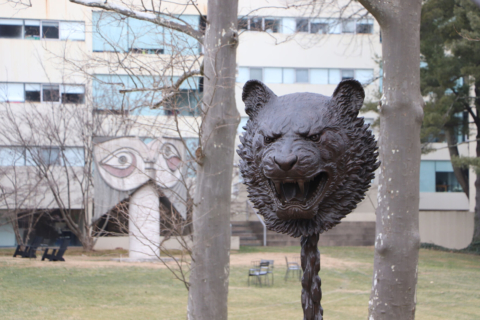
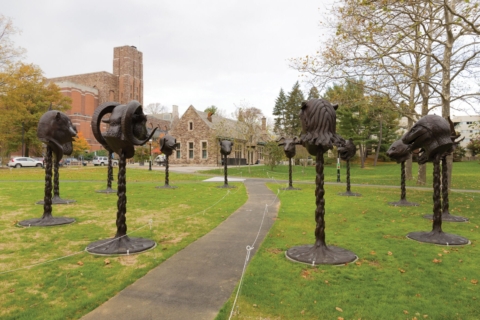
One of the easiest ways to engage with art related to seasonal change is by visiting Princeton University’s “Circle of Animals/Zodiac Heads” sculptures situated by the former Dinky train station.
The dozen 10-foot-tall bronze and 800-pound heads animal figures were created — or more accurately recreated — by Ai Weiwei, the famous Chinese artist and political dissenter, and arrived in Princeton in 2012 as part of a long-term loan.
As is commonly known, the Chinese zodiac is represented by 12 animals that give each year its name: rat, pig, horse, tiger, rabbit, dragon, snake, ram, roster, dog, ox, and monkey. Each animal allegedly marks the personality of the individual born during a specific animal’s year, with some years being more propitious than others.
The ancient calendar is based on the lunar and solar calculations of celestial and terrestrial patterns that repeat every 60 years. Each year in this cycle contains various energies or forces that affect life. The years are also named after 12 animals that the Buddha rewarded for honoring him.
The figures are replicas and reinterpretations of original art with a complex history. The figures were created for the summer garden of 18th-century Chinese emperor Qianlong. The artist was Giuseppe Castiglione, a Jesuit missionary and artist who impressed the emperor and could satisfy his interest in having exotic-European influenced art.
The zodiac garden became a noted destination for beauty seekers and then European plunderers who raided the site and stole the statues during the opium wars of the 1860s.
Seven of those original heads eventually were returned to China. The five missing heads were reinterpreted by Ai and continue a system where ancient Chinese art was reinterpreted by a European artist whose work had been reinterpreted by a Chinese-born, American-trained artist.
Ai seems to have embraced the system and criticism for creating “fake” recreations by saying, “My work is always dealing with real or fake, authenticity and value, and how value relates to current political and social understandings and misunderstandings.”
The “Zodiac Heads” complements the vast collection of Asian art found in the Princeton University Art Museum. However, the museum is undergoing a major expansion and has plans to reopen in 2024.
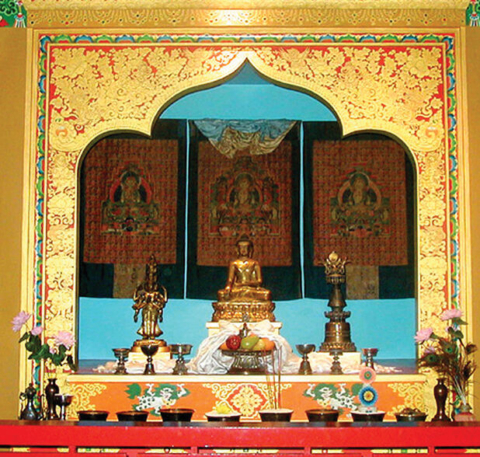
Meanwhile, just an hour away, the Newark Museum offers the opportunity to engage with the living tradition of Tibetan art. That includes a recognized and consecrated Buddhist altar.
“This altar, this art, is exactly what was in Tibet,” said Tibetan artist Phuntsok Dorje during our 1990 interview.
Dorje talked during a pause from painting the altar area with the same shapes of jewels, flames, and flowers Tibetan artist have left for centuries and passed from one generation to another.
Unfortunately, he said, since more than 6,000 Tibetan temples were destroyed by the Chinese, Tibetan art survives elsewhere.
How the Newark Museum became a Tibet on the Passaic River is part of the history of upheavals that have marked the 20th century.
But let’s start with the country itself.
Tibet, translated as “The Land of Snow,” is situated 14,000 miles above sea level in the Himalayan plain between China and India. History dates the country’s beginnings to the seventh century. Its location made it an important trade route for the merchants between the East and West.
As early as 680 A.D. Buddhism began to merge with the indigenous culture, eventually becoming a dominant political and social element. The prime example today is Tibet’s spiritual leader, the Dalai Lama.
Although strife with neighboring countries always has played a part in Tibetan history, struggles accelerated at the dawn of the 20th century when Tibet became crucial to the interests of British, Russian, and Chinese expansion. By mid-century, Tibet was caught in the tides of change that swept the world.
In 1949, Communist revolutionary leader Mao Tse-tung announced that Tibet would be “liberated.” The invasions began the next year. Communist reforms included the deportation of Tibetan children and demolition of most of the country’s religious centers and monasteries.
Then, 10 years later, the current Dalai Lama was forced to flee and establish a government in exile in India. Almost 1 million Tibetans followed.
Meanwhile, Tibetan culture had been coming to Newark via a circuitous and painful route.
Dr. Albert Shelton of Indianapolis had dedicated his life to the Foreign Christian Missionary Society.
In 1904 he and his wife were sent to Eastern Tibet. During a sabbatical in the U.S., Shelton found himself traveling by ship with a trustee of the Newark Museum, Edward Crane.
Shelton showed Crane a number of Tibetan artifacts that he planned to sell to fund his mission work. A friendship began.
When Shelton returned to Tibet, a territorial dispute with China had escalated into warfare. The doctor’s help to the wounded won him trust and friendship form the Tibetans. During the turbulence he was given sacred objects as payment or for safekeeping.
During the doctor’s next visit to America, Crane had arranged that the objects be lent to Newark for exhibition and the possible purchase of the collection.
At the conclusion of the exhibition, Crane suddenly died. The collection was purchased by his widow and presented to the museum.
On his return to Tibet, Shelton continued to acquire objects from missionaries in the Christian Missionary Alliance and the YMCA and through the gift of New York financier and adventurer C. Sydan Cutting, whose wife was a museum trustee.
With much of the cultural materials in the homeland destroyed, the collection has become recognized as one of the premier collections of Tibetan art in the world. It is a haven for the thousands of Tibetan refugees in the New York City area and has been visited several times by the Dalai Lama, who consecrated the altar.
When the museum was undergoing an expansion and renovations were put in place, the museum staff was faced with being the custodians of Tibet’s living traditions.
“The altar had become a scared place,” curator Gary Reynolds told me in 1990. To be sure to follow tradition, the museum staff wrote to the Dalai Llama and asked for his advice in dismantling the area holding religious objects and the altar and surrounding area.
“The museum feels a responsibility to work with the Tibetan community,” Reynolds said of removing the artifacts and preparing the permanent home for the icons, paintings, and manuscripts.
Through interactions with a video company producing an educational tape on the Tibetan collection, Reynolds learned that Dorje was living in New York City and had worked on a Tibetan Sand Mandala Project for the American Museum of Natural History.
Born in Tibet and raised in India, the then-32-year old artist began training for his vocation at the age of 5, when he was selected to be an artist.
“For the first five years I only colored blended and assisted the teacher. The master only had a few students,” he said standing in the new wing designed by Princeton architect Michael Graves.
The artist said that he trained for 20 years before he was permitted to work alone. Then after designing and painting the interior of several temples in India, he was invited to come to the United States and paint a monastery in New York State.
“The design is strictly traditional,” Dorje said. The five colors used represent the five elements: fire (red), earth (yellow), wind (green), water (blue), and space (dark blue). The shapes signify the divine, the law, and good fortune. The prayers inscribed on the walls enhance spirituality.
It is also part of the human connection to art. As Reynolds said, “You can read all this as decoration as well as explore the more profound meanings of everything.”
All it needs is an open eye and open mind.