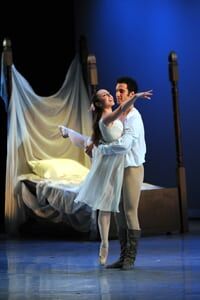
Douglas Martin has four death scenes to coach — for Mercutio, Tybalt, Romeo, and Juliet. Eight, when you count the double cast. Martin, the artistic director of American Repertory Ballet (ARB), comes to a telephone interview just after teaching Tybalt how to fall on a sword, make it look like an accident, and collapse. It takes longer to teach someone to die, says Martin, than to do a complicated sequence of steps.
Martin’s full-length “Romeo and Juliet” premieres with 30 dancers at the State Theater in New Brunswick on Friday, October 11, at 8 p.m. (There will also be a 10 a.m. student performance that day). The Prokofiev score will be played live by the Rutgers Symphony Orchestra, directed by Kynan Johns. Based, of course, on Shakespeare’s tragic love story, the production features early Renaissance Italy-styled sets designed by Kevin Lee Allen and costumes by Michelle Ferranti.
Founded in 1963, the New Brunswick-based professional company presents ballets from the 19th and 20th centuries alongside new and existing works by choreographers from today. Martin has been with ARB for 20 years, and when he became artistic director in 2010 he began to plan for repertory “that is distinctly and exclusively our own.” Under his watch the troupe has performed 21 works — 11 world premieres and 19 company premieres — including major revivals by Gerald Arpino and works by contemporary choreographers such as Mary Barton, Kirk Peterson, Trinette Singleton, and Patrick Corbin.
Karen Leslie Moscato and Mattia Pallozi will play Juliet and Romeo at the premiere. Moscato began studying at ARB’s Princeton Ballet School when she was four years old; this is her third season with the professional company. Pallozzi, born and raised in Italy, joined ARB/Princeton Ballet School’s trainee program in 2011. From the House of Montague, Alexander Dutko is Mercutio, Stephen Campanella is Benvolio, and Marc St. Pierre is Balthazar. The role of Tybalt, Juliet’s Capulet cousin, will be danced by 20-year-old Jacopo Janelli.
To tell a young dancer like Janelli that he has to do a death scene for real and feel it for real is not enough. Martin gives graphic specifics: “You have this slice in your gut, and when you lunge at Romeo it rips open. You stand and with your last breath you reach out to Romeo, straining, hurling forward, with nothing left, you die in his arms.”
The tomb scene has less motion but even more tension. A novice Romeo, realizing that Juliet is dead, tries to show his emotion with his body. “They try to do it with movement. But there is no movement,” says Martin. “You lay your body on hers, you look at that, and you walk back in horror and you scream. It is so far out of their boundary at a young age. It really takes a long time to get a young dancer to understand how to tell it.”
If that sounds gory and grim, so is Shakespeare, but the ballet is more joyful and upbeat than the play. The dance is buoyed by Prokofiev’s score. The ballroom scene swirls with movement. The street scenes show guys having a good time, fooling around, teasing the girls, showing off with hijinks.
Romeo is only 15, Martin points out, and inexperienced. “Overt sexiness is obtained through experience and confidence,” he says. In contrast, a 15-year-old has sensuality without sexuality, “a boy whom girls aren’t afraid of. When you are mooning after a girl, you might have this incredible sexual appeal through your beauty, but if you are sexually ‘knowing,’ then you aren’t mooning after those girls; you are just going to go to the disco and pick them up.”
The balcony scene is one of the touchstones. As performed at Rider on September 20 by Samantha Gullace and Edward Urwin, it distilled the catch-the-heart excitement and sweet disbelief of youngsters meeting and falling in love. The scene builds. Instead of Romeo beginning with a bunch of showoffy leaps, as in some other versions, the lovers “talk” to each other. First Romeo professes his love, then Juliet answers, then he replies, and only then do they dance together, starting with turns, and then lifts, small at first, surging into a climax as the music builds — and then a moment of quiet, before the tender farewell.
“Romeo is a lover but not a Don Juan,” says Martin. “We work on how to portray that they are young and innocent, yet they have their physical moment.”
Having come up through the ranks of the Joffrey Ballet, Martin values the importance of adjusting the roles and the coaching to each dancer. He has given three pairs of dancers the opportunity to be the young lovers. To the Juliet who is adept at facial expression, Martin gives a body cue: raise your sternum to show you want to be with him. To the Juliet who explodes with passion in her movement but needs more facial expression, he gives homework — to go home and practice in front of a mirror, to honestly decide “what is enough; what is too much.”
Martin learned from the greats. He was the youngest dancer in the corps in 1969 when the Joffrey premiered John Cranko’s R&J. The stars from Stuttgart who had created the roles, Marcia Haydee and Richard Cragun, danced that night. Eventually Martin worked his way into the roles of Paris and Romeo at the Joffrey. He also danced Romeo in Francis Patrelli’s version at Dances Patrelle. And at ARB, for Septime Webre’s choreography, he has been both Tybalt and Romeo. “I’ve even been blessed to perform the role of Romeo for many years with Mary Barton as Juliet. Those performances were the great treasures of my career,” he says. “I know the ballet inside and out and felt prepared to make my own.”
Martin’s goal for choreographing Romeo’s part was to make him “one of the guys,” a lover, not a fighter. “He might cavort with the whores in a fun way, but he is a younger brother learning from the older brothers.”
That is a departure from other versions. At the Joffrey, Cranko established Romeo as the hero, and he savagely attacks Tybalt. “My Romeo is the lead focus, but I don’t know that I would call him the hero,” says Martin. “He is not the aggressor.”
Romeo, in Martin’s choreography, is anguished by his friend Mercutio’s death, goes after Tybalt with his fists, and is knocked down. As Tybalt comes after him, Romeo sees a sword on the ground, lifts it, just as Tybalt comes flying through the air.
In rehearsal, Tybalt wasn’t propelling himself into his leap with enough energy, so Martin got off the bench and demonstrated, hurtling himself into forward and landing as hard as Tybalt should land. “They all sat there and looked at me, stunned,” says Martin. “They have no idea how much further they can go until they see it.”
Romeo and Juliet, American Repertory Ballet, State Theater, 15 Livingston Avenue, New Brunswick. Friday, October 11, 8 p.m. $27 to $57. Free pre-performance lecture with ARB school director Mary Pat Robertson at United Methodist Church, 323 George Street, 7 p.m. 732-246-7469 or www.statetheatrenj.org.