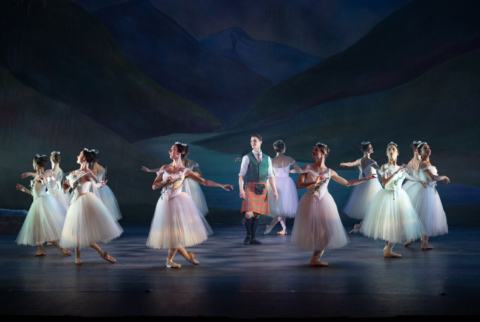
“Spirit of the Highlands” is a gratifying new adaptation of the landmark 1832 ballet “La Sylphide.” With its introduction of virtuosic toe-dancing that evoked an illusion of weightlessness (by Marie Taglioni, creator of the title role), its shifting of ballet narratives from classical mythology- to fantasy-based storylines, and its centering of a mortal’s pursuit of idealized beauty (symbolized by ethereal feminine creatures in white tulle), “La Sylphide” ushered in ballet’s formative Romantic Era.
Not to be confused with “Les Sylphides” (a plotless, early 20th-century ballet saluting the Sylph-like entities of Romantic ballets), “La Sylphide” tells the tale of James, a young Scotsman, whose betrothal to Effie is disrupted by his enchantment with the Sylph, a seductive woodland spirit. His distraction prompts Effie to instead marry Gurn, a fellow villager, while a scheming witch, Madge, tricks James into gifting his beloved Sylph a cursed scarf, which makes the elusive, fantastical being fade away forever.
Presented by American Repertory Ballet with entertaining staging and choreography by the company’s artist-in-residence Ethan Stiefel (after August Bournonville’s 1836 version of La Sylphide), “Spirit of the Highlands” premiered March 7 through 9 at the New Brunswick Performing Arts Center. In honor of his own Scottish heritage, Stiefel heightened the ballet’s Scottish components: The choreography is excitingly inflected with Highland Dance vocabulary, the character of James is given the surname Munro in a nod to Stiefel’s ancestral clan, and the Madge role, usually a generic crone, is designated as a Celtic High Priestess with a trio of Druid followers. Surprisingly, that’s what I found most pleasing about this “La Sylphide” re-imagining.
In praising the merits of a production of this Romantic ballet, I never thought I’d begin by singling out the performer playing Madge, a small, non-dancing, character part, typically portrayed hunched-over and done up in grotesque old-age make-up. But here, Madge is tall, gorgeous, smart, intriguing, witty, seemingly justified in her conniving behaviors, and by far the most interesting character on the stage — how much of that should be attributed to Stiefel’s re-conception of the role and how much to Erikka Reenstierna-Cates’s brilliant performance, I can’t say. At the matinee I attended on March 8, Reenstierna-Cates stole the show with her startlingly good acting, nuanced miming, riveting facial expressions, and flair for comedy. A theatrical home-run, it was also a huge score for progressive feminist thinking. Why must the fairy-tale villain always be a lone, physically off-putting, elderly woman driven by evil? Here, the wise witch wins the day.
Yet in making us cheer Madge’s ultimate triumph, this re-telling of the Romantic tale presents James as somewhat of a dolt — though, again, I don’t know if that’s Stiefel’s doing, or dancer Andrea Marini’s choice to render the character with bravura physicality (his leaps are frighteningly powerful!) while evoking emotional cluelessness. Gurn, on the other hand, as portrayed by Aldeir Monteiro, seems friendly, fun, and relatable — making Effie’s preference for James somewhat confounding.
In order for Romanticism to affect persuasively, the audience must be able to empathize with, or at least understand, the hero’s longing for the unattainable, his need for something beyond the everyday. But in this production — with its eye-catching Scottish costumes by Janessa Cornell Urwin and Howard C. Jones’s inviting cozy-cottage set — we see nothing “lacking” in James’s “real” world. It’s not clear why he pursues the Sylph (danced by Lily Krisko). He never looks entranced by her, nor dissatisfied with Effie.
While Krisko’s ballet technique is superb — her pliant feet making for strong, neat jumps, and her exquisite sense of line creating alluring body shapes — one wanted to see more speed, lightness, and unpredictability in her flitting about, so as to evoke that otherworldliness that would captivate James. Interestingly, in the ballet’s second act, when dancing with her coterie of sylphs, Krisko’s performance grew more bewitching. The technical skill, unison work, and expressivity displayed by the female ensemble as they frolicked together, then later mourned and cared for the dying Sylph, proved supremely Romantic.
American Repertory Ballet next appears at NBPAC May 9 through 11, in “Pasión,” a mixed bill of classic and new works. www.arballet.org.