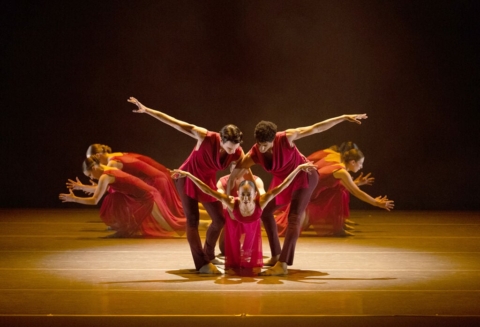
Fittingly, as our country celebrates its 250th anniversary this year, American Repertory Ballet closed its season at New Brunswick Performing Arts Center last weekend with “Americana,” a highly entertaining program of four American-flavored dance pieces.
The elegant Savannah Quiner, partnered by spunky Seth Koffler, kicked-off the show (at the May 2 matinee) with an ebullient performance of the pas de deux from George Balanchine’s Stars and Stripes. Wait, wasn’t Balanchine a Russian choreographer?
Yes, but he re-located to the United States where, in 1934, he co-founded the School of American Ballet. Through his teaching, and choreography for New York City Ballet, Balanchine created what has come to be recognized as the “American” style of neo-classical ballet.
Often built of difficult steps executed at unusually fast tempi (his way of reflecting an “American” energy), Balanchine ballets can be extremely challenging to dance. But here, with Koffler’s easy approach and clean technique, and Quiner’s spot-on performance of tricky turning passages, we forgot how hard it was and just sat back and enjoyed the spirited choreography and its rousing John Philip Sousa accompaniment.
Similarly, dancers Lily Krisko and Aldeir Monteiro gave sparkling rendition, later in the show, to Balanchine’s Tschaikovsky Pas de Deux, a famously wowing duet that allows each dancer to show off individually. A veteran company member, Monteiro exudes strength. His powerful leaps take off and land with dignified assurance and stability. Kristo dances with lovely lyricism, commanding technique, and a musicality that makes you feel as though her movements are really “one” with the sublime strains of the Tschaikovsky score. And while she’s captivating us with her fast footwork, her eyes are “dancing” just as animatedly, emitting a flirty quality perfectly suitable for this enticing showpiece.
While the Balanchine duets were delightful “cherries on top,” the program’s main offerings were the world premieres of two America-referencing ensemble works. First up, came Ol’ Timin’, created by ARB Artist in Residence Ethan Stiefel. Set to an evocative score of fiddle-featuring, foot-stomping, bluegrass-flavored string music, Stiefel’s piece is danced on a dimly-lit stage with a long, wooden picket fence in the background.
It’s dusk on the prairie, as women clad in simple dresses dance in couples with men in plain slacks and shirts. They move romantically until infected with a goofiness that gradually takes over the proceedings. The music and movements grow hillbilly-esque as the rustics start lifting their shoulders oddly, jumping like frogs, raising their elbows in awkward angles.
One girl seems “possessed” and, egged on by the crowd, launches the piece into a wild hoedown. Dancers descend to the floor, stomp, squat, swivel their hips and thrash their arms about as the music gets rawer, scratchier, and crazier. By the end, everyone is joining in to what feels like “agreed upon” swing-your-partner, square dance-like vocabulary. You can make what you will of the dance’s scene titles, “Moon Shadows” and “Swamp Fritters,” but to me it appears that the “young ‘uns” came to town and shook things up, introducing new sensibilities that were soon embraced by all. Is Stiefel suggesting the notion of youth rebellion as a force for societal advancement?
The program closed with the premiere of ARB dancer Michelle Quiner’s At the Heart of It, a celebration of the instigating fortitude of American women. A contemporary piece (performed in stockinged feet, not pointe shoes), it opens in darkness, as we hear inspirational quotes from the likes of Eleanor Roosevelt, Martha Graham, Michelle Obama, and Amelia Earhart. Though it contains one solo and a duet, the work delivers its message of feminine power largely through abstract group choreography suggesting strength and togetherness. An energizing score of electrified music lends a contemporary sensibility, but Quiner’s Graham-like movement vocabulary is derivative and unmemorable.
What we recall is Quiner’s keen sense of phrasing. Unlike the “string-of-unrelated-moves” style of choreography trending today, Quiner’s piece is made of fully-developed movement statements initiated and punctuated by forceful accents, underlining her work’s feminist theme. A promising choreographer, Quiner clearly understands how to make important ideas visible via dance.