How might a museum relocate its treasures and archives — all of it, the entire collection — to a secure, harm-free storage space?
That daunting challenge formed Phase One of The Hopewell Museum’s Reimagination initiative. We had launched an ambitious plan to completely renovate our 148-year-old Victorian-era brownstone.
Now, after two-plus years of cataloguing, conserving, packing, and moving our rich and rare holdings to an offsite location, the building on East Broad Street has become an architect’s uncluttered canvas, a pleasure-trove of possibility.
“Reimagination – Phase Two” has begun. (For the details of Phase One, see “Behind the Scenes at Hopewell Museum’s ‘Reimagination,’” U.S. 1, August 7, 2024.)
The Museum will reopen next fall, coinciding with our nation’s 250th anniversary. Until then, we’ll keep you updated on progress, as we implement the new design and develop our future programs.
At the same time, we aim to whet your appetite by showcasing our collection’s outstanding artifacts, and describing how they inform Hopewell Valley’s evolution since pre-settler times.
And there’s no better time to start … than now.
“Since colonial days, having a tall-case clock in your house was a sign that you achieved a certain level of prosperity. And this was true for the landed gentry in New Jersey. These clocks were status symbols and precise timekeepers,” says antiquarian horologist John D. Metcalfe.
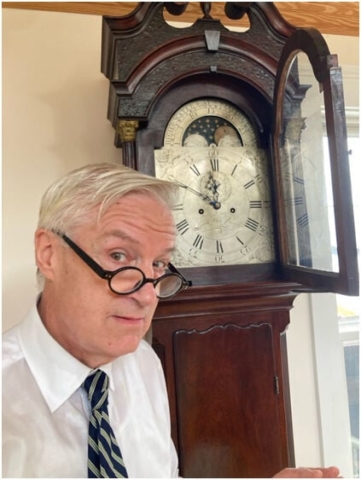
Trained at the British Horological Institute, and now with his shop in lower Manhattan, Metcalfe is the go-to “doctor” for a demanding circle of connoisseurs, including the British Museum, Metropolitan Museum of Art, and numerous private collectors.
A year ago, he restored Hopewell Museum’s two prized clocks. And recently he helped us disassemble, transport, and reassemble them in storage, during which we took the opportunity to interview and photograph him. His words and insights make up the lion’s share of this article.
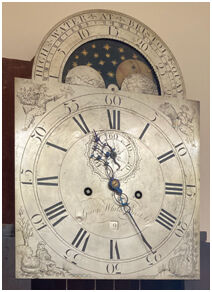
The Hopewell Museum’s first clock was made in Bristol, England, around 1780, by master clockmaker George White. In addition to its numerical dial, it features a circular moon-phase calendar and high-water tide-dial.
“Knowing what phase the moon was in affected country life a good deal,” Metcalfe explains. “For example: when to sow your crops, when you conceive a child — we’re all dependent on the moon phases.
“Tide dials, too. These were mostly done in clocks made by sea ports. That was vital information, to know when you could sail or not. And that of course is related to the moon’s phases.”
“These 18th century clocks have brass dials with silver overlay to make them legible in the dimly lit rooms of colonial America, which of course were lit only by candles and oil lamps,” he continues. “That silvering effect you see on the face is done by a very thin chemical deposit of reflecting silver, which is then lacquered to stop it tarnishing. It was essential because otherwise you couldn’t read the time in the evening. We forget how dark everything was in the country, especially in an agrarian state like New Jersey.”
Around 1800, Bristol, a port city, had a considerable export business to America. The museum’s Bristol tall-case clock may have arrived here then, when clocks and watches were becoming available and affordable.
Metcalfe suggests an alternative possibility: “The Bristol clock could have been brought over later, by Americans on holiday buying antiques. By the 1920s, English antiques were very fashionable in America, and large amounts of 18th century English furniture came over.”
Our second clock was made just down the road, in the early 19th century, a collaboration of two masters: Flemington clockmaker Joakim Hill and cabinetmaker John Scudder of Westfield, New Jersey.
“Curiously enough, New Jersey was far more of a clockmaking center than its neighboring states, far more than New York. Flemington’s Joakim Hill was very prolific, hugely successful, and his are all in the latest Sheraton style of that period.”
Sheraton style (named after English furniture designer Thomas Sheraton) was neoclassical, the revival of ancient Greek and Roman architectural motifs — columns, pediments, domes. It dominated furniture styles in Europe during the late 18th and early 19th centuries and became the most reproduced style in the United States during the Federal period. Thomas Jefferson’s Monticello and many American government buildings, including the White House, are prominent examples.
“Before the American Revolution, all fashion came from England, from the home country,” Metcalfe says. “But in the 1780s, Mr. Jefferson introduced everyone to French style, and that lasted well into the 19th century. But up until that point, style came from England. All the cabinet makers and the carvers, whether they were German immigrants, French or English, they were all copying from English patent-books of style.”
These handcrafted timepieces continued to be made well into the 19th century and were supplanted only when inexpensive, mass produced clocks from Connecticut made it possible for the average citizen to afford one. The cabinets themselves were splendid exemplars of woodcarving: Note the broken-arch swan-neck pediment with brass finials on either side, the arched glass door flanked by fluted pillars. And the case itself features a wonderful mix of inlayed mahogany — Scudder’s signature handiwork.
What time is it? 225 years ago, that question wasn’t an easy one to answer.
“Of course, there was no time standard then,” Metcalfe explains. “The time standard is a fairly recent idea. You could set your clock, perhaps by a sundial. But then that was your local time. You had your local time and other towns had theirs, and it didn’t matter frankly whose time was right — even a half-hour difference between the eastern and western-most towns made little difference.”
“That all changed with telegraphic communication and the railways — and then it became important because there were a number of crashes. And that made America see they had to establish a time standard.”
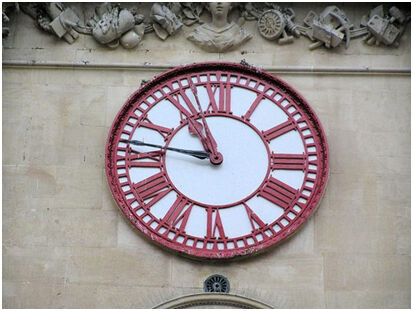
In fact, a clock in the façade of Bristol’s Corn Exchange Building (18th century) has two minute-hands, one in red, the other in black, just over ten minutes apart. The black hand showed local solar time, the red hand showed railway (or London) time.
“And when it all got standardized, then you no longer needed a clock to have two hands or two dials on it,” Metcalfe says. “Those clocks are highly collectible now, of course.”
A clock is configured to measure nothing less than time itself. And as the philosopher says, time is “the most valuable thing on Earth.” Small wonder that, for centuries, clockmakers employed exacting principles of science and craft to capture time with elegance and precision.
Two cases in point: clocks in the collection of Hopewell Museum.
“In its essentials, the concept driving these two clocks has remained the same for centuries: driven by weights and controlled by a swinging pendulum, which beats seconds. You hear the seconds because the pendulum is attached to a gear’s teeth, called the anchor escapement,” Metcalfe explains.
“And that was the formula that has endured to this day in making of these things. Up until the early 20th century—with the development of quartz clock technology—pendulum clockworks offered the most accurate timekeeping in the world.”
Celebrating time past, preserved.
Restoring antique handiwork, to study and admire.
Reimagining a proud museum, for posterity.
All in good time.
Eric Lubell is a trustee of the Hopewell Museum.