Ceramic art has come a long way since Peter Voulkos crossed the line from functional craft to art form with his abstract shapes in the 1950s, and Toshiko Takaezu pioneered the closed vessel in the late 20th century. One of today’s leading ceramic artists, Edmund de Waal, creates installations of hundreds of impeccably made cylindrical porcelain vessels in pastel shades of celadon or white.
A new exhibit explores brick as a medium. “Adam Welch: Bricks,” on view at the Anne Reid ’72 Gallery at Princeton Day School from Monday, November 25, through December 19, explores how the brick characterizes post-modern appropriation, marrying concept and form.
“A large body of my work focuses on the brick as a shape and a concept, involving an intellectual investigation oriented toward art theory and ceramic history,” writes Adam Welch, the artist.
Welch began his obsession with brick when he moved from Arizona to Richmond, Virginia, to earn his MFA in ceramics at Virginia Commonwealth University. Before then, “I was just making, making, making,” he says from his office at Greenwich House Pottery in New York, where he has been director since 2011. “In Richmond my focus shifted as a result of my surroundings. I went from expressionist to minimal, paring down superfluous actions.”
Brick was the object that could best fulfill that. “It’s part of the continuation of the modernist formalist notion of the essence of things,” says Welch, who is also a lecturer in the visual arts program at Princeton University. “There is no more singular primary object, pared down, than the brick, and it fulfills so many functions in daily life.” That was Welch’s aha moment.
He began by making large block forms and solid walls. Bricks worked their way into his daily activities. “I started knowing nothing about bricks and had to research their history, function, and manufacture.”
Clay or baked mud bricks were first used in the Middle East before 7500 BC, and bricks were first fired in China about 3,000 years ago. With the industrial revolution and the rise of factory buildings in England, red brick became the building material of choice — it was faster and more economical than stone. The transition from hand-made brick to mass-produced brick happened in the first half of the 19th century.
Welch was interested in bonding, the patterns of stacking brick. His bricks were individually handmade but made to look uniform. Then he became interested in making them look more handmade, letting the handmade quality express itself. Stamping the brick is important in documentation, he says. Traditionally brick would be stamped with the name of the manufacturer, but Welch uses initials to describe how the brick is made. A brick stamped DP Welch is dry pressed, and a brick stamped HM Welch is handmade.
“Stamping identified the maker, but functions as a recessed area to encourage bonding between mortar and the surface of brick,” says Welch. “There’s a connection between where I’m marking my work, sprawling big identification, and relating back to the history of brick making.”
Welch has been making brick for 10 years. “I find there are limitless options and variables and ways you can manipulate the brick,” he says. “I continue to discover new things, and this show represents the culmination — putting the brick through a series of scientific tests to get to know the brick.”
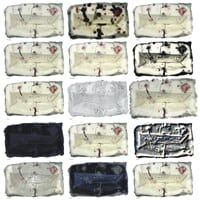
He took the brick to a testing facility and had it tested for porosity, tensile, and compression strength. Next Welch put it through a series of photo doctoring, using different filters to “express the brick potential.” In one series he took a single brick and exposed it to 280 colors from Martha Stewart paint samples, painted one each color, and displayed these on the floor in the order of paint swatches at a hardware store. He then photographed each one, lined up in a row, and sourced the color to the Home Depot website. “I pulled each one and put it into the same order so you can see the digital reality and the other reality — the actual brick — and the photographed reality, digitally reprinted.”
These three variations on perspective show the way we see the world now, the digitally reproduced reality and the completely computer-based reality. “I particularly liked Martha’s colors,” Welch added. He seemed to recall reading scholarly articles about ceramics written by Stewart early in her career, but then couldn’t be certain if he was just having a “weird dream.”
“There’s a larger connection related to her own professional trajectory,” say Welch. “The way she used the language to identify the colors — blueberry, schoolhouse red, corn bread — I was struck by the way she categorized them. She was eliminating the risk of having to decide. You can use any of these colors — you would know what color would work for the trim with a wall. I quite liked how she was simplifying the process for people who don’t have ability to make pairings. (In my own work) I was being critical but also appreciative.”
The exhibit includes a 40-minute video of the bricks slowly fading from one color to another. “The colors are very close; it’s subtle,” he says. “It’s like a digital flip book.”
Not surprisingly, Welch has been fascinated with the practice of “bricking up” — filling in windows of old buildings with brick. “Most of the bricks don’t match,” he says. “They come from different manufacturers.” So he became interested in re-creating these windows with his own glazed brick. He started to make digital mock-ups for a public art project. “That led to the idea of doing more and more investigating with brick in a way I couldn’t with the actual object. The original object is important to manipulate and take it to a level to further express what can’t be done in physical world.”
From his office at Greenwich House Pottery, Welch can look out the floor-to-ceiling windows onto Jones Street in the Village. Opposite the windows is more glass, through which Welch can see the two artists-in-residence. One is an emerging artist and the other, Ghada Amer, an established Egyptian-American painter who is interested in ceramics but has not worked in the medium before. She doesn’t have the technical knowledge, explains Welch, but wants to be involved with making and learning it.
This is a new and privately funded residency. “Ceramics is so prevalent in the art world now, with more and more galleries showing it, but not necessarily made by ceramic artists,” says Welch. “The funder wanted to encourage this at the biggest ceramic facility in the city.”
The internationally recognized Greenwich House Pottery, part of a larger social service organization, has been offering classes and exhibitions since 1909. In the three-story walk-up, 38 adult classes are offered, as well as special events. But Welch doesn’t spend much of his day interacting with the residents. Rather, his time is spent planning, budgeting, and funding the residencies, working with staff — including 25 faculty members — to ensure everything runs smoothly. He coordinates an outreach project to a fine arts high school in Harlem, and engages in problem solving and planning for the future so that Greenwich House Pottery will remain vital.
Squeezed into his busy life — Welch commutes to New York from his home in Hightstown — he spends his weekends firing up the kiln at Princeton University, playing with his kids, and working on his own ceramics in his home-based studio.
Welch grew up in Burke, Virginia, where his parents — a civil engineer and a daycare provider — were supportive of his pursuit of art. The youngest of four, he was allowed to be who he wanted. “It was before over-medication — if I were growing up now I would probably be put on Ritalin,” he says. Having his mother’s charges around the house was distracting, he says. He discovered pottery in 10th grade and was good at it, earning $1,000 in a student art show in 1993. He bought a wheel and worked through the summer, then was able to negotiate with the principal to take two ceramics classes and no math. In his senior year he convinced the principal he could give up a language class and take a third ceramics class.
“Everyone who took math and a language got a presidential diploma, but I got engaged with knowing what I wanted to do for a living,” Welch says. It took four colleges before he found the one that was right for him, inspired by many mentors along the way, and he earned his bachelor’s degree from Northern Arizona University in Flagstaff.
One of the works in the show, a digital print with 93 images of one brick over another, merged together, is based on the work of statistician and eugenicist Francis Galton, who created composite photographic portraits, hoping to create types that would help with medical diagnoses or identification of criminals.
Based on this disproven concept, Welch has merged together individual bricks to give the essential characteristics of the brick itself. “It connects it all back to this idea, the modernist notion of unified theory. Paring down to the essential characteristics, getting rid of the periphery to find the core.”
Adam Welch: Bricks, Anne Reid ’72 Gallery, Princeton Day School, 650 Great Road, Princeton. Open Monday through Friday, 8 a.m. to 5 p.m. when the school is in session. Monday, November 25, through Friday, December 20. Artist’s reception, Thursday, December 5, 12:30 to 1:30 p.m. Free. 609-924-6700, ext, 1772, or www.pds.org.