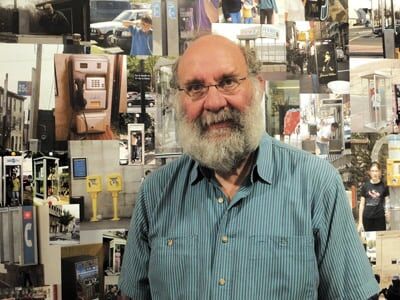
‘I didn’t invent the concept, but I’ve taken it to a new level,” says David Dobkin as he fastens an 8-by-10-inch photograph of a man standing in a foreign phone booth onto a gallery wall.
The picture is merely one of the hundreds of images of children, women, and men — including himself — that Dobkin is displaying as a small part of his big art installation with the quirky title, “Myself, I Think We Should Keep Collecting Titles.”
The exhibition opens Thursday, September 19, with a reception at the Lewis Center for the Arts at Princeton University’s Lucas Gallery at 185 Nassau Street.
The “concept” that Dobkin mentions is the habit of collecting. The “new level” is the quantity of objects that he has acquired over the past 30 years. It is a collection large enough to fill the second floor gallery space, rooms at home, and numerous storage boxes.
At the center of it all is an interest in something constantly present and constantly overlooked.
Dobkin is best known as a member of Princeton University’s faculty and administration. He arrived at the university in 1981, served as a professor of computer science, and says his interests include using geometric ideas and techniques to produce high-quality images on a computer or to use “in the reconstruction of archaeological artifacts from a 3,000-plus-year-old ruin in Greece.”
He is also interested in the impact of information technology on society. That, he says, “ranges from the recent emergence of social networks to efforts to understand the technology that allows the NSA (National Security Agency) to know so much about us.”
Although he was appointed dean of faculty in 2003, the Princeton resident now finds himself an unintentional visual artist. Yet, rather than using the traditional mediums of paint, clay, or stone, Dobkin works with the stuff more or less at hand. Or, in his case, more and more at hand.
“I started collecting snow globes in the mid 1970s,” Dobkin says. “And I started collecting post cards a little before that.” He points to another wall that contains a galaxy of cards that encompass everything from corny city scenes to naughty nudes. “You do not have to consciously collect (post cards). You get them in the mail and just put them away. In the 1970s I covered a wall with them.” He has also used them to fill 11 shoeboxes.
Dobkin’s unconscious or practiced habit of accumulating objects through choice or chance has yielded approximately 800 snow globes, hundreds of food-related photographs (menus, meals, and servers), and numerous variations of “wash your hands” or “curb your dog” signs.
He also has hundreds of popsicle sticks, water and juice caps, compact discs, and introductory credit cards that he has fashioned together to create room dividers and window curtains (visible from Nassau Street).
While the rooms that contain the above items seem to be a photograph of the disparate details of an explosion, there is also an unexpected cohesion.
“It’s my life in the sense that it’s life,” he says. “I took all the pictures, but it’s not just my life.”
Dobkin’s life started in Pittsburgh, Pennsylvania, as the son of a wholesale grocer father and a mother who taught typing and shorthand.
“My grandparents” — Jewish immigrants from Eastern Europe — “had to do everything they could to stay alive,” he says. “My parents were the bridge generation, still in the old world and making a new life for us in the new one. I lived a life defined by luxury. That is, I had the freedom to pursue things that others did not have the freedom to do,” he says.
Saying that there was no art in his early life, he mentions that Andy Warhol had attended his elementary school years earlier. Warhol was also an avid collector of everyday objects and often used the familiar as the subject for his art.
Dobkin’s forte was math and after graduating from high school he attended Massachusetts Institute of Technology, receiving both a bachelors and masters degrees, and then Harvard University, receiving a doctorate in applied mathematics.
After teaching at Yale he took a teaching positions at the University of Arizona, where he met his future wife, Suzanne (now a professor of education at Rider University). At the urging of a colleague, Dobkin applied and was accepted to teach at Princeton University.
Over the past three decades — in addition to being married for the same period of time — Dobkin unwittingly began preparing for this once in and of a lifetime exhibition.
“In 1982 my wife — who was not my wife at the time — and I went to Europe together and we were in Amsterdam. She saw a phone booth and said, ‘that’s cute, why don’t you take a photo?’ It became a disease,” he says in front of images.
While Dobkin routinely increases his collection by picking up objects or photographing a chef or menu, he also enlists others to help or enable. “I can ask people who are going on a trip to send a postcard or get a paperweight or take a photo. It is not like collecting Tiffany,” he says.
The wall, however, is a counterpoint between the universal — where random images of people using the now old fashioned convenience — and the extremely personal. “If you look at the wall of people with phone booths, you can watch my kids grow up and watch me grow old,” he says.
The phone booth as motif is physically extended in the exhibition by a replica created out of toilet paper tubes and credit cards suspended by a chain of safety pins. Ironically, it may be the only phone booth in Princeton.
Another wall filled with images of food and meals was taken from his home, transcending the idea of personal space. “You only see bits and pieces of it, but we remodeled the kitchen in our house. But when we had a stain, I covered the walls with pictures. When the contractors came in, I asked for them to keep the pictures.” The contractor suggested making walls with images that could be hung on Velcro. That, in turn, allowed the wall to be transported to the gallery.
Dobkin brushes away the idea that he is obsessive and says, “I have a lot of hobbies. I do collect and organize things. It’s an effort to group things. For example, I have about 10,000 digital photos on my website, and I can go to the exact photos of phone booths without extracting other things. I have been documenting my life digitally for the past 13 years. When I got the last digital camera, it was bought to create a web page. It’s an extended memory.”
He then adds that in his dean’s office he has 100,000 pennies that he has sorted by year and mint. “You can’t do it electronically. A friend of mine built a structure to store (the pennies) in,” he says. One of those structures — a set of several tall clear plastic tubes on a pedestal — is included in the exhibition.
Then one summer, he says, he had some spare time, found the old computers and electronics, took them apart and created something he calls the “brain room.” In the exhibition keyboards suspended from long cords dangle and play with the imagination.
If any of the above suggests that Dobkin is compulsively well organized, he will say that that assumption is incorrect or perhaps partially incorrect. “I’m pretty disorganized at home and in my office. Well I wouldn’t say I’m disorganized. If you look around, you would think there’s a lot of clutter. There’s the shelf from home that has a fair amount of clutter.”
The referenced shelf is a replica of one from his home, though the shelf’s contents — a football sized waving M&M, an Aurora Company Superman model, the plastic bust of King Tutankhamen, a soft-sculptured penguin, and square footage of things found in a vintage toy store or highway stop — have been moved to the exhibition.
“If you come to my house and give (some object) to me, I put it on the shelf,” he says. Then, seeming to come to a realization, he says that the exhibition has fascinated him because it has forced him to relook at the things he owns and to discover what he does not recall seeing before.
When asked about his wife’s reaction to a husband who fills the house with an organized riot of objects, he says, “We have a life of guerrilla warfare. She has her rooms, and I have my mine. It’s all in the name of love.”
But the love has a cost. “We had to move to new houses — too many processions. We had to scale up,” he says. But that is a thing of the past. “We decided after the last move that’s it. Heaven forbid — we haven’t figured out that we can throw things away.”
That save-it-all attitude exists despite the fact that others in the family have caught the same disease. “My wife collects silly things like quilts and mugs,” says Dobkin of his wife’s apparent interest in functionality.
His three children — Sarah and Jane (both out of school) and Ben at Princeton University — also accumulate “things.” “My oldest daughter started collecting bottles; my other daughter started collecting key chains; and my son started collecting cheese sticks labels with jokes on them” (a practice the boy gave up in elementary school).
Yet they are no match to their father, whose collection in his Princeton University office caught the attention of Joe Scanlan, an artist, Princeton professor, and the Lewis Center’s director of the program in visual arts.
“I have the faculty to my office for lunch and some of the collection is there. And (Scanlan) was at my house and came up with the idea,” says Dobkin.
“David is a great example of a person whose proclivities are perfectly manifested as works of art, regardless of his formal training,” says Scanlan in a written statement. “Like many artists, David notices objects and material flows that most people don’t, and he combines them in ways that not only reveal his esthetics and thought processes, but also spark curiosity and visual delight in the people who see them.”
Scanlan is a postmodern conceptual sculptor who has mounted 19 solo exhibitions and examines the idea of art and self-promotion as well as the idea of art and consumption.
“The approach to art at Princeton is still focused on art as discrete objects made by individuals. While that is still a valid practice, I would hope to infuse it with more skepticism for that tradition and a greater awareness of contemporary alternatives,” says Scanlan.
He notes that Dobkin combines several artistic strains. The professional who collects then creates from what has been accumulated (for example, Louise Nevelson who created sculptures from discarded wood and metal); the contemporary anti-esthetics who, Scanlan says, “devise rules, systems, or other means for making art that defies traditional notions of composition and taste”; and the self-taught or “visionary” artists whose works significantly resonate despite being created outside of accepted traditions.
Those elements make the exhibition — cosponsored by the program in visual arts in the Lewis Center — the apt choice for Scanlan’s interdisciplinary graduate course. “The course and the exhibition explore the concept of the amateur as a liberated novice, a non-professional, and a lover of things,’” he says
Although Dobkin says he does not really think about such terms as artist or amateur artist (seeing them as press release fiction), he says Scanlan “has done a fantastic job in creating the show,” one for which he also started collecting titles for the show; they’re also on view on one of the exhibition walls.
As Dobkin looks around at the archaeological-like reconstruction of the artifacts from his house, he says, “I am a little nervous. I have never done anything like this. It’s like being a display.”
Reflecting about what he wants to happen with this exhibition of his life and the objects of our time, he says “There are aspects about this that life is about the details. None of the pictures are profound. But all of the pictures are part of life. We’re busy living our lives. It would be great if people took away an appreciation of the details of daily life. This is all around you, and people don’t notice it. Or they don’t think it is art. It encourages you to look at the details of your life.”
Now that is a concept to take to a new level.
David Dobkin’s “Myself, I Think We Should Keep Collecting Titles,” Lucas Gallery, Lewis Center for the Arts, 185 Nassau Street. Opening reception on Thursday, September 19, from 6 to 8 p.m. Free. Continues to Friday, October 4, Monday through Friday,10 a.m. to 4:30 p.m.
For more information visit www.princeton.edu/arts.