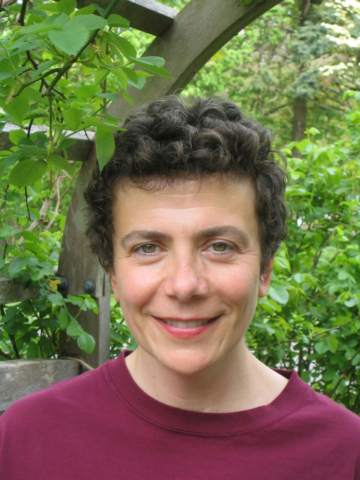
Life for composer Frances White didn’t change much during the pandemic shut down, since she is somewhat of a happy hermit, living in Griggstown with her husband, writer James Pritchett, and their cats. In fact, the new quietude energized her.
“I have always tried to be sure my life has plenty of quiet and solitude in order to work well, so in that sense, it wasn’t that big of a change,” White says. “Griggstown is a little rural community near the D&R Canal, so it’s always pretty quiet here. But since I’ve been spending more time at home, I’ve been hyper aware of the sonic landscape around us. This spring, in particular, has been amazing.”
A prolific composer, White is known for instrumental, vocal, and electronic music, and her works have been commissioned and performed by ensembles such as the New Jersey Symphony Orchestra, Crossing Chamber Choir, Momenta Quartet, Parthenia viol consort, and many others.
A perusal of her website reveals the breadth of her compositions, and interest in writing for and collaborating with different media and art forms. In addition, White’s works appear in a variety of recordings on the Wergo, Centaur, Nonsequitur, Harmonia Mundi, and Bridge labels. Her music has been used in soundtracks for two films by director Gus Van Sant.
Known for her sensuous, atmospheric compositions, which blend her writing with natural and ambient sounds, White didn’t put her creativity on hold during the pandemic, but continued composing, collaborating, and sharing ideas online, as well as seeking out grants.
“I did continue composing, in fact, I’m working on ‘Upon Reflection,’ a chamber opera for the viol consort Parthenia and soprano Sherezade Panthaki, with text and images by Wendy Steiner,” she says. “It’s a work that explores an artist’s relationship to her own work, which in this time seemed particularly apt. I think a lot of us are questioning why we create: in a world that’s so filled with injustice and violence and evil, what meaning does our work have?”
One of the more interesting grants she received recently is from the Puffin Foundation, “which generously has provided funds to support my upcoming residency in Denali (Alaska) National Park as part of the Composing in the Wilderness program.”
White says she’s already daydreaming about what kind of sounds she might find in the 49th state.
White will be there for two weeks in July, when she and eight other composers will spend time in the backcountry of Alaska, then return to Fairbanks, where their newly composed pieces will be rehearsed and performed by the faculty musicians of the Fairbanks Summer Arts Festival.
She has no idea what kind of sounds Mother Nature will offer, but says she’s completely open to whatever Denali might give to her.
“I know from experience that whatever I might imagine, nature will present me with a sonic landscape that is completely not what I expected and will lead me to places I can’t even guess at yet,” White says.
The evocative sounds of the Far East also fascinate her, and she has enjoyed writing for and playing the traditional Japanese bamboo shakuhachi flute.
Before the pandemic, White had completed “The book of evening,” which she wrote for the Momenta Quartet. Inspired by Mark Strand’s poem “Moon,” the piece features the shakuhachi.
“I had wanted to write for shakuhachi and string quartet for a long time, and when the opportunity to write for Momenta came up, this poem wouldn’t leave me,” White says. “The shakuhachi was performed by my good friend, composer and performer Elizabeth Brown.”
Piano is her main instrument, but she became entranced with the sound of the shakuhachi flute and wanted to learn it as well as write for it.
White, who had never played a wind instrument before, says, “I had a very powerful experience when I first heard the traditional meditative music of the shakuhachi, and I remember having this weird feeling of recognition. It was as if this was music I had always been searching for but never found until now. The other thing that made me love it was that somehow the shakuhachi’s voice is like an animal voice, like sounds of nature.”
“Further, there’s a strong spiritual element to the traditional music that speaks to me very powerfully,” says White, who was raised as a Catholic. “It’s like Gregorian chant in that it’s not ‘just’ music, it’s a spiritual practice.”
Throughout history, composers have written for instruments they didn’t play, but White viewed the shakuhachi as something that needed to be studied in depth before the writing process could begin.
“It’s part of a tradition that I knew nothing of, had no real-world connection to, and I wanted to be sure that I could write for it in a way that was respectful, that wasn’t just appropriation,” she says. “So I had to really enter into the shakuhachi world. Fortunately, (ethnomusicologist) Tomie Hahn, the wife of a colleague and good friend, Curtis Bahn, played shakuhachi, and she became my teacher.” (White also studied with shakuhachi master Riley Lee when he was in residence in Princeton.)
The idea of mixing natural sound in with her compositions didn’t occur to White earlier in her career.
“It was when I started working with computer music at the Brooklyn College Center for Computer Music that the whole idea of real-world sound in music entered the scene for me,” she says. “We were working with making sound on computers, and in those days, computer disk space was unbelievably limited, simply no room on the computer to store lots of recorded sound.”
“Synthetic sound could be much more easily stored, so we spent a lot of time thinking about and listening to real world sounds, trying to figure out what it was, acoustically, that made them so beautiful, so that we could replicate this in our synthetic sounds,” White says. “Then, when I went on to Princeton University, computer storage space was getting cheaper, and it opened up the whole possibility of using recorded real-world sound in your computer music pieces.”
The technology was not the only revelation: After years of living in Brooklyn, the relocation to Princeton brought nature to White’s doorstep.
“There was a beautiful woodland less than 10 minutes from my first apartment in Princeton, and only a little farther was the Institute for Advanced Study’s woodland, which is a world famous spot for birding,” she says. “And after all those years in as urban a setting as you can think of, suddenly I was discovering bird song, the intricate sounds of streams, the wind in the trees, and so on.”
“My husband is a bird-watcher, and he helped me learn to identify birds by their songs,” she adds. “We ultimately collaborated in an interactive installation called ‘Resonant Landscape’ (he wrote the software, and I wrote the music) in which we presented a map on a computer screen, and listeners could explore that map by moving around on it and encountering different sounds and mixes of sounds in various spots.”
White names 20th-century composition pioneers such as John Cage, George Crumb, and Terry Riley as influences, as well as Morton Feldman, Jean-Claude Risset, Luc Ferrari, “and then later my teachers Charles Dodge and Paul Lansky. Once I learned about Annea Lockwood’s work with sound, she was important to me too, as was Pauline Oliveros,” White says.
“(Composer/dancer) Eleanor Hovda was a huge influence on me, too,” she says. “Eleanor was a mentor who encouraged me to engage hands-on whenever possible with whatever instruments I might be writing for. And her music, her incredible sonic imagination, was a great inspiration.”
White’s childhood environs in Bowie, Maryland, were quiet enough that she can vividly recall the buzz of insects from the field behind her house, or lying awake at night listening to mockingbirds sing.
Her father was an electrical engineer, and her mom had been a teacher before staying home to raise the family, but both loved music and wanted White and her sisters to have lessons.
“One of my earliest memories is of my mother hanging out the laundry on a sunny day and listening to Mario Lanza on the kiddie record player,” she says. “Plus we had these records called ‘Tale-Spinners,’ which told stories set to classical music. I think my favorite was ‘The Little Mermaid,’ which was set to the Grieg piano concerto.
“My dad amassed an impressive collection of opera recordings,” she continues. “I remember going on vacation in Maine, swimming out in the lake, and hearing ‘Tosca’ echoing from the cabin we’d rented, accompanied by the cries of loons.”
Piano lessons began at age six for White, but the thought of public performance made her anxious, so music became something much more private.
“I started making up music at maybe about 10 years old, and I’d improvise things on the piano and even write them down,” she says. “But, I never, ever seriously thought I would be a composer. After all, I was a little girl, and everybody knows composers are old, dead white men, right?”
“I was lucky enough that in high school, I finally had a music theory class, and as part of it we composed little pieces,” White says. “The teacher encouraged me, and suggested that what I had written was kind of special. When it became time to pick a major in college, I loved music and making things up so much that I decided to major in composition, and everything just flowed from there.”
She graduated from the University of Maryland in 1981 with a B.M. in music composition, then attended Brooklyn College, CUNY, earning an M.A., also in composition. Around 1988, White came to Princeton University, where she earned another master’s degree (1990) en route to a PhD, for which all the course work has been completed.
White’s husband Pritchett is known for his focus on the music of John Cage and is the author of “The Music of John Cage” (Cambridge University Press), the first critical study of the whole of Cage’s work. In addition, Pritchett created the text and video for White’s instrumental theater trilogy, “The old rose reader,” “As night falls,” and “The book of roses and memory.”
“He’s also a poet and writer of stories,” White says. “We’ve collaborated a lot on works where he’s written the text and I the music.”
Even with her enjoyment of solitude, it was the emotional connections and in-person collaboration that White missed the most during the lockdown.
“I never really noticed how often, pre-pandemic, I was in New York City for rehearsals, meetings, concerts, etc.,” she says.
“Just today, now that we’re all fully vaccinated, I had the supreme joy of getting together with Wendy Stein and Lisa Terry, one of the Parthenians (viol ensemble), in person for a reading of some of the material from the opera,” White says. “(I hadn’t realized how much) I missed the energy that I derived from interacting with wonderful and inspiring colleagues.”