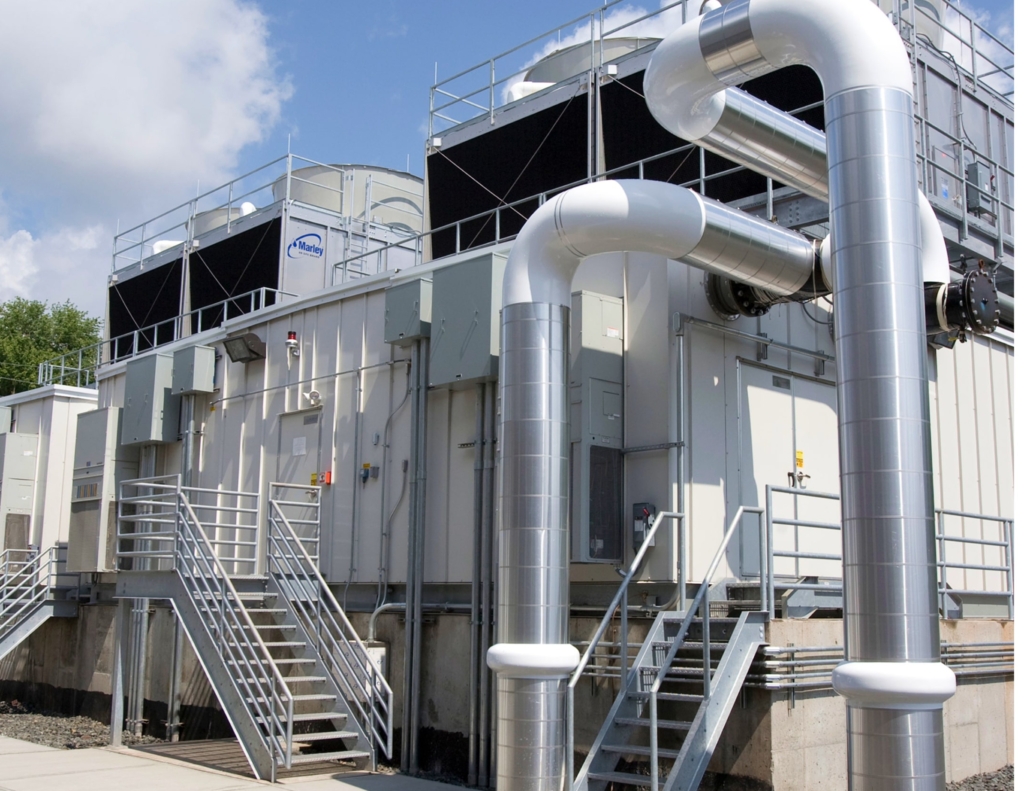
A massive data center under construction along Route 1 in South Brunswick has become the focus of growing opposition to the facilities across central New Jersey.
As federal and state lawmakers call for a halt to environmental permitting for the project, neighboring municipalities are taking steps to restrict or ban future data centers, citing concerns about air pollution, electricity demands, water consumption and the impact on surrounding communities.
At the center of the controversy is the Sentinel Princeton Nurseries Data Center, a 341,000-square-foot facility being built at 4405 Route 1 on some 143 acres of the former Princeton Nurseries property, near the borders of Princeton and Plainsboro.
The facility’s tenant is Bloomberg LP, the global financial information and media company, which confirmed its involvement in October, according to media reports.
Bloomberg spokesman Ty Trippet said that the company employs nearly 4,000 New Jersey residents, including almost 1,500 at its Princeton campus, and views the data center as another investment in the region.
Trippet said the facility is not an artificial intelligence or hyperscale data center and would use no more than 30 megawatts of power at peak demand. He also said the diesel generators planned for the property would be used only for emergency backup power.
Sentinel Data Centers, the New York City-based developer, also said that the project would use closed-loop cooling and energy-efficient technology, with generators restricted to emergencies and limited testing.
Nevertheless, the project has drawn opposition from residents, environmental organizations and elected officials who question whether the facility’s environmental effects have been adequately examined.
The New Jersey Department of Environmental Protection is reviewing an air pollution permit covering 12 diesel-powered emergency generators, each rated at 3,620 kilowatts.
The proposed permit would limit routine testing and maintenance to 28 hours annually per generator while allowing additional operation during qualifying emergencies.
DEP has said its health risk assessment found the potential effects of emissions to be negligible under state technical standards.
Opponents, however, question whether the assessment adequately accounts for simultaneous generator operation, extended power outages and the proximity of residential neighborhoods and schools.
On Nov. 9, U.S. Rep. Bonnie Watson Coleman and state Sen. Andrew Zwicker called on DEP Commissioner Ed Potosnak to pause the permitting process until those concerns are addressed. The lawmakers asked DEP to reconsider its emissions calculations, including the potential effects of operating each generator for at least 500 hours annually, or explain why a lower figure would be appropriate.
They also questioned why the draft permit covers 12 generators when other plans and public statements have referenced as many as 20 at the site.
“We respectfully request that DEP not issue the permit in its current form,” the lawmakers wrote. “We are asking for a complete, transparent review that protects public health and gives residents confidence that the law will be enforced.”
Assemblywoman Tennille McCoy, whose 14th Legislative District includes Plainsboro, separately called on DEP to deny the permit. “Air doesn’t stop at a township line,” McCoy said. “Plainsboro families will breathe what this facility emits, yet Plainsboro had no seat at the table when the project was approved. Before a single generator is permitted to run, NJDEP should offer our residents a full, transparent accounting of what this facility will put into our air.”
McCoy also pointed to a mixed-use development approved in June 2025 on approximately 109 acres of former Princeton Nurseries property in Plainsboro, immediately south of the data center site.
That development includes 950 residential units, a 75,000-square-foot hotel and nearly 320,000 square feet of commercial space.
“We are asking residents to make a home on one side of this property line and asking them to accept an industrial power plant’s worth of diesel generators on the other,” McCoy said.
Princeton officials have expressed similar concerns.
Mayor Mark Freda and the Princeton Council called on DEP in October to reject the permit in its present form, warning that emissions could affect nearby residential neighborhoods and two elementary schools.
“We have grave concerns regarding how the backup diesel generators planned for the data center in neighboring South Brunswick will affect our community,” the officials said.
The environmental review is separate from the local land-use process that allowed construction to begin.
South Brunswick approved the development in May 2025, following a redevelopment process involving land formerly owned by Princeton University.
The property has been the subject of development disputes for decades. Princeton Nurseries once operated across more than 1,000 acres in the area before closing its Kingston operation in 1995. Portions of the historic nursery property were subsequently preserved, while other sections remained available for development.
South Brunswick residents Mark and Katherine Smith challenged the redevelopment designation and planning process associated with the data center. A judge ruled against their challenge in August, and the couple appealed.
Construction has continued while the legal and environmental disputes remain unresolved.
The DEP extended the public-comment period on the proposed air permit from Oct. 7 to Nov. 9 following requests from state lawmakers. Approximately 200 people attended a Sept. 23 public hearing in Plainsboro, with about 30 offering testimony. The department has not announced when it will make its final permit decision.
While the South Brunswick project continues to move forward, the controversy has prompted other municipalities to reconsider whether data centers should be permitted within their borders.
In Hopewell Township, the Township Committee voted Nov. 9 to introduce an ordinance that would explicitly prohibit data centers in all commercial, business and industrial zoning districts. The proposed amendment would establish a definition of a data center and identify the facilities as prohibited uses under the township’s land-use regulations.
Mayor David Chait said the measure is intended to clarify existing restrictions while protecting the township from potential environmental and infrastructure effects.
“Two things I want to make specifically clear here is our code already does not allow data centers to exist. No one could just build a data center,” Chait said. “[A data center] is not an allowed use, but what this is doing is making that clear in the opposite way of it not being allowed it is explicitly banning them.”
Chait said the definition is intended to distinguish large facilities filled with servers and data storage equipment from smaller server rooms used by businesses.
He also raised concerns about the potential demands that large data centers could place on local infrastructure.
“The impact on power, the grid strain, water…we are in a well driven community, noise and other pollutions that can exist from that and really the wear and tear on infrastructure are large scale,” Chait said.
The proposed prohibition would not apply to redevelopment areas governed by existing general development plans.
The ordinance must undergo Planning Board review before returning to the Township Committee for a public hearing and final vote, potentially Dec. 7 or Dec. 21.
Lawrence Township is also considering a prohibition, although officials have delayed action to allow additional study. The Township Council introduced an ordinance in October that would ban data centers throughout the municipality.
The measure was scheduled for a public hearing and final vote Nov. 5, but was tabled after the Planning Board declined to endorse the proposal without further review. Planning Board members raised questions about whether an outright prohibition was the best approach or whether data centers should instead be regulated through strict performance standards.
Planning Board attorney Ed Schmierer suggested allowing the facilities as conditional uses, which would require developers to meet specific standards before receiving approval.
The proposed ordinance describes data centers as an intensive land use involving concentrated computer operations and substantial electrical, cooling, backup power and communications infrastructure.
It also states that those characteristics could be incompatible with the township’s development patterns, infrastructure capacity, environmental constraints and community character.
Lawrence officials are awaiting further Planning Board review before deciding how to proceed.
East Brunswick and North Brunswick have already adopted local bans on data center construction, according to media reports.
The growing municipal opposition comes as New Jersey lawmakers consider additional statewide regulation of the industry.
In July, Gov. Mikie Sherrill signed legislation establishing a separate utility rate class for large data centers, intended to prevent the costs of supplying electricity and expanding infrastructure for the facilities from being passed along to other customers.
A second law, signed in August, requires data center operators to report electricity and water consumption to the New Jersey Board of Public Utilities twice annually.
Zwicker and state Sen. Joseph Cryan have also introduced legislation requiring DEP to study the environmental and infrastructure effects of data centers while temporarily prohibiting new construction during the study. Projects already approved or under construction would be exempt.
The debate reflects increasing demand for facilities capable of supporting cloud computing, financial services, artificial intelligence and other technology requiring large amounts of computing power.
Supporters point to the economic investment, tax revenue and digital infrastructure provided by data centers. Opponents argue that their electricity demands, backup generators and other infrastructure requirements can impose costs on surrounding communities that extend well beyond the properties where the facilities are built.
For the South Brunswick project, those questions remain tied to the pending state air permit, even as construction continues and surrounding towns consider how to prevent similar controversies in the future.