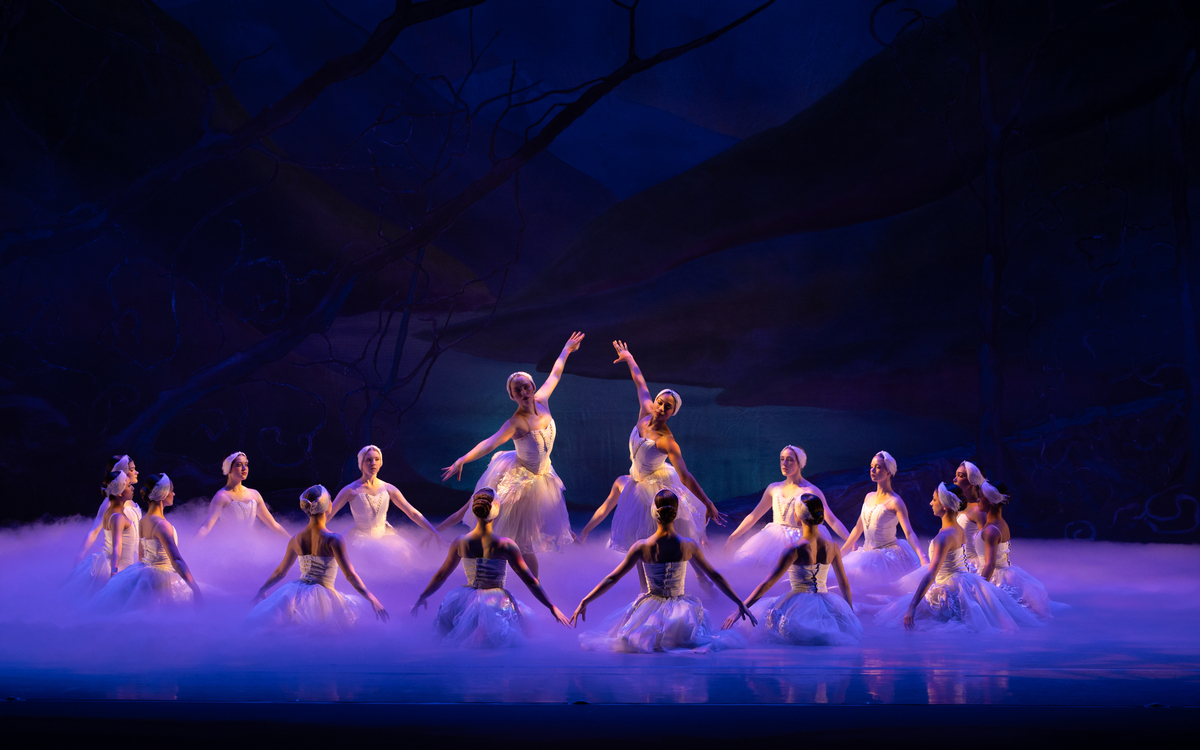
The Princeton Ballet School-affiliated American Repertory Ballet presented an ambitious new production of the uber-famous classical ballet Swan Lake at the New Brunswick Performing Arts Center Oct. 23-25.
Choreographed by the company’s artistic director, Samantha Dunster (after Marius Petipa, with additional staging by Alexei Charov and Natalia Charova), it tells the familiar tale of Princess Odette, who is turned into a swan by an evil sorcerer.
Odette can’t be restored to human form until a man pledges true love for her. Prince Siegfried comes along and does just that.
But Siegfried is soon tricked into proposing marriage to the sorcerer’s daughter, the Odette look-alike Odile — thus betraying Odette, with whom he can be reunited only in death.
While ARB’s production may not be the most exciting or inventive Swan Lake one has ever seen, it is, perhaps, the prettiest. Amid pastoral, palatial and lakeside settings evocatively designed by Howard C. Jones and handsomely costumed by Janessa Cornell Urwin, ensembles of dancing peasants, courtiers and swans fill the stage with ravishing balletic activity.
I’ve been following this company for a long time, and it’s always the flawlessly synchronized corps de ballet work that distinguishes ARB’s performances of classical story ballets.
Here we are repeatedly entranced by the swans’ unison movements and are appropriately tickled by the quartet of hand-holding cygnets as they proffer that well-known sequence of speedy footwork and birdlike head moves with perfect precision.
In the ballet’s third act, we are treated to a graceful sextet prettily danced by an array of princesses, one more enticing than the next, as they present themselves as candidates for the prince’s hand.
And even the prince himself, portrayed by Aldeir Monteiro, contributes to the show’s overall prettiness, as his dancing is marked more by beautiful lyricism than wowing athleticism.
Yet most notable is the prettying up of the evil sorcerer. Usually a truly frightening, ugly monster of a man named Rothbart, in ARB’s production the character is rechristened Die Eulenhexe (which means “owl witch”) and is played by Madison Elizabeth Egyud as a sexy blonde alluringly clad in a sweeping black lace gown.
Though this viewer enjoyed all the beautification, it could be argued that the ballet’s dark story is too cheerfully told and Dunster’s choreography almost too easy on the eyes.
Granted, from its origins in the courts of Europe, classical ballet was always intended to reinforce the beauty of a hierarchical society in which aristocrats are supported by the labors of admiring peasants who “stay in line” and attractively frame the actions of their “betters.”
Yet here, when the curtain goes up on the palace scene, where the drama’s heartbreaking betrayal is to occur, the setting feels too warm and friendly, its turquoise draperies suggesting an aquatic peacefulness and its earthy brown woodwork evoking sensibilities more comforting than intimidating.
And throughout the ballet’s happy-toned first act, there’s no foreshadowing of the tragic events to come, nor any suggestion to look beneath the surface of human behaviors.
Clear signs of distress, however, emerge in the second act when, from the moment she steps onstage, we detect horrific pain on Odette’s face. In her exquisite rendition of the challenging Odette/Odile dual role, Ryoko Tanaka displays crystalline classical lines and more persuasive acting than the other principal performers.
The exception is the great American ballerina Kathleen Moore, whom one is privileged to see here in the role of the Queen. Now a Princeton Ballet School faculty member,
Moore was formerly a principal dancer with American Ballet Theatre, renowned for her definitive performances in Antony Tudor’s groundbreaking psychological ballets.
It would only be nitpicking to note my one disappointment with Tanaka’s performance. Though she danced the opening adagio section of Odile’s fiery Black Swan pas de deux with impressive elegance, when it came to the always highly anticipated 32 fouetté turns — that traditional test of a classical ballerina’s superior merit — Tanaka weakened and fell short of the mark.
Throughout, the driving force of ARB’s pleasing production is Dunster’s lively, well-crafted staging. While her movement vocabulary of familiar ballet steps and phrases can sometimes feel repetitive, she is a master designer of stage action, animating the space with intricately patterned group dancing, smartly used to highlight, introduce or respond to the eloquent storytelling choreography of the ballet’s main characters.
Dunster’s choreography is highly musical, and it is a joy to watch how she “makes visible” the richness of Swan Lake’s beloved Tchaikovsky score.
She gratifyingly manipulates varying spatial levels, accents and kinetic energies to underline the timings and textures of the music.
Under Dunster’s direction, the ballet’s mime passages are also musically timed. And I couldn’t help but smile at how even the lowering of the first-act curtain happened in exact alignment with the melodic phrasing of the music.
American Repertory Ballet next appears in The Nutcracker at McCarter Theatre (Nov. 27-29), Two River Theater (Dec. 5-6) and State Theatre New Jersey (Dec. 17-20).