A photograph hanging in Bryan Grigsby’s Bordentown home captures a moment from the Vietnam War that has remained with him for nearly six decades.
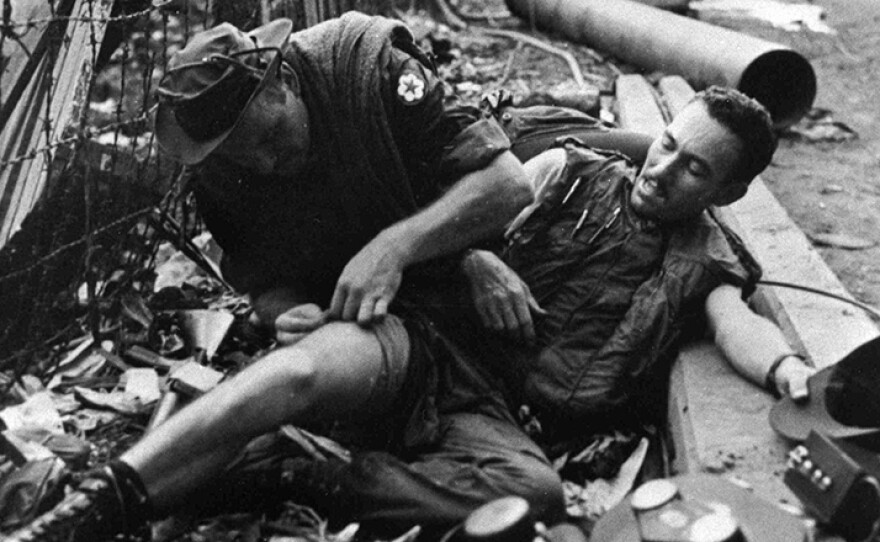
Taken May 6, 1968, the black-and-white image shows a wounded Army cameraman receiving medical attention from a fellow soldier during fierce fighting outside Saigon. Grigsby was behind the camera that day, recording a scene involving two men with whom he had been documenting the war.
It was one of countless images he took during his military service, but the photograph remains among his favorites, a reminder of the dangers faced by the soldiers whose job was to preserve a visual record of the conflict.
Now, more than 58 years later, Grigsby will revisit those experiences during a Veterans Day-related presentation at Old City Hall in Bordentown City.
Grigsby, a Pulitzer Prize-nominated photographer who spent 30 years with The Philadelphia Inquirer, will present and discuss photographs from his service in Vietnam during the Sunday Soiree Series on Sunday, Nov. 8, at 4 p.m. The free program will also offer a preview of a book Grigsby is working on about the war, an experience that changed the course of his life and introduced him to the profession he would pursue for decades.
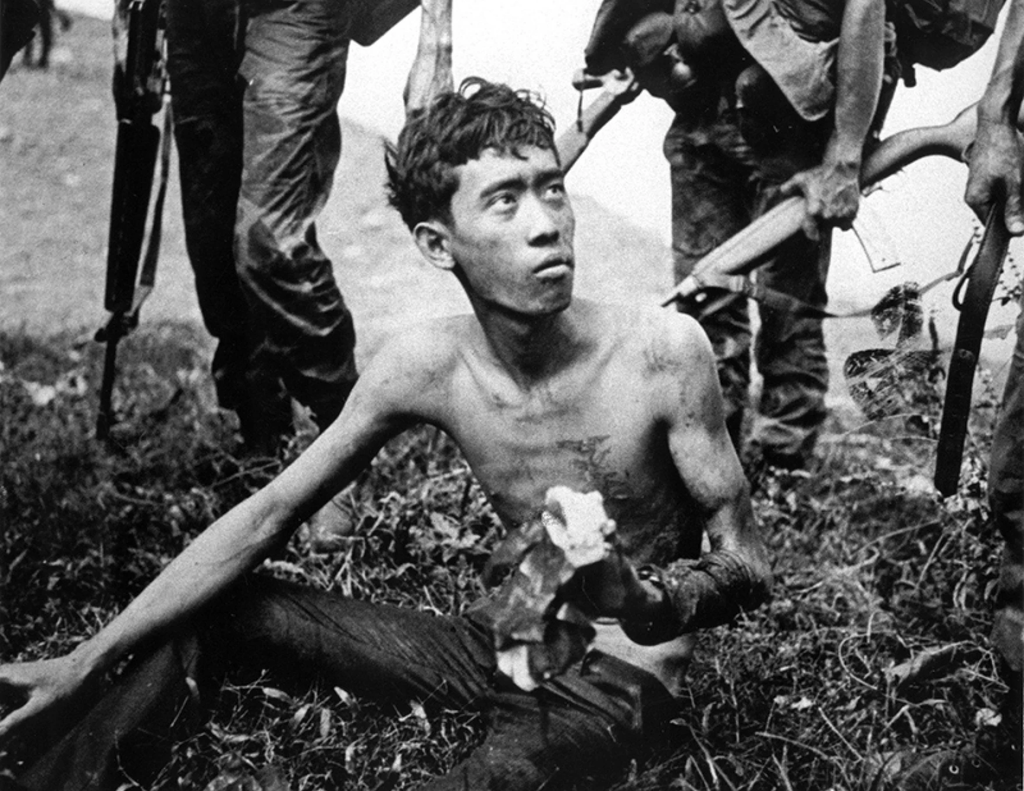
A native of Gainesville, Florida, Grigsby served with the Department of the Army Special Photo Office, known as DASPO, from 1967 to 1970. He spent a total of seven and a half months in Vietnam, photographing military operations, soldiers and the daily realities of war. His assignments took him into active combat, sometimes placing him in the same danger as the troops he was documenting.
One of those assignments led to the photograph that still hangs in his home.
On May 6, 1968, Grigsby was working with fellow Army cameramen Richard Griffith and Howard Breedlove during the May Offensive, a period of renewed fighting that followed the Tet Offensive earlier that year.
The three had been sent to document house-to-house fighting near Plantation Road in Gia Dinh, a suburb of Saigon. It was Grigsby’s second assignment of the day. As they approached an area where fighting was underway, Breedlove began setting up his camera equipment. Moments later, he was wounded by enemy fire.
Grigsby recalled hearing Breedlove shout, “I’m hit!”
Grigsby and Griffith rushed to help him. As Griffith applied a tourniquet to Breedlove’s injured leg, Grigsby raised his camera and photographed the scene. The image captured both the danger of the assignment and the immediate response of one soldier helping another.
Grigsby recounted the incident in a March 2015 Bordentown Current profile written by Lexie Yearly, which accompanied the release of a documentary about Army combat photographers.
The photograph is now part of the Bryan Grigsby Collection at Texas Tech University’s Vietnam Center and Sam Johnson Vietnam Archive. The archive identifies Breedlove and Griffith and notes that Griffith himself was wounded several days later.
The university’s collection also documents that Grigsby received the Silver Star for his actions while photographing combat during the May 1968 offensive.
The experience was among the most dangerous of Grigsby’s time in Vietnam, but combat was only part of what he photographed.
DASPO cameramen were responsible for documenting military operations and the experiences of American servicemen throughout Southeast Asia. Their work included still photographs, motion pictures and sound recordings. Some assignments took Grigsby into the middle of fighting. Others involved photographing military installations from the air, documenting activities at remote bases or taking pictures of soldiers who rarely encountered members of the civilian press.
Those assignments also gave the young photographer an opportunity to meet and photograph people whose experiences might otherwise have gone unrecorded.
Grigsby recalled that soldiers often welcomed the presence of the cameramen, particularly in locations far removed from major military bases.
“They liked us,” he told the Bordentown Current in 2015.
The soldiers, he explained, appreciated having someone document their service, and the photographers often found themselves recording aspects of military life that received little attention elsewhere. His work would eventually become part of the historical record of the Vietnam War, appearing in the Time-Life book series “The Vietnam Experience” and in documentaries about the conflict.
Yet Grigsby had never intended to become a photographer.
Before joining the Army, he had spent several years attending college in Florida, changing majors and pursuing an interest in music. At age 24, he enlisted as an Army bandsman. During basic training, however, he learned of an opportunity to work in communications in Washington, D.C., potentially covering President Lyndon B. Johnson through the White House Communications Agency.
Grigsby changed his military occupational specialty to audio specialist in hopes of obtaining the assignment. By the time he completed training, the available Washington positions had been filled.
Instead, he received orders to report to Fort Shafter in Hawaii, where he became part of DASPO, an organization that sent photographers and sound technicians on assignments throughout Asia.
His first overseas assignment, in 1967, took him to South Korea, where he worked exclusively with sound equipment. When he returned to Hawaii, the Army decided it no longer needed a full-time audio specialist and trained him in still photography. The change proved decisive.
Ironically, Grigsby had grown up surrounded by photography without developing much interest in it. His father was a serious amateur photographer who maintained his own darkroom and photographic equipment. His older brother, a chemical engineer, had gone to work for Kodak.
Despite that family background, Grigsby had paid little attention to the medium.
“I had grown up in the middle of this and completely ignored it,” he recalled in the 2015 interview.
But once he began taking pictures for the Army, he discovered an ability he had never recognized. Looking back at the photographs from his military service years later, he was surprised by the quality of some of his early work.
“It turned out I had an eye for it,” he said.
His assignments in Vietnam provided a demanding education in photography, requiring him to make decisions quickly, work in unpredictable conditions and recognize moments worth preserving. By the time he completed his military service in 1970, Grigsby had decided to become a professional photographer.
He returned to Gainesville, where he completed a bachelor’s degree in telecommunications with a minor in education at the University of Florida. Photography was not offered as a degree program at the time.
He began his newspaper career as a staff photographer at The Gainesville Sun, eventually becoming chief photographer. After seven years, he moved to Missouri to become director of photography at The Springfield News-Leader.
In 1982, Grigsby joined The Philadelphia Inquirer, beginning a 30-year career as a staff photographer, photo editor and assigning editor. His work earned him a Pulitzer Prize nomination in feature photography.
The Inquirer position brought him to the Philadelphia area and eventually to Bordentown, where he continues to live with his wife, arts journalist Susan Van Dongen.
Although his professional career took him far beyond the military, Grigsby never stopped documenting the history and aftermath of the Vietnam War.
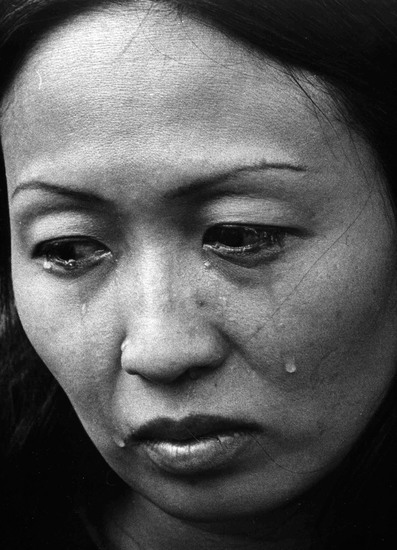
After returning home, he photographed a group of anti-war veterans, South Vietnamese refugees arriving in the United States and other subjects connected to a conflict that continued to shape American society long after U.S. troops withdrew. His work also included a photo essay published in The Philadelphia Inquirer Magazine in 1998 examining the continuing legacy of Vietnam.
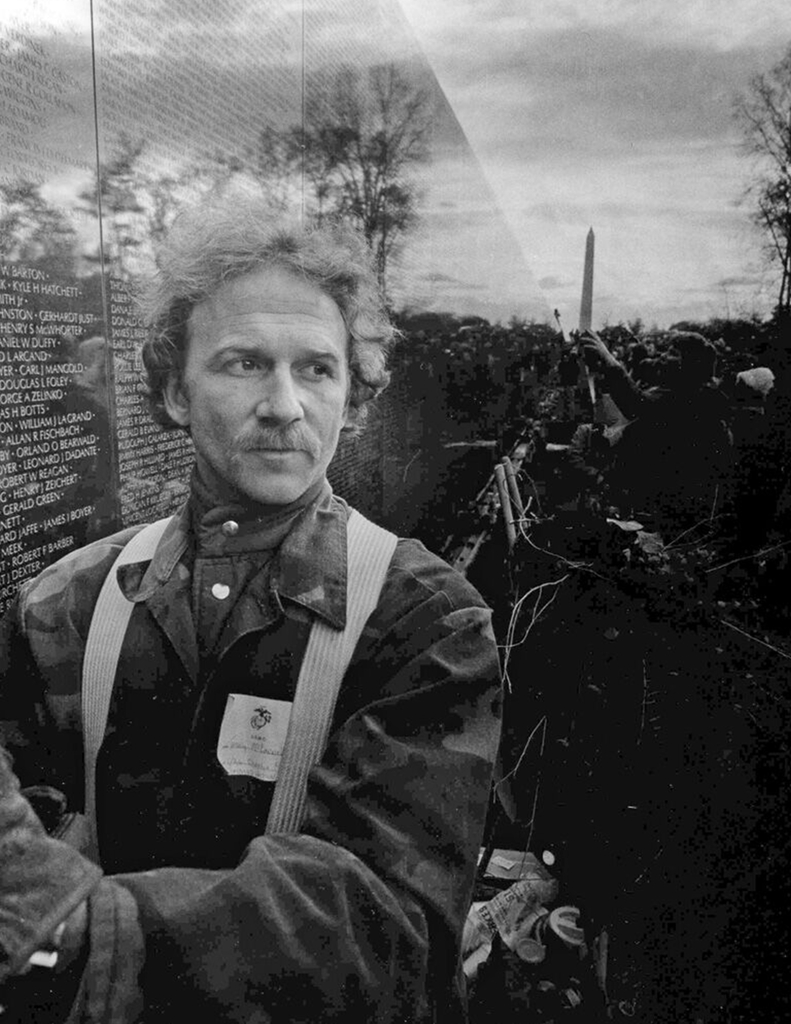
In November 1982, only months after joining the Inquirer, Grigsby traveled to Washington, D.C., to cover the dedication of the Vietnam Veterans Memorial. The event would become one of the most personally significant assignments of his newspaper career.
Designed by Maya Lin, the memorial consists of two long black granite walls inscribed with the names of Americans killed or missing during the war. Its dedication on Nov. 13, 1982, brought thousands of veterans and family members to Washington, including many who had struggled for years with the war’s painful legacy.
For Grigsby, the gathering represented something more than another assignment.
In a commentary published in U.S. 1 on Jan. 11, 2023, marking the memorial’s 40th anniversary, he described the difficult reception many Vietnam veterans encountered when they returned to the United States.
“Many of us came home to a cool or hostile reception,” he wrote.
Unlike the veterans of World War II, Grigsby recalled, those returning from Vietnam often found themselves associated with an unpopular war and the political divisions it had created. Public attention to their experiences diminished in the years following the conflict, while portrayals of Vietnam veterans in popular culture frequently emphasized violence, instability and alienation.
Grigsby also recalled that some veterans of earlier wars were reluctant to accept Vietnam veterans as equals, and that recognition of the psychological effects of combat was only beginning to develop. He described the dedication of the memorial as a turning point.
Vietnam veterans traveled from across the country to participate in a parade down Constitution Avenue, gathering to honor the names engraved in the granite walls. For many, it was a public acknowledgment of service and sacrifice that had been absent when they returned home.
Grigsby was there representing the Inquirer, but the assignment also brought him face to face with his own wartime memories. He had spent months photographing American soldiers under conditions most civilians would never experience. Now he was photographing those who had survived the war, along with the families of those who had not.
The memorial itself offered a different kind of subject from the combat scenes he had photographed in Vietnam. Instead of soldiers moving through dangerous streets or preparing for military operations, his camera captured veterans standing quietly before the names of their fallen comrades.
Some wept. Others searched the walls for familiar names.
As Grigsby scanned the crowd with his telephoto lens, he was particularly affected by older men and women he believed were parents of soldiers who had died in Vietnam. He photographed their faces as they stood before the memorial, recognizing the grief that remained years after the fighting had ended.
“Sometimes their images became blurred by my own tears,” he wrote.
Four decades later, the photographs continued to affect him. In his commentary, Grigsby described how the act of looking at those images could bring back the feelings he had experienced at the dedication.
The memorial had become a place where veterans could remember their experiences and where families could honor loved ones whose lives had been lost. For Grigsby, it also connected the two parts of his life, the young Army photographer who documented the war and the newspaper photographer who returned years later to record how Americans were coming to terms with its consequences.
That connection between the photograph and the person behind the camera has remained an important part of his work.
In 2015, Grigsby was among nearly 50 former Army photographers interviewed for “Unseen Warriors: Army Combat Cameramen in Vietnam,” a documentary produced by Traditions Military Videos.
The project was developed by Ellen Holzman and Meredith Vezina, who had spent more than two decades collecting and distributing historic military footage. They wanted to recognize the photographers who had created the images seen in countless documentaries, television programs and books, but whose own stories were often overlooked.
The documentary drew on interviews with veterans from DASPO, the 221st Signal Company and the 69th Signal Photo Platoon, combining their recollections with photographs, motion pictures and audio recordings.
Grigsby contributed photographs and a sound recording from his military service. The resulting documentary explored not only the danger of photographing combat but also the camaraderie, daily routines and personal experiences of the men responsible for documenting the war.
Many of those photographers were young soldiers who received their training in the military and found themselves recording events that would become part of American history.
Grigsby’s own collection at Texas Tech includes photographs, audiotapes, drawings, personal recollections and materials relating to his assignments in Vietnam.
Among the items are records of his first combat operation with the 25th Infantry Division in February 1968, accounts of the May Offensive and recordings made during fighting near the French National Cemetery outside Saigon. The archive also includes documentation of his later Vietnam assignment in 1969, demonstrating the range of work undertaken by the military photographers.
While much of Grigsby’s career was shaped by those early experiences, his interests as a photographer eventually expanded to subjects far removed from the battlefield.
During his years at the Inquirer, he photographed people, events and places in the United States and abroad, including assignments and travels that took him to Paris, Guatemala and other destinations. He also developed a fascination with Philadelphia’s annual Mummers Parade, which he began photographing in the mid-1980s.
The event offered a striking contrast to the military subjects that had first attracted him to photography, with its elaborate costumes, colorful characters and long-standing local traditions. Grigsby approached the parade as an outsider, interested in documenting the people and rituals behind the spectacle.
His photographs were featured in “Mummers X 2,” a 2020 exhibition at the Trenton Free Public Library that paired his black-and-white images with color photographs by U.S. 1 arts writer Dan Aubrey. The exhibition included 29 photographs exploring the parade from two different perspectives.
Grigsby’s career also included teaching photography as an adjunct instructor at area colleges, sharing his experience with younger photographers. Yet the images from Vietnam remain an essential part of his body of work.
His upcoming presentation at Old City Hall will bring those photographs and the stories behind them to his hometown community. The program will also introduce a book project that continues his efforts to document the conflict and the military photographers who recorded it.
The Sunday Soiree Series brings artists, cultural figures and community members together for presentations and discussions. It was developed through Bordentown City’s Old City Hall Restoration Committee, a volunteer organization dedicated to raising awareness and funds for the restoration of the historic downtown building.
The Veterans Day-related presentation will be held Sunday, Nov. 8, at 4 p.m. at Old City Hall, 13 Crosswicks St., Bordentown City. Admission is free, although donations are welcome. For more information, visit facebook.com/OldCityHallRestoration.
For Grigsby, the photographs are more than a record of military operations or assignments completed early in his career. They document people he encountered, dangers he witnessed and experiences that continued to influence his understanding of photography long after he left Vietnam.
And, as he reflected on the 1982 memorial dedication in his 2023 commentary, they remain connected to a part of his life that never entirely ended when he came home.
In his words, “I had also left a piece of myself in South Vietnam.”