
By R. H. Schmitt Jr.
Trenton, Princeton and Mercer County have long commanded much of New Jersey’s Revolutionary War attention. But just beyond those better-known battlefields, Allen’s Town, Upper Freehold and the surrounding Monmouth County countryside formed one of the overlooked crossroads of the American War for Independence.
As the nation continues this month to mark America’s 250th anniversary, U.S. 1 thought it fitting to steal a glimpse through the colonial historical lens and take, if you’ll allow, a bayonet’s stab at exploring the important role that Allen’s Town Village — Allentown Borough, for all of you modernists — played in that struggle for independence.
We must state clearly at the outset, with regard to this historical reflection — this columnist’s tribute to his beloved hometown and her residents — that we are as mere riders on a dark and galloping charge, bound for a fuller understanding of the place Allen’s Town occupied in the making of a nation.
That ride is meant to carry us back to a time of political upheaval, tectonic shifts in economics, trade and cottage industries, astonishing scientific evolution and medical discoveries, and, perhaps most important to our expedition, the audacious introduction of the idea that a person might live freely in the pursuit of his happiness or, at the very least, up to the limits of his inalienable rights and responsibilities as a private citizen, who would not by nature nor by common sense kneel before king nor kaiser.
If anything is to represent the brass ring to be grasped during our midnight journey backward into the illumination of our own history, it is this: the concept of individual liberty, uttered first on this continent by the humanistic philosopher, inventor, writer and revolutionary Thomas Paine, Englishman, founding American father and author of “The American Crisis.”
Most are aware Paine kept a cottage for himself and a small stable for his horse, Buttons, just a few miles south from here in Bordentown, but the unsubstantiated story that he lived on what is now Church Street, in Allen’s Town, with his niece for a time, also lingers — as so much else does in these parts.
We are at full gallop now, thundering back through time, clinging on astride a somehow familiar historical steed, hurtling breakneck, all a-clatter and dashing in and out of the long-dark village alleys and passageways of the old town, past the familiar Old Mill, yes, but is that a second mill standing close by?
A tannery appears across the way where Sensi Park should be. The blur of neon and electric light left behind in our periphery, giving way now to candles flickering behind the rippled glass panes of taverns, cozy, firelit inns and quartermasters’ offices while modern trustworthy pavement falls away under hoof to unevenly worn highways of packed earth and patched brick, and on, and still striding, and still galloping on, over cobblestone, mud, murky streams of brackish water, out into the great pastures and farmlands dotted with farmhouses and barns cast in distant shadow.
We are some 10 miles from Trenton, 14 miles from Princeton and 14 miles from Freehold. In other words: the crossroads of colonial transportation, business and, eventually, the strategic center point of the American Revolution.
So then, with a final leap over wild, tangled blackberry brambles and the snarled underbrush of the deep green of the forested woodlands, ages gone, and finally, now, pausing, panting, now squinting at unknowable Lenape-Unami Indian trails, faint, barely traceable, in fact, in the glowering dusk, that break off and lead out across the wildlands of western Jersey and disappear, as they are wont to do, into a million stories, tales and fables, we find ourselves well placed — just as Gen. Sir Henry Clinton would find in his attempt to use this area to outflank Gen. George Washington in his later march to New York.
See here, there are at least two Indian paths we could follow, if we’re careful. But the one fading Indian path we want fades in and out among the tall grass and brush alongside a brisk fresh stream we’ve come to call Doctors Creek, which runs right through the heart of Allen’s Town and, if followed far enough east, would lead us out through untamed forests and eventually to the Pinelands watershed and on out to the bright coastal waters of the Atlantic.
We’ve arrived. Welcome to a spring morning in colonial Allen’s Town.
Not far from this clearing by Doctors Creek, we will find that at least two mills, a fulling mill and a grist mill, are already, with the sun barely at full rise, in full daily operation. These mills, founded by Nathan Allen years earlier, are the machines at the heart of all sorts of related, necessary industries in town and nearby, and will come to be owned and operated by Joseph Height, the prosperous Burlington tavern owner of the Stage Coach Tavern in Burlington City.
The prominent family names to be reckoned with at this time included Borden — both father and son — and Rogers.
Although we are most interested in a brief history of colonial Allen’s Town’s prominent role during the hostilities between the Crown and the colonies from 1765 to 1783, it would be difficult to tell that story if we left out what life was like there leading up to the Revolution.
Our challenge is that there is so much more to the story and to the significance of Allentown with regard to the War for Independence than can be included in a short tribute such as this one. Further, we admit our absolute reliance upon wiser, more expert historians who have done much hard work, digging and corroboration amid the historical fog and the usual expected contrarian counterpoints.
Among these experts, chiefly, is noted Monmouth County historian John Fabiano, who has made it his very life’s work to uncover, vet and verify the rich histories of the establishment of historically accurate local and more widespread colonial history and cultural understanding along with his collaborators Anne Garrison and Alice Wikoff, all residents of the Historic Village of Allentown.
The cultural and historical value of their study, originally published in 2001, cannot be underestimated. In addition to that seminal document, Wikoff is well known for her beloved hand-drawn illustrations of the town’s early structures, prominent homes and governmental buildings. These are collected in her book, “A Sketchbook of Historic Allentown.”
After its original establishment in 1706, the village grew to approximately 80 wooden and brick structures, but by the time of our visit, 1756, just as anti-British sentiment is heating up in Allen’s Town, Upper Freehold and Bordentown, the village was the scene of bustling industry.
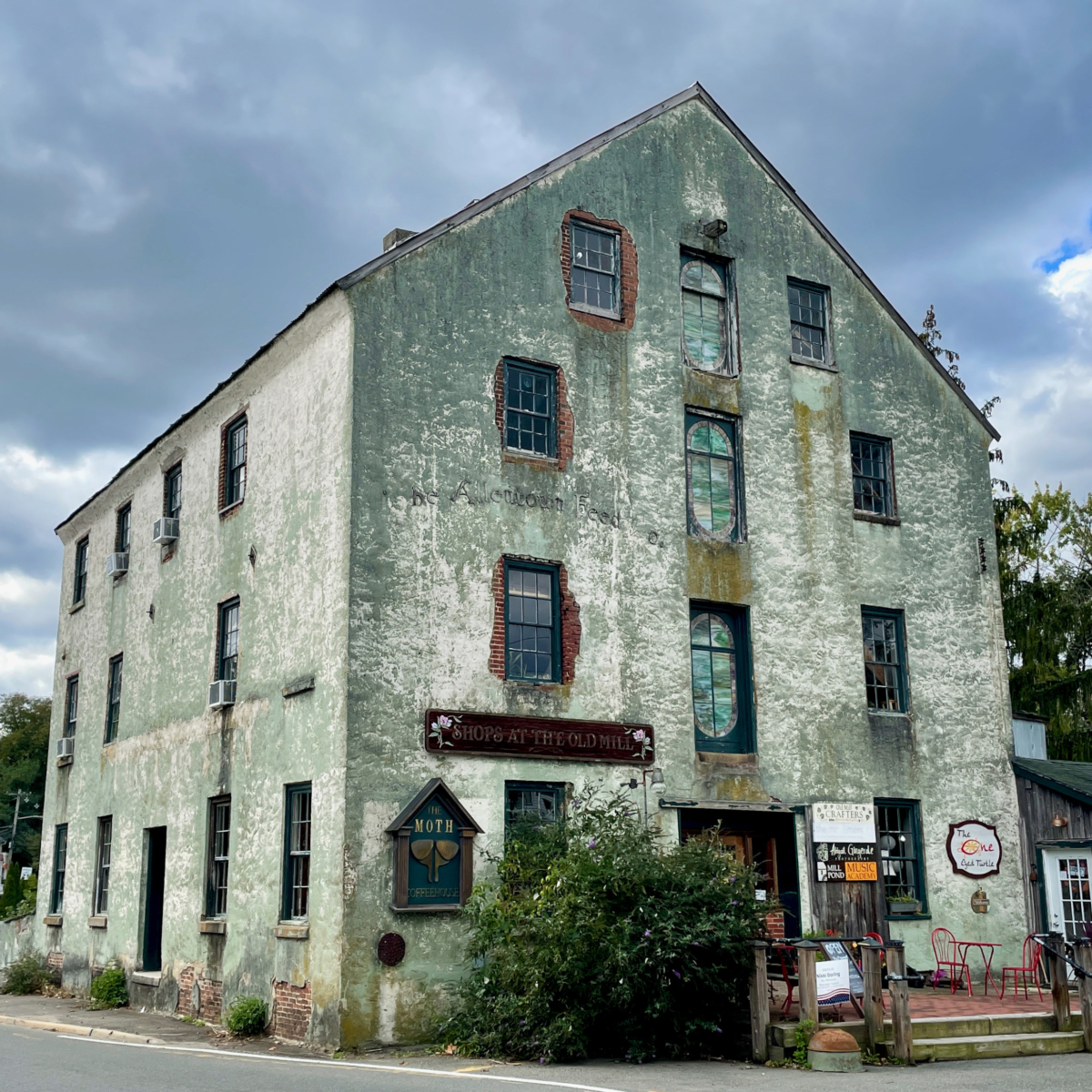
In addition to the mills, there was a tannery, a pork-processing facility, haberdasheries, millineries, no fewer than three busy inns and three smoky, clattering blacksmiths, general dry-goods shops, bakeries and much more.
As the British became more demanding — even turning citizens out of their own homes in Allen’s Town, Bordentown and elsewhere in 1777 and 1778 — those businesses, including that of a bright, patriotic young Allentown lawyer, David Brearly, would contribute significantly to the cause of liberty from the Crown, according to Fabiano et al.
That important work reminds us of the close relationship between prominent merchants in Bordentown, Burlington, Allen’s Town and Perth Amboy, who together controlled travel and trade in the decades before the American War for Independence.
The coming war would bring British soldiers, their now-infamous Hessian mercenaries and loyalists, and the Colonial Army of farmers, schoolteachers and merchants, led by His Excellency Gen. George Washington — late of the French and Indian Wars, where he established both his military prowess and absolute fearless resolve.
But we are also stalking the quarry of Allen’s Town’s place in a new nation’s varied, burgeoning areas of commerce: our perfectly centralized location between New York and Philadelphia, the steadily developing shore towns and the hill country to the north and west, its crucial importance as a breadbasket, and a booming carriage and furniture, equestrian, milling and forge town, complete with wheelwrights, hoopers, brewers and more.
Arguably, however, as the “belt” of the Jerseys, that is the stretch of the Old York Road, or “The Crown Road,” as it was sometimes called, all the way through Allen’s Town and into Bordentown, was a strategic pinch point for both opposing forces, who regularly camped, spied, skirmished and resupplied men and livestock alike at the colonial crossroads.
In addition to Fabiano, Garrison, Wikoff and their contributors, I will, as needed, depend upon other historians, storytellers and amateur researchers as we go along.
Colonial Allentown was a centralized hotbed of a variety of invaluable 18th-century industries that included extensive and varied agricultural contributions, carriage making, furniture manufacturing, blacksmithing, equestrian interests of every stripe, at least one well-regarded doctor and several prominent lawyers, one of whom, Maj. James Imlay, was a signer of the United States Constitution and a member of the United States Congress.
Another was the well-known patriot and legal scholar Col. David Brearly, who, although young at the time, became a United States judge.
Allen’s Town was established in 1706 by Nathan Allen, who built the first mill after purchasing two separate parcels of land from wealthy Scots Quaker Robert Burnett, who first emigrated from England to Perth Amboy in 1690.
Burnett, inexplicably rarely discussed regarding Allentown’s early history, purchased some 4,000 acres east of Doctors Creek. The two parcels that Allen acquired from Burnett consisted of 110 acres on the east side of Doctors Creek. The other large parcel consisted of 528 acres on the north side of Indian Run Creek.
This would enable Allen to set into motion his dream of both a grist and fulling mill. Around that first earnestly planted dream, the small village began to grow.
The prosperous Quaker, Burnett, had two daughters who stayed on in Allen’s Town: Margaret, who married Nathan Allen, and Isabel, who married William Montgomery.
Montgomery, for his part, purchased a large parcel of land in Upper Freehold from his father-in-law. Later incorporated as a municipality within Monmouth County from portions of Upper Freehold on Jan. 29, 1889, the village was notable not only for its central proximity between colonial north and south Jerseys, but also for its taverns, inns, mail depots and stagecoach stops between Philadelphia, New York, the coast and the westerly wildlands very near the Delaware Water Gap.
This, plainly, was Allen’s Town — the very crossroads of the American Revolution. These are plain facts, well-established and commonly discussed among historically minded residents.
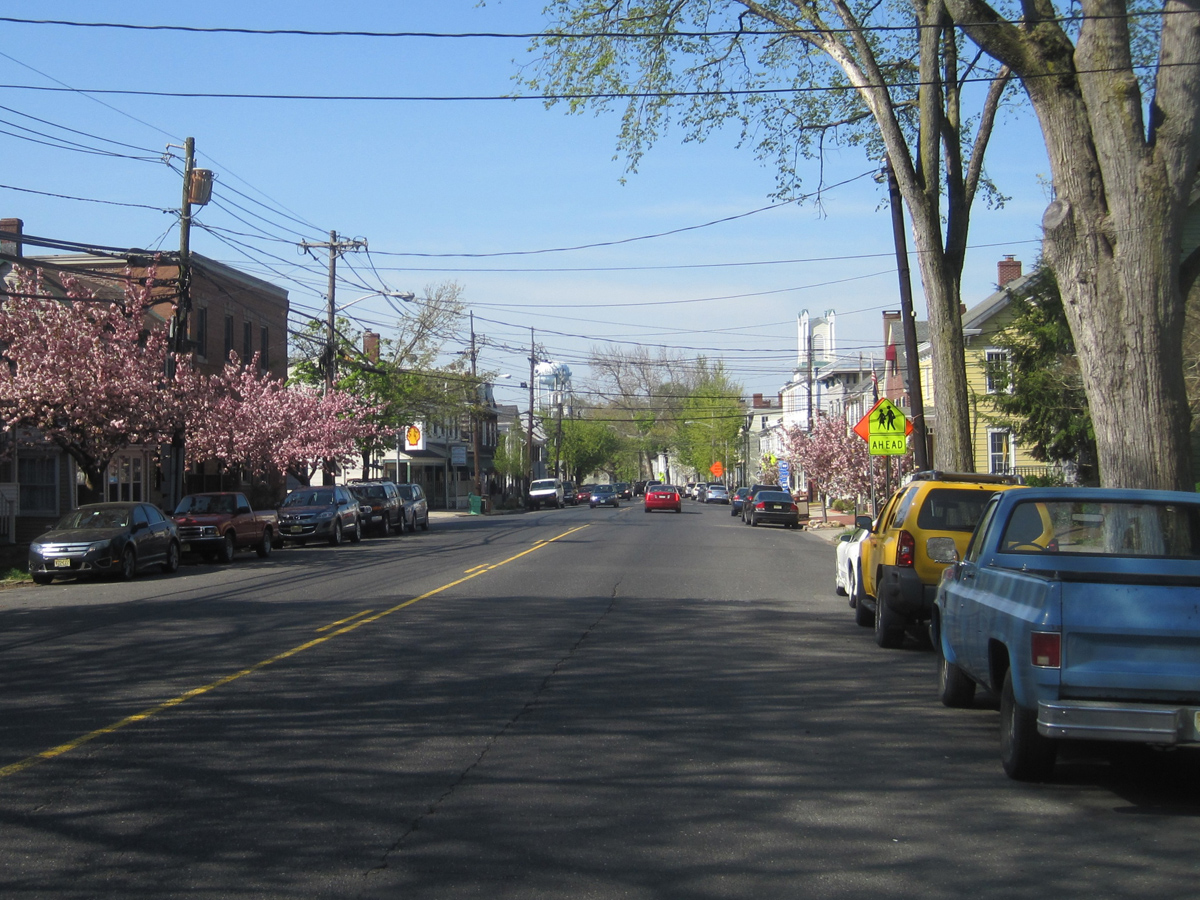
Although the Historic Village of Allentown currently occupies less than a square mile of land, streams, parks and ponds, it is nothing short of astonishing in its contribution, not only to the American Revolution, but to the very founding of our nation.
Alongside such industrious and important neighbors as Upper Freehold Township, Chesterfield — and the Quaker Village of Crosswicks — and Bordentown, a community worthy of volumes in its own right and the traditional home of none other than Thomas Paine, the earlier mentioned British-born philosopher, inventor and radical humanist, often referred to as the father of the American Revolution.
Visitors to nearby Bordentown can visit the Paine monument on the corner of Prince and Courtland streets, a quiet spot offering sweeping views of the Delaware River and only steps away from the River Line station.
According to Fabiano et al., while much of early Upper and Lower Monmouth County was embroiled in open hostilities between factions of Tories — sympathetic to the Crown of King George III — and patriots yearning to establish a new republic, democratically ruled by law, not bloodlines and strategic marriages, Allentown stood out, for better or worse, as a firm, unapologetic bastion of patriotic sentiment and fervor.
Rumors have swirled for centuries that the main carriage stop and inn on the Old York Road, most recently known as DiMattia’s Restaurant, was once a serpent’s den of early Revolutionary spycraft, secret meetings and skulduggery.
Located a mere 10 miles from Trenton and some 14 miles across farmlands to Princeton, Gen. George Washington himself passed through and stayed in Allentown on several occasions.
Both the British and the Colonial armies understood the strategic importance of controlling the narrow belt that the Old York Road represented — a direct run between New York and Philadelphia, as well as a promising point to offer a protective southern flanking guard for both the Second Battle of Trenton and the Battle of Princeton for whichever army controlled it.
It should be noted here that the importance of the study, as an aside to this abbreviated 250th anniversary tribute, such as it is, cannot be overestimated in either its thoroughness of academic research or bounty of sources cited and vetted.
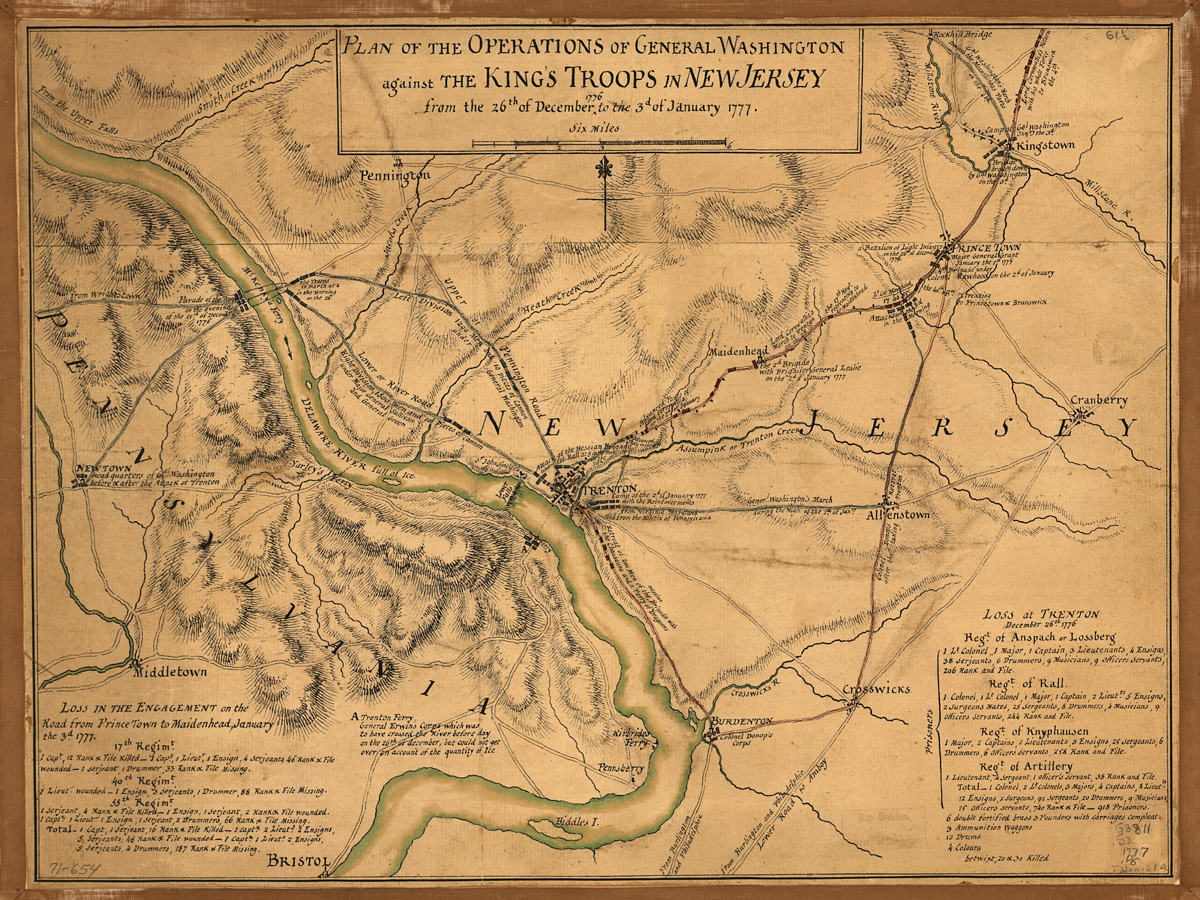
The original document includes comprehensive topographical maps of the territory of Allen’s Town, Upper Freehold and other surrounding areas; both colonial and British troop movements; strategic meetings right in the homes and secret meeting places within the village; corroborating letters; newspaper accounts; lists of common soldiers, officers and their duties; and even quartermaster’s accounting documents of uniforms, rations, ammunition, and the care and feeding of livestock during encampments in and around Allentown.
Within the comprehensive study, there are even unearthed excerpts from a diary kept by a British defector, Thomas Sullivan, who switched sides to join the Colonial Army in the summer of 1778.
In fact, the British Army’s occupation of certain lands in and immediately around Allentown and Upper Freehold has yielded an ever-deepening understanding and historically evidenced treasure trove of information regarding both Colonial and British troop movements, encampments, strategies, and even everyday life of both soldiery and civilians during this turning point in our nation’s tumultuous birth some 250 years ago.
Ongoing America 250 events
Trenton
Cultural Heritage Parade and Democracy Reborn Festival, rescheduled date to be announced: Trenton’s America 250 Parade & Festival was postponed because of extreme heat. trentonnj.org.
City Proclamation of the Declaration of Independence, Wednesday, July 8, noon to 1 p.m.: Mayor W. Reed Gusciora will participate in Trenton’s annual proclamation at 23 S. Warren St.; a second proclamation will be held at 6 p.m.
Freedoms Reframed, ongoing through Sunday, July 26: The 1719 William Trent House Museum presents an art and poetry exhibition on freedom, identity and the Declaration’s promise. williamtrenthouse.org.
Summer Saturdays 2026, Saturday, July 11, 10 a.m. to noon; also July 18, July 25 and Aug. 1: Trenton City Museum hosts free America 250 workshops for children ages 5 to 12. ellarslie.org.
The Crossing, Saturday, Dec. 26: The world premiere of “The Crossing” takes place at Patriots Theater at the War Memorial on the 250th anniversary of the Battle of Trenton. thecrossingmusical.com.
Patriots Week: Battles of Trenton Reenactments, Sunday, Dec. 27, 11 a.m.; also 3 p.m.: Trenton marks the 250th anniversary of the Battles of Trenton with reenactments at the Battle Monument and Mill Hill Park. barracks.org.
Princeton
“Nursery of Rebellion”: Princeton and the American Revolution, ongoing through Monday, July 13: Princeton University Library examines Princeton’s role in the Revolution. library.princeton.edu.
Princeton’s Taverns: On the Road to Revolution, ongoing: The Historical Society of Princeton’s Dohm Alley exhibition explores taverns in 18th-century Princeton. princetonhistory.org.
Five Independent Souls, ongoing through Sunday, Jan. 17, 2027: Morven Museum & Garden presents an exhibition on New Jersey’s five signers of the Declaration. morven.org.
Revolution Sundays: The Battle of Princeton, Sunday, July 12, 1 p.m.; also select Sundays through Oct. 18: Princeton Battlefield Society presents programs on the Battle of Princeton and Ten Crucial Days. pbs1777.org.
When the Declaration of Independence Was News, Sunday, July 19, 2 p.m.: Morven hosts historian Emily Sneff for a program on how the Declaration was first communicated. morven.org.
Listening to the Revolution, Thursday, July 30, 6 p.m.: Morven hosts a free Blawenburg Band concert. Rain date is Friday, July 31. morven.org.
Princeton 1776 Fest, Saturday, Oct. 3: Morven hosts a free community celebration with music, living history, crafts, exhibitions, food and drink. morven.org.
Experience the Battle of Princeton, Sunday, Dec. 27, noon to 2 p.m.: Princeton Battlefield Society marks the 250th anniversary of the Ten Crucial Days. pbs1777.org.
Hamilton
Founding Flavors of Hamilton, ongoing through Friday, July 31: Hamilton restaurants offer historically themed menus, trivia nights and special events. hamiltonnj.com.
Kuser Mansion Tours, Saturdays and Sundays in July, noon to 4 p.m.: Kuser Farm Mansion offers guided tours of the 1892 Queen Anne-style home. hamiltonnj.com.
John Abbott House Tours, Saturdays and Sundays in July, 1 to 4:30 p.m.: The Historical Society of Hamilton Township offers free tours of the circa-1730 house. hamiltonnj.com.
East Windsor
New Jersey and the American Revolution, Thursday, July 16, 6 p.m.: Mercer County Library’s Twin Rivers Branch hosts Brian Armstrong for a program on New Jersey’s role in the Revolution. mcl.org.
George Washington’s Ten Crucial Days, Tuesday, July 21, 6:30 to 8 p.m.: Mercer County Library’s Hickory Corner Branch hosts historian David Price for a program on Washington’s winter campaign. mcl.org.
NJ Needlework, Tuesday, July 28, 6:30 to 8 p.m.: Mercer County Library’s Hickory Corner Branch hosts a program on embroidered scenes connected to New Jersey’s Revolutionary story. mcl.org.
Ewing
Special Screening: “1776”, Thursday, July 9, 2 p.m.: Mercer County Library’s Ewing Branch screens the 1972 film “1776.” mcl.org.
“Alive in Ewing” Cemetery Tours, Sunday, July 12, 2 to 5 p.m.: The Ewing Township Historic Preservation Society presents guided cemetery tours at the 1867 Sanctuary. ethps.org.
Hopewell Valley
Revolutionary War Pension Files, Saturday, July 11, 10 to 11:30 a.m.: Mercer County Library’s Hopewell Branch hosts a genealogy program on Revolutionary War pension files. mcl.org.
Lawrence
Poetry Circle: America 250, Thursday, July 9, 6:30 to 8 p.m.: Mercer County Library’s Lawrence Headquarters Branch hosts a poetry reading and discussion. mcl.org.
Plainsboro
Museum Summer Camp, Monday, Aug. 24, 1 to 5 p.m.; also Aug. 25-28: The Historic Wicoff House Museum offers an America 250 camp for children ages 5 to 11. plainsboronj.com.
Summer History Faire, Saturday, Aug. 29, 1 to 4 p.m.: The Historic Wicoff House Museum hosts a Summer History Faire. wicoffhouseplainsboro.com.
West Windsor
“11 for Semiquin”, Friday, July 10, 7 to 8:30 p.m.: West Windsor Arts hosts an exhibition featuring 11 artists responding to local history and America’s 250th. westwindsorarts.org.
Fall Festival, Sunday, Oct. 4: Revolution West Windsor plans a fall festival at the historic Schenck Farmstead. westwindsorhistory.com.
Bordentown
Joseph Bonaparte Exhibit, ongoing through Saturday, July 18: The Bordentown Historical Society presents an exhibit on Joseph Bonaparte at the 1740 Friends Meetinghouse. bordentownhistory.org.
Bordentown Independence Day Fireworks Celebration, Tuesday, Aug. 4: Bordentown Township’s postponed fireworks celebration will be held at Joseph Lawrence Park. bordentowntownship.com.
Allentown, Upper Freehold and Millstone
Mill Demonstration at Historic Walnford, weekends through November, 12:30, 1:30, 2:30 and 3:30 p.m.: Historic Walnford offers 15-minute gristmill demonstrations. monmouthcountyparks.com.
Other 250 Celebrations
The Crossing: Picturing the American Revolution, ongoing through Sunday, Jan. 10, 2027: The Michener Art Museum presents an exhibition on Washington’s crossing of the Delaware. michenerartmuseum.org.
Liberty Madness, Saturday, July 11, 3 and 7 p.m.; and Sunday, July 12, 10:30 a.m. and 2 p.m.: Thinkery & Verse presents “Liberty Madness” at East Jersey Old Town Village. middlesexcountyculture.com.
Revolutionary Skies, Friday, July 10, 8 p.m.; also July 17 and July 24: Raritan Valley Community College Planetarium presents a Revolutionary War-era astronomy show. raritanval.edu/planetarium.
Redcoats to Rebels, Friday, July 10, 9 p.m.; also July 17 and July 24: Raritan Valley Community College Planetarium presents a British Invasion and American rock laser concert. raritanval.edu/planetarium.
Soldier Saturdays: Hessian Occupation, Saturday, July 11, 11 a.m. to 3 p.m.: Washington Crossing Historic Park hosts a free living-history program on Hessian soldiers. washingtoncrossingpark.org.
Rebels and Redcoats Car Show, Sunday, July 12, 10 a.m. to 2 p.m.: Washington Crossing Historic Park hosts its Rebels and Redcoats Car Show. Rain date is Sunday, July 19. washingtoncrossingpark.org.
Monmouth County Fair, Wednesday, July 22, 4 to 11 p.m.; also July 23-26: The Monmouth County Fair returns to East Freehold Showgrounds. monmouthcountyparks.com.
First Crossing Reenactment, Sunday, Dec. 13, 10 a.m. to 3 p.m.: Washington Crossing Historic Park hosts the first December crossing reenactment. washingtoncrossingpark.org.
Christmas Day Crossing Reenactment, Friday, Dec. 25, noon to 3 p.m.: Washington Crossing Historic Park holds its annual Christmas Day crossing reenactment. washingtoncrossingpark.org.
