In “Fight in the Museum,” artist and columnist Thomas Kelly interviews area artists to gain insights on their art, their process, and the struggle to make a living as an artist. Starting this week, the column will run semi-regularly in U.S. 1.
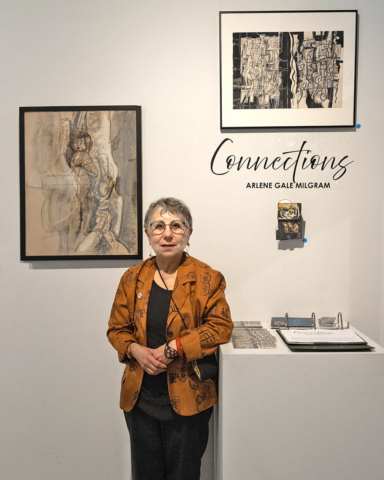
Arlene Milgram is a mixed media artist, a mark maker, and makes what most would consider to be abstract art. She has an exhibition up through June 5 at Artworks Trenton.
Arlene’s work is personal. It is full of energy and emotion. She works in many media, but the work is still hers. Milgram speaks about the marks she makes are about her, her force, energy and drive. And she is right.
When in your art career did you decide to go into the abstract?
It was never a conscious decision; more of an evolution. Tyler School of Art at Temple University taught Renaissance painting techniques when I was there. My early work was figurative leaning towards semi-abstract, very painterly and often loosely based on photos.
Although I usually work abstractly, I still draw from life all the time, and often do self-portraits. Also, I keep an occasional cartoon journal. My abstract is often read as figurative or landscape. What reads as abstract in my current work is very real to me.
The marks I make in my work are a picture of the thoughts I have as I process my life experiences.
Which media do you use and why?
As many media as possible and why not? I love to experiment with different media and learn new processes. Lately I have been focused on works on paper (drawing and collage) and watercolor (sometimes with collage or markers). When something doesn’t work, I add another media. I believe in re-purposing my old or failed pieces into new ones. I hate to give up so I will rip, sew, collage, over-paint, anything to find a resolution. Along with re-purposing work I like to use found objects as well.
Different bodies of work center on drawing, collage, watercolor, acrylic, oil, collage, printmaking, encaustic, and assemblage. I go from one to the other.
What are you communicating with your art?
In my statement I wrote that, “I am the marks I make.” My work is personal.
I hope I am communicating my energy. I make art to process my feelings about the world and how it affects me. It can serve me as an exorcism, a meditation or a celebration. I don’t presume that the viewer feels the same thing.
I do hope that when someone sees my work they can see their own feelings in it. In other words, what is personal can also be universal. Abstraction allows for that.
Do you make preparatory sketches?
I draw all the time. I often use sketch book work in collage, but when I draw or do watercolors, I just go for it. I often start a few works at once, so in a way that is what preparatory sketches can do.
Do you decide on color strategy first before starting?
I start with a color idea, not sketches. When something doesn’t work, I change it. I like surprises and discovery. I don’t want to know the end in advance. For me, it is all about the process. If I ever achieved perfection, I’d have to stop.
There is a found quote in one of my assemblages that states: “Let an error slip by like some treasure.” I don’t know who said this, but to me the treasure is in what slips by. The error is the treasure because it is the motivation for change. It is imperfection that pushes me forward to keep trying new solutions.
How has winning a coveted NJ Arts Fellowship impacted your work and outlook?
First and most important to me was validation. I entered unsuccessfully every year since I found out about these grants. It meant a lot to me to finally get it. This grant allowed me to buy supplies, frame art, enter more exhibits, join more art associations and take more classes without even considering the cost.
I took multiple printmaking classes at Frontline Arts and Artworks Trenton. I went to Kingston, New York to R and F Paints to explore encaustics in their studio. I’m very thankful for that grant.
The fact that I continue to work after it proves it taught me that I should invest in my art.
Who were some of your early influences?
I attended School Art League classes in Philadelphia every Saturday from the time I was in fourth grade through high school. In junior high, I added late afternoon classes at Fleisher Art Memorial. I also went there every Friday night for life classes. I took summer classes at the Philly Art Museum with Sidney Goodman, and at PAFA. Also with Neil Leiberman at Bucks County Community College.
Mr. Leon Cohen was among the best teachers ever. I modeled my approach as a teacher after him. While in high school, I had the opportunity to do a lithograph that was published and traveled to the Metropolitan Museum and the Smithsonian Institute. The Philadelphia school system at that time was at the forefront of art education. There were many opportunities to show work and win prizes. I got to see a lot of art.
My parents took me to museums when I was young and later, I would go to Philly and New York museums with friends. Artists who influenced me then were impressionists to abstract expressionists. I loved Van Gogh, Gorky, Munch and Mitchell and Rothko and Neel. Although I went to Tyler in the late sixties, I was not open to new movements at that time. My taste now is far more eclectic.
What fight/struggle do you have regarding your art?
Before I retired, I would answer, space and time. Now I have time. With time comes far more output and space remains the biggest problem. Not just space to work, but space to store so much work. Because I use old work in new work, I keep it all.
Size is limited too because I have a small space. I work on a drawing table in my living room, on the kitchen table or on the floor of a small space surrounded by bathroom, bedroom and closet doors. Upstairs bedrooms are storage rooms. Physically, I am lucky to be able to get up again when I work on the floor, though now I creak. I enter less and go to fewer openings because I am not always comfortable driving at night. All are small complaints. I have come to terms with no longer expecting major museum shows.
I guess my work is for a select audience, so I also don’t count on sales. I really create because I need to in order to function. Making things gives me space for my energy, its a repository for my worries and gives focus to my life. That is enough.
How do you decide which media to use for a piece?
That depends on what is available, my purpose in the piece, and just how I feel that day. When something doesn’t work, I reach for something else and keep trying things until I find resolution.
What is on the horizon? What are you looking forward to?
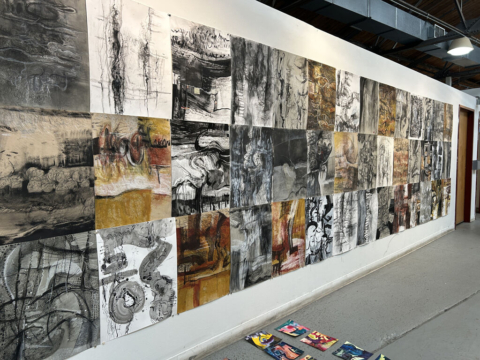
I am really excited about my show at Artworks Trenton this May. Addison Vincent is a great curator and the way he presented the work is an art in itself. The theme is Connections. It connects my work from the last few years across media. We mounted many pieces in a mosaic arrangement, and each piece gets energy from the others.
It is thrilling for me to see it all together. My proudest take away from this is that it doesn’t look like it was made by an old lady. I’m looking forward to what comes next.
Online: www.arlenegalemilgram.com.