Seeing a textured play that delves deeply into characters, weaves several ideas deftly, and provokes genuine thought has become a rare thrill.
Plays like Tennessee Williams’s “Cat on a Hot Tin Roof,” realized in a stirring, eye-opening production at New Hope’s Bucks County Playhouse through May 23, and Arthur Miller’s “Death of Salesman,” also revealed in new aspects in a moving Broadway revival, epitomize the majesty theater can yield. Compare to the 90-minute polemic wonders of the 21st century — you know the ones that meander through usually bland conversation until they get to the single heavy-handed scene that constitutes the playwright’s apparent self-conscious intention — “Cat on a Hot Tin Roof” and “Death of a Salesman” announce themselves as monumental works of art, examples from a time but germane to all times. They exude craft, intelligence, and knowledge of human situation that are almost invisible in current theater.
I miss Tennessee Williams and Arthur Miller. I miss their scope, their encompassing breadth of outlook, and their ability to express important ideas without preaching to their audiences, relying on fashionable politics for themes, or settling for two-dimensional characters when the history of theater from Aeschylus on demonstrates depth is possible.
Call me old-fashioned, but I would sit for three hours over and over again to watch Eric Rosen’s stunningly immediate and all-embracing production of “Cat on a Hot Tin Roof” in New Hope or Joe Mantello’s original approach to “Death of a Salesman” at New York’s Winter Garden Theatre. Rosen and Mantello, with the help of uniformly excellent casts, restore faith in what the theater can do. They rekindle a glory that seems sadly lost as new playwrights tend to use wit, assuming they have any to use, instead of incorporating it within the large contexts Williams and Miller are capable of conceiving and putting on a stage.
Tell me. What new play by what playwright do you look forward to seeing? Tom Stoppard’s recent death leaves us with no Pantheon playwright — maybe Jez Butterworth — whose works matter much. The best of today’s most produced and lauded offer incomplete work that may have some merit but never completes the circle of thought and depth that the likes of Williams, Miller, Eugene O’Neill, Lillian Hellman, William Inge, or their British counterparts of 70 years ago did.
In Eric Rosen’s clear, compelling “Cat on a Hot Tin Roof,” the Bucks County Playhouse and Winter Garden Theatre are not only presenting and preserving American theater at it best, they are also proving how vibrant the classic American plays of the mid- 20th-century are. How they realize the intrinsic drama, emotion, and humanity theatre can provide.
Stand up where you are and applaud for Rosen and his sterling cast of Lucas Dixon, Elizabeth A. Davis, Wayne Duvall, Tony Roach, Kate Levy, Bree Elrod, David Sitler, Gene Gillette, and Caterina Marchese.
Notice there is not one name in this company that you associate with a star — for now — yet this remarkable, intelligent ensemble managed a champion-worthy feat. They rendered the brilliant but stylized and repetitive poetry of Tennessee Williams’s dialogue, each line of which moves “Cat on a Hot Tin Roof” forward, as conversation, as slice of high-stakes life.
Through all the talk of stained-glass windows, 2,800 acres of the richest land west of the River Nile, spastic colons, Europe as one big fire sale, sexless marriage, alcoholism, mendacity, avarice, and greed, Dixon and Davis lead a troupe that makes everything they say genuine and urgent. Williams shines through, but Brick, Maggie, Big Daddy, and the entire Pollitt family, make their cases, hurl their accusations, express their regrets, and tell the Bucks audience all it needs to know about the myriad topics Williams chooses to explore, thoroughly and dramatically.
Eric Rosen and his cast are in tune with every beat, every thread, every argument, and every counter-argument Williams’s rich script gives them. From Davis’s entrance as Maggie until the lights go down when Act Three ends, not only Maggie the Cat, but all of the doings on the Polllitt plantation on the occasion of Big Daddy’s 65th birthday, are alive. Alive!
Rosen’s production doesn’t flag for a moment. More than that, by adding language Williams could not use on stage in 1955 and facing shadowy matters more directly, Rosen’s “Cat” becomes the exemplar of a favorite American theme, a family gathering in which all linen, dirty and otherwise, comes to the fore.
Rosen uses all of “Cat’s” three hours to illuminate all that is happening. He and his company never flinch at anything they must say. Better yet, they rivet you in a way that, to borrow from Miller’s “Salesman,” attention must be paid.
Full attention. Invigorating attention. Three hours go by like the express train from Princeton Junction to Penn Station, NYC.
I have seen “Cat on a Hot Tin Roof” about 30 times, and its movie version about 30 more. (Favorite productions — Elizabeth Ashley’s in 1974, Kim Cattrall at McCarter, Sanaa Lathan with James Earl Jones in London, 2009.) Rosen’s production does something I’ve seen in no other.
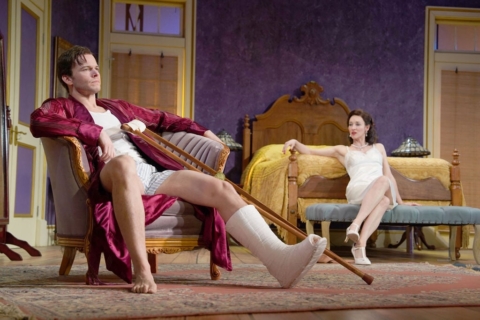
It moves silent, resistant, secretive, unresponsive Brick to center stage, and Lucas Dixon relishes the moment and makes it pay. Dividend after dividend.
Brick is the character on stage the most. Maggie, which seems to be a lucky part for women named Elizabeth, and Big Daddy are keepers of the major drama, but Brick is integral to every scene. His fitness to run or take part in running a major agricultural property, his lack of desire to have sex with a beautiful woman he admits is the “best” in bed, his nagging guilt over a best friend lost to alcohol and inability to cope with a truth that would be taboo in 1955, his descent into laconic alcoholism, and him being the son both his parents favor, is the crux of “Cat on a Hot Tin Roof.”
Eric Rosen lets Brick be that crux.
Oh, Elizabeth A. Davis, Wayne Duvall, and Kate Levy as Maggie, Big Daddy, and Big Mama don’t surrender the stage to Dixon.
But they don’t dominate it. They share it. As would happen when a family meets.
Rosen’s contribution and Dixon’s abundant talent just put the family conflict on an even keel.
Often, actors playing Brick on stage, fade into the background. Maggie, Big Daddy, and Big Mama have the words, set courses, lead conversations, and eke out whatever information Brick is willing to offer.
Lucas Dixon is integral to every scene. His smiles, grimaces, posture, a way of using Brick’s crutch as weapon or symbolic support is, speak volumes that match all Davis, Duvall, and Kate Levy are doing.
And they do a lot. This cast doesn’t waste one morsel of “Cat on Hot Tin Roof.” They are complete because Dixon adds so much. He always tells you what Brick is thinking. Even in sequences when Brick is working to ignore the blather around him and waiting for the comforting click in his head his chosen whisky, Echo Springs, provides him, Dixon stays present and part of the proceedings.
Elizabeth A. Davis also maximizes all there is in Maggie. At her entrance, the play’s first entrance, Davis lets you Maggie’s sexiness, perceptiveness, brainpower, and intolerance for the rude, noisy, and no-necked. In every encounter, Davis’s Maggie can stand on her own and prevail. She’s even done the research to learn how to conceive a child with a man who won’t do his part in their process.
Davis provides the great line readings and movement that mesh so well with Dixon’s facial expressions and body language. She is a Maggie for the ages, right up there with the best I’ve seen.
Remember Elizabeth A. Davis. She will be a star some day, And soon.
Wayne Duvall has Charles Durning, Fred Gwynne, and Pat Hingle, not to mention James Earl Jones to follow as Big Daddy, and he, like Dixon, does one thing that differentiates him from those Pantheon actors. He makes you see Big Daddy as man of many experiences who has learned from those experiences. He does not rely on volume, fuss, and his achievements. Duvall’s Big Daddy can take person-to-person with his son, showing his concern and a sincere desire not only to help Brick but to make Brick the heir he so much wants him to be.
Kate Levy follows this production’s suit by being a Big Mama that is believable in all ways. When Levy tells Maggie, “the rocks are here,” you see a knowing Big Mama and not just a foil for Big Daddy or someone the other can make easy fun of.
Tony Roach is a cosmopolitan rather than Tennessee provincial Gooper. He does not have a lot to do, but he is clearly sophisticated, well-heeled, and competent in Roach’s hands.
Bree Elrod finds the cattiness in Mae, delivering her zingers with natural but pointed precision while making the case that as plotting and condescending as Mae is, she has logical ground to stand on.
David Sitler is slimily unsubtle and obsequious as the covetous Rev. Tooker. Gene Gillette shows the tact and professionalism of Dr. Baugh. Caterina Marchese finds way to annoy enough for the five no-necked monsters she alone represents.
Jack Magaw’s set is beautiful and shows taste and well-placed examples of fire sale items to which Big Daddy refers. Annie J. Le’s costumes are perfect, acknowledging a sense of occasion while suiting the characters wearing them. I like that she did not exaggerate Mae’s pregnancy and dressed Gooper as a country gentleman and not a stuffy lawyer. I was not happy with Big Mama’s dress, thinking black the wrong choice for one aspect of Williams’s play, but it fits the fashion of the 1950s.
Kat C. Zhou and Jane Shaw did wonders as the respective lighting and sound designers.
Zhou worked magic with the lights in Maggie and Brick’s room and found varying ways to show fireworks and other effects that enhanced Rosen’s production. From the knock of croquet balls to an array of fireworks sounds and off-stage screams from Gooper and Mae’s children, Shaw filled the stage with appropriate and welcome sound.
“Cat on a Hot Tin Roof.” Through May 23 at Bucks County Playhouse, 70 South Main Street, New Hope, Pennsylvania. Shows 7:30 p.m. Tuesday, Thursday, Friday, and Saturday; Wednesday, Saturday and Sunday 1:30 p.m. Tickets ($37 to $86) at bcptheater.org. Phone: 215-862-2121.