A riddle: How was the opening night of Lin-Manuel Miranda’s “In the Heights” at Bristol Riverside Theatre reminiscent of a football game?
The answer: The first act was unfocused, with impressive movement but loose storytelling, no obvious place to look, uneven acting, and wretched sound design that drowned out lyrics and dialogue, the fuzzy lyrics being a major factor considering Miranda writes in a fast hip-hop that requires clear comprehension for his musical to take hold.
The second act began and all problems seemed miraculously solved. The sound was moderated to a level that made all comfortably intelligible. The acting became sharp, the hip-hop rhymes clear. The dancing looked pointed rather than random. An atmosphere was created that completely reversed pre-intermission feeling of chaos.
Back to the riddle. I can’t know this for a fact, and, despite having the urge, it would have been rude to ask anyone at Bristol on the “night of…,” but the reason the opening night at Bristol reminded me of a football game is it looked as if some power-that-is went backstage during intermission and read the riot act to the cast and tech crew.
The situation was probably not as dramatic as I picture, and perhaps, I’m dead wrong about how the marked difference between acts came about, but somehow the cast got religion following intermission and played with more discipline, more of a will to engage the Bristol audience by performing to them and not at them. Adjustments ensued. The dances that sprawled past cohesion became jubilant and fun as well as lively. Genuine emotion and concern for the characters was able to emerge. A theme developed. The overly hot sound that obliterated lyrics relaxed to a level that was perfect. “In the Heights” was rescued. Back from its break, what looked to be a well-intentioned but scattershot mess transformed itself into the delightfully enjoyable show “In the Heights” should be.
Of course, the lasting riddle is which “In the Heights” will be on stage between now and April 27.
My guess is the sharper one signified by opening night’s second act. However it happened, the Bristol cast corrected all of the flaws that marred the first act of the performance I attended. That lesson, I hope, will be the guiding one. It’s obvious that cast can hone in on what’s important, that choreographer Luli Brindisi’s spirited dances can have needed definition (and not just look like movement for movement’s sake), and that Ryk Lewis’ sound design includes a sweet spot where volume and audibility work in proportion. (Frankly, overamping is the bane of many 21st century musicals. Until they prove otherwise, I regard most sound designers as villains of the age.)
In addition to me suspecting some coaching between acts, there are reasons why “In the Heights’” second act might play better than its first.
The first act is one of introduction to the characters, their individual plot lines, and their place in the overall story of a busy but close-knit community. The second brings these separate stories to a head. There are fewer group scenes with the entire cast on stage and less need to explain each situation. They’re already established.
This leads to more sequences in which two characters are resolving issues between them, expressing a feeling, sharing dreams, or arriving at a decision. The greater intimacy and closer focus of these scenes make it easier for them to grab and maintain traction. They are not subject to the distraction likely in passages when characters talk over each other to make their presence felt or opinions known.
These smaller yet more poignant takes give director Carlos Armesto’s actors the chance to display more of their characters’ personalities, more facets that add depth and texture to Miranda’s music and Quiara Alegría Hudes’ book.
Performers like Jessy Gruver, Victor Rodriguez, Jr., and Suzanna Guzmán, especially the continually perfect Gruver, were able to overcome the muddied pace of the first act. Being able to play scenes in a small space and concentrate on a single matter allowed Paula Gaudier and Wesley Hodges, a couple whose romance is threatened by parental disapproval, to open up and give their characters more intensity, which earns them more empathy and audience support.
In the first act, the relationship between Gaudier and Hodges looks comme il faut, another plot idea tossed off among a dozen Hudes supplies. Gaudier’s character’s angst about a disappointing year in college also suffers in the brisk give-and-take of the first act. It can’t manage to get its due, even when Jessy Gruver, playing Gaudier’s mother, steps in to give some authoritative weight to a scene.
The second act seems to offer “respira,” an opportunity for actors and their characters to breathe and make the purpose of their scenes more impactful.
The character, Abuelita (little grandmother), has been an audience favorite since “In the Heights” was first produced in 2008. Her story line prevails in Bristol’s first act, but it takes on special resonance in the second act. Not only because of what happens to the character but because the Bristol cast seems more aware of how to frame the later scenes.
Abuelita also earns affection in the first act because Suzanna Guzmán, whose bio reveals her to be an experienced and well-traveled operatic mezzo, is the first to defeat the sound debacle by giving a clear, strong performance of “Paciencia y Fé” (“Patience and Faith,” words that will resonate even more during the closing scenes of Armesto’s “In the Heights.”)
Guzmán’s rendition galvanizes in a way that nothing before it was able to do, mainly because she could take center stage and bring the audience into a song without an overload of stage business bursting around her.
The sloppiness of the first act actually loses some characters some status. As noted, Jessy Gruver and Victor Rodriguez, Jr. are good at overcoming the commotion surrounding them. Other characters, including the lead, Usnavi (Daniel L. Melo), his cousin, Sonny (Elijah Pearson-Martinez), and the three beauticians who know everything that’s happening in Washington Heights, get too subsumed in Armesto’s constant flow of traffic to establish themselves as more than featured players.
Melo is a victim of the poor sound. The opening number of “In the Heights” has Usnavi introducing himself and all of the community’s main figures and interesting denizens, but if the amp’s errant volume botches the clarity of his words, Melo can’t set the scene as securely as Usnavi must. Hence, it was hard to keep track of who was who and what Usnavi has to say about them. (Luckily, I know every word of the opening song. If I didn’t, I’d have been lost from the start.)
Two other victims of the first act confusion were choreographer Luli Brindisi and actor Sonya Hernández, who played Vanessa, a beautician who has visions of a classier life in lower Manhattan and is Usnavi’s principal love interest.
Brindisi’s dances explode with life, but sometimes in the first act, they seem more in the way than integral to the proceedings. A handy comparison is the big numbers in the first act versus the thrilling “Carnaval del Barrio” in the second.
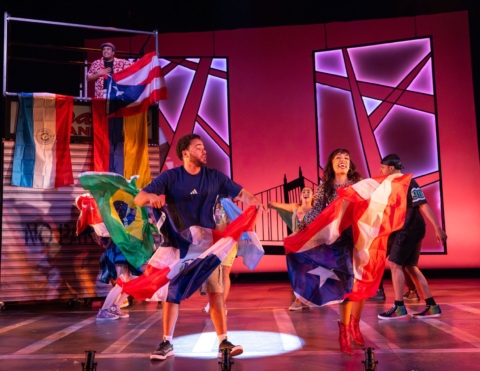
Production numbers in the first act have so much going on, you don’t know where to look. It’s exciting when the dance ensemble — Veronica Carolina Leite, Keith Livingston, Shannon Sharpe, and Shan Williams II — leaves the stage to undulate in the aisles next to where the audience is sitting, and kicky when lights strung throughout the orchestra flash in rhythm, but all the motion lacked on important thing, cohesiveness. “Carnaval del Barrio” appeared to be much more finished, incursions into the audience and flashing lights augmented by dancers brandishing the various flags of the Latino countries that populate Washington Heights making sense instead of just seeming like a good idea, the dance registering as something special rather than something that is self-consciously grand.
When given the chance to state her case about wanting more than Vanessa can find in Washington Heights and to ponder how serious Usnavi is about his and Vanessa’s relationship, Sonya Hernández is terrific. She creates depth that is too often missing from the stage unless Jessy Gruver shares it. Instincts tell me Vanessa’s part was cut in this production. (It might be faulty memory.) Even if it was, Hernández made me believe and become interested in Vanessa’s dreams in ways other characters could not. She took the spotlight when it was offered. I wish it was offered more.
Please don’t think the cast of “In the Heights” is in any way wanting or not up to doing Miranda and Hudes’ show. The adjustments it made between acts show their mettle.
Jessy Gruver gets highest marks because even when the first act was going off the rails, she could bring it into clear line as the reasonable, no-nonsense owner of the barrio’s most successful business. Victor Rodriguez, Jr. abetted Gruver by being stern of purpose in his scenes. Suzanna Guzmán was consistently charming, but I wonder about Armesto giving her Abuelita some business that goes against the impression we should have about her health.
Sonya Hernández is lucky to break out and have moments that show the depth she can give Vanessa. Chelsea Zeno and Cami Taleisnik are entertaining as her beauty shop sidekicks.
Daniel L. Melo is a likable Usnavi, but in this production, other characters dominate, perhaps because Melo is generous enough to grant them the stage. (Only Abuelita’s story, and the fate of a car/taxi service garner full attention.) Elijah Pearson-Martinez is appropriately goofy as Sonny, and I liked that he did not use much of an accent, indicating he was younger and learned English in a more natural way than older characters might have.
Paula Gaudier and Wesley Holmes have to wait until the second act before their characters have the opportunity to be seen with total clarity. They make the best of that chance.
Facundo Agustin could sell me a piragua (cherry, please) any time. Keith Livingston seems authentic as Graffiti Pete. Leite, Livingston, Sharpe, and Williams are exhilarating.
What Meghan Jones’ set lacks in opulence, it gains in versatility, giving Brindisi lots of room to set his dancers twirling, fast-stepping, and moving those hips. Linda B. Stockton’s costumes were hit and miss but evoked enough of “In the Heights’” setting. J.D, Hopper’s lighting was quite inventive and filled parts of the theater often neglected. Ryk Lewis was misserved by too high a setting in the first act. Once corrected, his sound plan was fine.
In the Heights, Bristol Riverside Theatre, 120 Radcliffe Street, Bristol, Pennsylvania. Through Sunday, April 27. Wednesday and Thursday, 7:30 p.m.; Friday and Saturday, 8 p.m.; Wednesday and Saturday, 2 p.m.; and Sunday, 3 p.m. $57 to $71. www.brtstage.org or 215-785-0100.