Sometimes all the news that matters is the news that brightens up a day, and no news reporter does it better than the cartoonists who know how to encapsulate a thousand sly words of wit into a single image.
Some past communication with Trenton Free Public Library Trentonian archivist Laura Poll brought up the thought of several Trenton Times cartoonists who have brightened up our times and are worth remembering.
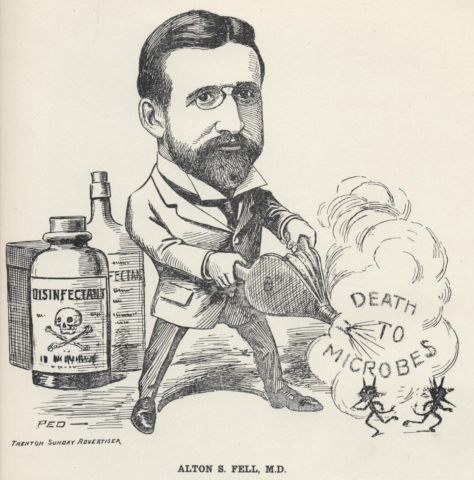
The one whom Poll brought up was William Pedrick (born February 28, 1868, and died August, 11, 1927).
Poll, who studied art before becoming an archivist, says she became acquainted with Pedrick during her work in the Trentonian archives — which date back to a collection of books presented to Trenton by Benjamin Franklin.
As Poll notes, although born in Mt. Holly, Pedrick “devoted most of his life to the study of American history which centered on the Trenton area before his life was cut tragically short. At age 59, he left behind an enormous portfolio of work that celebrated the personalities and events of the City of Trenton. Well known throughout Trenton in his day, his paintings hung in the State Capitol, City Hall, the Courthouse, and other public buildings.
“After studying at the National Academy of Design in New York and attending the Pennsylvania Academy of Fine Arts in Philadelphia, he returned to New Jersey and set up a studio on East State Street and then at the Masonic Temple in Trenton. There he created pen and ink caricatures of notable local politicians and personalities that graced the pages of the Trenton Sunday Advertiser and his own Acme Magazine. While portrait painting was his favorite branch of art, he was also a well accomplished landscape artist, specializing in scenes depicting the role that Trenton held during the American Revolution.
“A founder of the Trenton Arts Society and the Trenton Art Alliance, Pedrick strove to make an art museum possible in the City of Trenton. As an organizer of the Trenton Fair Art Club, he helped choose a painting of an outstanding artist each year to be placed in the municipal collection with the goal of making Trenton a place of recognition in the world of art. He was on the advisory board at the School of Industrial Arts for more than 20 years, and a Member of Committee to promote Industrial Art in Trenton.”
Her comments got me thinking about two more recent Trenton Time cartoonists whom I recall from my time working there.
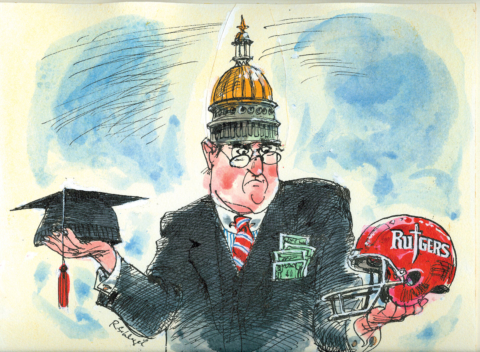
One was Ralph Schlegel, who told me during an interview several years ago, “I am a product of my background and have a feeling of right and wrong as I see it. I approach things from that point of view, and I act on it.”
Schlegel devoted more than 30 years to teasing, enlightening, or even enraging area readers by creating more than 1,500 editorial cartoons for the Times of Trenton. He retired two years ago.
He also provided illustrations for U.S. News and World Report (the cover), the New York Times, Business Week, Readers Digest, and more. It is a small sampling of a big output.
“I do pictures for advertising, editorial, and publishers,” said Schlegel of his work. “I was a freelancer and things worked out well. I am locally a political cartoonist; other places I’m an illustrator.”
Schlegel was fast to explain the difference between the two. “As an illustrator, you’re working with other people to put forth an idea by another person. If you are an editorial cartoonist, you’re on your own. If the client doesn’t like, they don’t buy it. I get an idea and submit it. They either take or they don’t,” he said.
Schlegel said there is a key to making an effective editorial. “You have to make a statement. And you have to be articulate. If (the artist) can’t get an idea across, it’s worthless. You have to have the graphic ability to make it work.”
Calling himself a “left-leaning moderate,” Schlegel said, “I am not a hardcore ideologue in any way. I have an open mind.”
About his drawing style, Schlegel told me, “I like things to look sketchy. It may take a day or two, but I want it to look like I just sat down and did it.”
Schlegel’s interest in illustration came from his father, who was a graphic artist for Paterson Parchment Paper. The company created decorative wrappers for major food companies. As indicated by the name, the company was in northern New Jersey, where Schlegel was born. When the company moved to Bristol, Pennsylvania, his family followed, and the young illustrator spent his formative years in Langhorne and Morrisville.
He said, he “always thought in images” and mixed pictures with language to convey a message.
After a two-year stint in the Army during the early 1950s and working a variety of jobs (including the U.S. Steel maintenance shop), the 22-year-old Schlegel decided that he needed a trade, took advantage of the GI bill, and attended the Philadelphia Museum School of Art (which became the Philadelphia College of Art and is now the University of the Arts). In those days the courses were more basic. “It was just drafting and painting and drawing and art education if you wanted it,” he says.
During that time he also came across an illustrator who helped set a standard that he tries to maintain: the early 20th-century German pen-and-ink satirist Henrich Kley.
In the 1960s Schlegel landed a job as an artist in the Philadelphia Evening Bulletin’s promotion department. There he met and married his wife of 55 years Sharon Ribner, better known to the region as the late Times of Trenton writer Sharon Schlegel.
It was in 1981 — when the Times of Trenton was the more plainly stated the Trenton Times — when Ralph Schlegel’s editorial career started with a cartoon dealing with the New Jersey State Police. As he recalled, “I don’t know what happened. It sort of evolved.”
No matter how it developed, Schlegel added editorial cartoons to his freelance services “I had a ball with it all. There may have been some down moments, but no one said there were editorial boundaries. I am happy with my career. I came along at the right time. I saw the best of it. I did the best I could. I was very proud. If I had to start today I guess I couldn’t because things are different. But I’m pleased with my career.”
The cartoonist whose current address is Yardley, Pennsylvania, drew his last lines for a September 30, 2011, issue — the topic was the recall of Trenton Mayor Tony Mack.
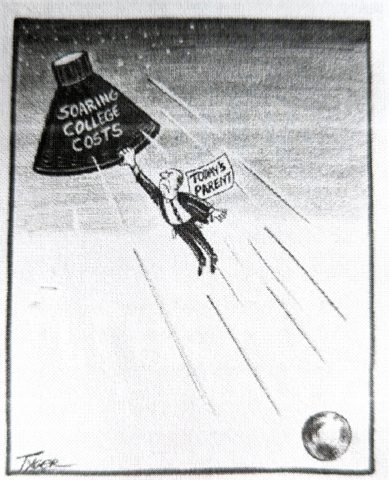
Another Trenton Times cartoonist is the late Frank Tyger, born to Belle and Joseph Tyger in Brooklyn, New York, on December 24, 1929.
Tyger went to City College of New York (CCNY) and the Cartoonists and Illustrators School before serving two years in the U.S. Army, including a stint as a cryptographer in Germany.
Upon returning, he settled in Trenton, joining his parents after his father in 1950 agreed to relocate with his employer, Baxter Clothes.
Tyger joined his father in the men’s clothing business, working with Yards Department Store and Baxter Clothes, where he also began working in the marketing division.
He then moved to Albert Finkle Advertising Agency in Trenton, where he began developing his skills as an artist and writer.
According to a website devoted to Tyger’s art, his first cartoon was published in the Saturday Evening Post in 1954. It was followed by cartoons, quotes, and puns published both nationally and internationally.
Then, “in 1962 James Kerney Jr., then editor and publisher of The Trenton Times, offered Frank the job of his dreams — editorial cartoonist. For the next 34 years, Frank worked for The Times drawing these cartoons, assuming other responsibilities including promotion manager, and writing a weekly Monday column for the paper. During this time, he continued to pursue his lifelong interest in authoring quotes and puns which were published nationally in magazines such as Reader’s Digest, Forbes, Editor and Publisher, and the Saturday Evening Post.”
In May, 1968, Tyger penned the following verse for Editor and Publisher. His purpose was to summarize the challenges faced by the editorial cartoonist:
Cartoonist’s Lament
Where, oh where, is the local cartoon?
Far, far away, and not coming back soon.
It costs so little to buy the best
Mauldin, Herblock and all the rest.
Besides, the local cartoon means taking stands
And stepping on toes
And making decisions cause an editor woes.
It’s such a comfort to use a mat
And keep your own thoughts under your hat.
Tyger died in Ewing in 2011. And in between then and writing the above, he never lamented. And just like editorial cartoonists today, he kept his hat off — and his thoughts on the page.