Much has been written about the power of place. For David DeFreese, board chair of the Greater Princeton Youth Orchestra (GPYO), the legacy of Westminster Choir College is palpable.
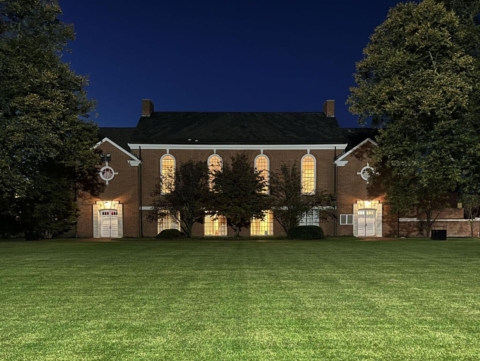
After all, as the former home of the esteemed Westminster Choir, the campus has attracted top talent from around the globe, with major conductors and performing arts organizations drawing on the choir’s reliable excellence for decades of celebrated performances and recordings. This past summer, the Westminster campus, located at the intersection of Hamilton Avenue and Walnut Lane in Princeton, became GPYO’s new home.
“We love the facility,” DeFreese says. “We love being a part of the history of this campus. I was very excited when we were able to find a way to be a part of that legacy. This is a really special place in the performing arts world.”
He indicates a poster of Leonard Bernstein mounted near the stairs of Bristol Chapel that bears the inscription, “Westminster Choir College provides a great measure of beauty to a world that needs it badly.”
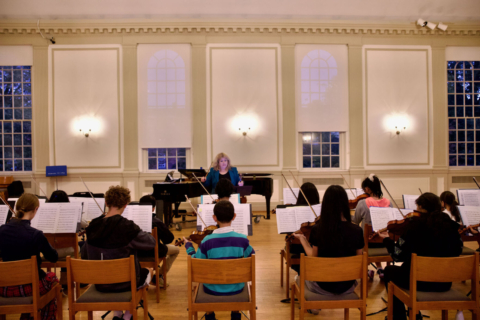
With its own history extending back more than 60 years, GPYO’s mission is to provide superior training and performance opportunities for young people in search of a challenging musical ensemble experience, and to cultivate a lifelong appreciation of the arts. The after-school program accepts musicians from second grade through high school by audition. Prior to settling into its new digs, classes and rehearsals were held at Unitarian Universalist Congregation of Princeton.
GPYO supports five performance ensembles: Symphonic Orchestra, Concert Orchestra, Chamber Winds Ensemble, Camerata Strings Ensemble, and Preparatory Strings Ensemble. All rehearse weekly on Monday evenings and perform a minimum of two to three concerts annually.
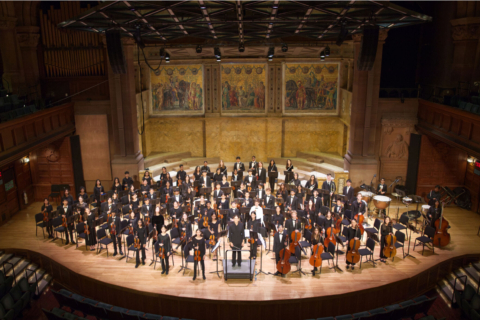
This winter’s concerts will include performances by GPYO’s upper-level groups at Princeton University’s Richardson Auditorium on Saturday, February 3, at 7 p.m.
The Symphonic Orchestra will play the rarely heard “Blumine” movement from the original version of Gustav Mahler’s Symphony No. 1 (later excised by the composer) and the “Romeo and Juliet Fantasy Overture” by Pyotr Ilych Tchaikovsky, conducted by Jiannan Cheng. Cheng, who joined GPYO this past summer as its new music director, is on the faculty of Rowan University, where, among her duties, she teaches conducting and serves as music director of the Rowan University Orchestra.
On the same program, the Concert Orchestra will perform the overture to “The Barber of Seville” by Gioachino Rossini, the “Pavane” of Gabriel Fauré, and music from “The Phantom of the Opera” by Andrew Lloyd Webber, conducted by Joseph Pucciatti. Pucciatti, a long-time music educator in the Trenton area and artistic director of Boheme Opera NJ, also joined GPYO over the summer.
Rounding out the conducting staff is David Rabinowitz, who directs the Chamber Winds Ensemble, and Blair Cunningham, who conducts the Camerata Strings Ensemble and the Preparatory Strings Ensemble. The latter groups will perform for family members on a separate concert at the aforementioned Bristol Chapel, a venue with much more limited seating, at the end of January.
Other benefits available to GPYO students include access to sectionals (rehearsals in which portions of the orchestra play through and iron out a score’s trickier passages) led by special guests, masterclasses with professional musicians (most recently Philadelphia Orchestra associate concert master Juliette Kang), educational workshops, and a concerto competition, providing the opportunity for students to prepare a movement from one of the great concertos for possible inclusion in a spring concert.
This year’s competition winner is Alexia Fang, a Montgomery High School student whose performance of the first movement of Sergei Rachmaninoff’s Piano Concerto No. 2 secures her appearance as soloist with the Symphonic Orchestra at Richardson Auditorium on June 9.
It is not only the historical significance of the campus that makes the former base of Westminster Choir College so attractive. GPYO has found a good fit with neighboring Westminster Conservatory of Music, the community music school of Westminster College of the Arts, established on the campus in 1970. The two organizations now share a reciprocal tuition arrangement that allows student musicians to avail themselves of their joint resources.
“What we realized during the pandemic was that a lot of institutions could not just go about things on their own,” DeFreese says. “So many performing arts groups were looking for collaborations and partnerships.”
Building the GPYO
DeFreese’s reverence for tradition extends to the GPYO itself. He has been gradually piecing together a history of the organization, an effort made more challenging by the fact that many records were lost in a house fire years ago. Happily, the founder of the orchestra that became GPYO, Matteo Giammario, is still available to share his stories. Giammario will be 99 in March.
Born to parents who emigrated from Italy’s Apulia region — the heel of the “boot,” as it were — he developed an early fascination with music from the Neapolitan songs he overheard growing up in Trenton’s Little Italy. His mother steered him from the guitar to the violin, which started him on the path of his life’s passion, which has been for music education and performance.
Following service in the U.S. Navy during World War II, Giammario used his G.I. Bill benefits to attend NYU, where he received his bachelor’s degree. He earned his master’s from Columbia University and a doctorate from the University of Arizona. Further training was undertaken at the Santa Cecilia Conservatory in Rome.
Most of Giammario’s teaching career was spent in the Trenton school district, where he served first as a music educator, then as director of music education. In 1960 he was invited by the American Federation of Musicians, Local 62, to conduct the Mercer County Symphonic Orchestra. The orchestra originally performed mainly at the Trenton War Memorial and, according to an article in the digital archive of the New York Times, was intended as a sort of training ground for future members of the Greater Trenton Symphony. From the start, its personnel consisted of local high school and regional college musicians.
The orchestra became a resident ensemble of the Lawrenceville School. Another article in the Times announces a benefit concert at the school in 1975 to be conducted by the internationally beloved pianist and humorist Victor Borge. The orchestra, it notes, “is composed of approximately 70 musicians from public and private junior and senior high schools and a few community colleges within the Delaware Valley.”
At the time, Giammario was also conductor of the Bucks County Youth Orchestra and the Ars Nova Chamber Orchestra.
Later still, Giammario oversaw the board during a period of transition that yielded the orchestra’s rebranding as the GPYO, offering even greater breadth to the student musician experience.
“He is so dedicated to the concept of music, music education, music performance,” DeFreese says. “He’s a true piece of history and a legend in the Trenton-Princeton community.”
In retirement, Giammario continues to compose and arrange, and of course share his rich history and that of the orchestra he founded. The concerto competition, named for him, is one of the many ways in which the GPYO has committed to honoring his legacy.
The Youth Orchestra of Central Jersey, located across Route 1 in West Windsor, was founded by Portia Sonnenfeld in 1978 as a preparatory orchestra for Giammario’s Mercer County Symphonic Orchestra. The two organizations are now unrelated. Previously, Sonnenfeld was a music teacher at Littlebrook Elementary School in Princeton. She became the orchestra director at Princeton High School in 1973. In 1980, she established the Little Orchestra of Princeton (in 1984 renamed the Chamber Symphony of Princeton), which evolved into today’s Princeton Symphony Orchestra.
The students of GPYO have played challenging concerts and recitals at numerous local, regional, and international venues, including Carnegie Hall, the former Avery Fisher Hall at Lincoln Center, the Kimmel Center for the Performing Arts in Philadelphia, the New Jersey Performing Arts Center, Patriots Theater at the Trenton War Memorial, the New Jersey Governor’s Mansion Drumthwacket, and several European invitational tours.
DeFreese played trombone in his high school band (the instrument has since been passed on to his nephew) and later, as an adult, took up the flute. He recalls with pride performing with his children in the Hillsborough Community Band. But he attributes the bulk of his music education to having followed his son, who is a French hornist. In fact, it was through him that he first learned of GPYO, and the experience was transformative.
“I started out as a parent volunteer with concerts and set-ups and things like that,” he says, “and then the board invited me to join several years ago.” He singles out a performance by a concerto competition winner at Richardson Auditorium 10 years ago, his son’s first year, as one of his great experiences. “I couldn’t believe that such a young person could have such a command of the music, command of Richardson Auditorium, command of the audience. It stuck with me for a long time.”
DeFreese’s degree, from Princeton University, is in mechanical engineering. But he understands that musical performance doesn’t always have to be a life pursuit. In fact, music can be a means of enrichment, no matter where life takes one.
“Many of the top musicians don’t actually pursue music education or music performance,” he says. “Many of them become STEM students or pursue STEM careers. [STEM = science, technology, engineering, and mathematics.] Doctors, engineers, scientists. The fact that they have a passion for music, even though they go into different careers, is good.”
And he observes that it goes both ways. “We had a board member who went to college for computer science, but she has come back and gone into music, and she has a music studio. That’s her career now.”
In theory and often in practice, music makes better people. The discipline and skills developed in the playing music, and playing well with others, have applications everywhere. In so many ways, a grounding in music carries with it the potential to strengthen communities and to make a better world.
A New Home with a Long History
Westminster Choir was founded in 1920 by John Finley Williamson, widely regarded as one of the 20th century’s most influential choral conductors, at Westminster Presbyterian Church, in Dayton, Ohio.
Already in 1922, the choir was touring the country annually, with appearances at Carnegie Hall, Philadelphia’s Academy of Music, and even the White House, where the group sang for Presidents Calvin Coolidge, Herbert Hoover, Franklin Delano Roosevelt, and Dwight D. Eisenhower.
The ensemble made its first commercial recording in 1926, the year Williamson established the Westminster Choir School, which employed a faculty of 10 and sported a student body of 60.
In 1932, the school relocated to Princeton. Classes were held at First Presbyterian Church and Princeton Theological Seminary until 1934, at which time the school settled into its present location at 101 Walnut Lane. The campus was dedicated with a performance of Johann Sebastian Bach’s Mass in B minor at Princeton University Chapel, with the Philadelphia Orchestra conducted by Leopold Stokowski. Williamson retired as president of the college in 1958.
For decades, Westminster Symphonic Choir was a choir of choice for the nation’s great orchestras, including the Philadelphia Orchestra, the New York Philharmonic, the Boston Symphony, the Cleveland Orchestra, and the New Jersey Symphony Orchestra. It also received invitations over the years to perform with touring orchestras, such as the Berlin Philharmonic, the Vienna Philharmonic, and the Royal Concertgebouw Orchestra. Conductors with whom the choir performed included Leonard Bernstein, Herbert von Karajan, Eugene Ormandy, Leopold Stokowski, Robert Shaw, Arturo Toscanini, and Gustavo Dudamel.
In a series of controversial decisions that still has emotions running high among alumni, performing arts organizations, and music-lovers around the world, but most especially in the Princeton community, a financially strapped Rider University, which merged with Westminster in 1992, attempted to sell the campus in 2018 and by 2020 had largely absorbed the college’s operations into university’s Lawrenceville campus, uprooting an historic institution that had existed at its Princeton location since 1934.
Lawsuits were filed, dismissed, and reinstated. Two court rulings this past summer went against Rider, and it was reported that a new prospective buyer for Westminster has emerged, proposing to reestablish the school at the Princeton campus.
Whatever the future holds, for now, it’s nice to have some positive news to share about this former bastion of artistic excellence.
For more information about the Greater Princeton Youth Orchestra, visit gpyo.org.
GPYO Winter Concerts, Richardson Auditorium, Princeton University. Saturday, February 3, 7 p.m. $20 general admission. www.gpyo.org.