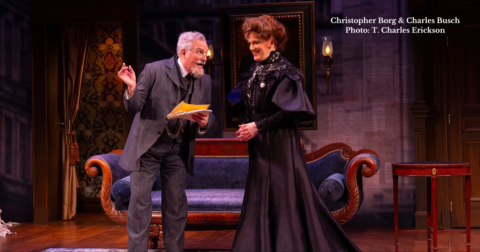
Although one can depend on Charles Busch plays for arch lines, grand gestures, offbeat characters, and sumptuous speeches, his latest, “Ibsen’s Ghost,” having its world premiere at New Brunswick’s George Street Playhouse before heading to New York for an off-Broadway run, never gains the comic or literary traction to create interest, insight, or laughs.
Busch provides enough plot twists, everything from competing models for Ibsen’s famous heroine, Nora Helmer, to a clairvoyant exterminator adept at curing psychological illness, but none of them grab in a way that would make “Ibsen’s Ghost” compelling or even a sustained good time. The most Carl Andress’s production has going for it are some quirkily bright performances by its supporting cast and a handsome set by Shoko Kambara that each entering character denigrates as being Spartan or dull.
With his record as a playwright, Busch deserves the benefit of the doubt. I kept looking for signs that “Ibsen’s Ghost” would turn into a rollicking farce or intentionally mangled melodrama, but such expectations were in vain. The play looks more as if it is trying to find its core. It clutches at ideas, introduces characters with potential, and has that tussle about whether Ibsen’s widow or erstwhile protégé was his inspiration for “A Doll House’s” Nora, but there’s no glue to hold all the attempted threads together or weave them into a consistently involving story.
What’s left is a play of moments. Each character and each actor playing one gets at least one chance to shine. There’s the occasional tang of Busch’s usually ready wit or a sly Crawfordish moue to show his character’s displeasure. Some plot lines, especially the one about who deserves to publish a tome called, “I, Nora,” seem worth exploring, but rather than gathering steam and rolling to some comic conclusion, “Ibsen’s Ghost” regularly falls flat and can’t be resuscitated by the next new impulse Busch pulls from his hat.
Substance, sustenance, and suspense are all missing. In the long run, “Ibsen’s Ghost” provides its audience with little to care or think about. A cartwheel from Jen Cody, Christopher Borg’s delectable Rat Wife, or Jennifer Van Dyck’s excellently delivered dialogue may buoy or pepper a sequence, but in general, “Ibsen’s Ghost” needs to return to the drawing board of Busch’s imagination before it’s ready for primetime.
“Ibsen’s Ghost” begins a week after Henrik Ibsen, Norway’s literary hero and one considered a neighbor to Shakespeare and a companion to his contemporaries, Shaw and Chekhov, in his standing as a playwright, passes away leaving his widow, Suzannah Thoresen Ibsen (Busch) to straighten up what “Ibsen’s Ghost” purports was, under the surface, a messy life.
Apparently, Ibsen was not given to straying romantically from Suzannah but enjoyed being the mentor to several young women with whom he met in a dank basement beneath the Ibsen sitting room.
Busch leaves most of what may have transpired in that basement to innuendo, but there is the matter that one of the women, Hanna Solberg (Van Dyck), revealed passages from her life that parallel Nora Helmer’s reason for leaving her husband.
Suzannah is concerned primarily with Hanna besmirching her late husband’s reputation as an almost rigidly honorable man while being piqued that Hanna may supplant her in the public’s perception as his muse as regards Nora.
“A Doll’s House” is not the only Ibsen play Busch taps in composing “Ibsen’s Ghost,” but it takes more focus than references to “Hedda Gabler” (a pistol with which Suzannah toys), “Ghosts” (concern about Ibsen’s sons, one from wedlock and the current prime minister of Norway, one illegitimate from a liaison of which Suzannah and her stepmother are aware, “The Wild Duck” (Hanna arriving at the Ibsen manse sporting a bow and a quiver of arrows), and others that involve various friends and relatives dropping into the lead character’s home each day.
One curiosity is when Ibsen’s publisher, George Elstad (Christopher Borg) speaks about Ibsen’s plays, he badly mispronounces the one that happens to be my favorite, “Rosmersholm,” the title of which refers to an estate owned by a squire named Rosmer, and should be pronounced ‘Rosmer’s home’ rather than ‘Roshmer’s Sholm,’ as Borg’s Elstad says.
“Ibsen’s Ghost” is most entertaining when a character takes off on a flight of speech. Van Dyck’s monologues as Hanna are particular delights, as if Busch had her bits added to by Oscar Wilde. Christopher Borg is captivating when he abandons the mercenary publisher, Elstad, and becomes the Rat Wife. Judy Kaye, as usual, makes one pay attention to her character. Jen Cody is a slapstick wonder as a housemaid whose limbs bend in opposing directions and can’t maneuver anywhere in a straight line.
Alas, the sequences of glory are fleeting and are isolated gems that don’t lead to next beats or specific plot action.
The cast keeps “Ibsen’s Ghost” afloat.
Charles Busch may not have provided Suzannah a strong enough core or decided purpose, but as he has proven throughout his career, he knows how to establish his character’s mark on a stage.
In a tribute to Busch’s generosity as a playwright and cast member, Suzannah is overshadowed by Cody’s eccentric afflicted maid, Van Dyck’s righteously logical Hanna, and Borg’s hilarious and frightening Rat Wife. Even so, his star quality comes out in some of the expressions he makes while showing the audience an emotion only we see and in his ability to command attention to anything his character is doing.
I wish Busch the actor could save Busch the playwright on this occasion, but a script that gets many of its laughs from lists that end in a preposterous choice, such as one that concludes with “bamboozle,” doesn’t give him the chance to galvanize the show.
Jennifer Van Dyck is perfect, displaying the hauteur of a confident woman while comically acquainting us with Hanna’s difficult past and standing up for Hanna’s rights. Jen Cody scores with her hoydenish portrayal of a maid with unruly limbs but a healthy libido. Cody also makes an amusing character transformation. Except for his “Rosmersholm” glitch, Christopher Borg is simultaneously suave and oily as Ibsen’s publisher and lots of fun as the psychic Rat Wife. Thomas Gibson, of “Dharma and Greg” and “Criminal Minds” fame, plays deftly against type as a roguish but ardent sailor/adventurer who turns up at the Ibsen home for a keepsake belonging to his father.
Despite what Busch has characters say, Shoko Kambara’s den is so cozy and well-appointed, my first impression upon seeing it was wanting to move in. In color tones and style, Kambara provides an admirable set. Gregory Gale is equally as adept with the period costumes, particularly the archery gear for Hanna. Ken Billington’s lighting and sound by Jill BC DuBoff and Ien DeNio serve well.
Ibsen’s Ghost, George Street Playhouse, New Brunswick Performing Arts Center, 11 Livingston Avenue, New Brunswick. Through Sunday, February 4, Wednesday through Saturday at 8 p.m. and Thursday, Saturday, and Sunday at 2 p.m. $25 to $70. www.georgestreetplayhouse.org or 732-246-7717.