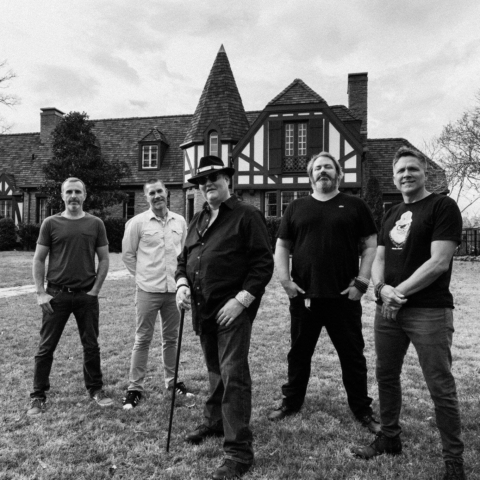
It started in a Bayard Lane basement.
That’s where harp-wielding frontman John Popper and drummer Brendan Hill molded the core of Blues Traveler, sons of Princeton that went six-times platinum [a million sales for each platinum level] with the 1994 release of their fourth album, four.
In the mid-80s, Popper and Hill were jamming around at Hill’s parents’ house on Bayard Lane, doing a Blues Brothers-type review of songs.
That basement duo was also in the award-winning big band music program at Princeton High School, where they’d find guitarist Chan Kinchla.
“I was the stoner-jock dude,” Kinchla said in a phone interview with U.S. 1 in June. “I would go sit in the rehearsal rooms and play guitar all morning, skip class. They saw me in there just all the time. So eventually, we started playing together.”
That was circa 1986. Keg parties became the band’s first frontier, Kinchla said. “It got to be where the cops would hear we were playing somewhere, and then they’d follow the noise and bust the keg party.”
The band’s first “real gig” came at the venerable John & Peter’s in New Hope, PA, in front of their parents and a couple of wholesome drunks.
“We were 16 and 17,” said Kinchla. “When we got there, John & Peter’s were like, ‘You guys are kids!’ They didn’t really know. So we did the show, and then they were like, ‘You’re too young, we can’t have you back.’”
By then the band’s lineup was Popper, Hill, Kinchla, and the late Bobby Sheehan on bass.
Popper was a year ahead of the group, graduating from PHS in 1986 and moving to New York City for college. The band accompanied him there.
Late ‘80s New York was “a Wild West, especially the Lower East Side, and Brooklyn where we lived,” Kinchla said. “No one cared at all. I was 18, 17. By senior year in high school, we were just going up and playing little open mic things in New York, where you could come up on stage, open mic nights, really early on,” Kinchla said.
The city had just repealed its Cabaret law, removing limits on bars having no more than three people on stage, and it seemed every bar was having live bands. “Which was great, because we could play four or five nights a week, for no money,” Kinchla said.
“There were tons on the Lower East Side. Lismar Lounge, we used to play in the basement there. Nightingale was where we really came up. Dan Lynch [Blues Bar]. There were just a bunch of little dive bars.”
New York was gas on their flame. “It was really where we learned how to play. And there was a lot of other bands, great bands that we could watch and model ourselves on,” citing a few as Mr. Thing, The Worms, featuring Jono Manson, The Surreal McCoys, and Johnny Allen, “a great blues guy who played over on Bleecker Street.”
This was a booming era for alternative rock. Blues Traveler released albums on A&M Records in 1990, 1991 and 1993, and they made several appearances on Late Night with David Letterman, becoming a favorite of his and band leader Paul Shaffer. Shaffer plays keyboard on “Stand,” on four. [Recommended Late Night viewing: a scorching “Crash & Burn,” also on four, on YouTube.]
“We had been building slowly but surely,” Kinchla said.
“I give A&M a lot of credit for sticking with us, because the first three records didn’t really sell like gangbusters,” he said.
Blues Traveler had been working the jam band circuit, Kinchla said, alongside groups like Phish (bonus points: guitarist Trey Ansastasio attended Princeton Day School) and Widespread Panic, seeing a model in the Grateful Dead.
“We were just like them; building our live audience, under the radar, and had all these really hardcore fans. We didn’t have any real hits,” he said.
With four, Blues Traveler knew they had a good record with some “accessible” songs on it. They hoped it might achieve their first gold record, for 500,000 sales.
A&M wanted “Run-Around” out first, but the band convinced them to go with “Hook,” knowing they could thus get two singles out instead of the usual one-and-done promotion of their prior albums.
But “Hook” was only marketed to college radio, Kinchla said. “At the time, that was alternative, it was college radio. ‘Hook’ did well on those charts, but it didn’t cross over to Top 40.”
Next, the album was released in September 1994, and had about the same effect.
“It did well. But then we got our college charts, and it came and it went, and we were like, Oh, there it was. That’s a little bit of growth, a little more hype,” Kinchla said.
“Our live numbers were doing great. We were on that path.”
Then in February, 1995, “Run-Around” got its turn as a single-release.
“All of a sudden, the record just went back on the charts, and what they called back in the day – it really reacted,” Kinchla said.
“Run-Around” reached #2 on the Billboard Adult Pop charts, and won the band a 1996 Grammy for Best Vocal Performance.
“So next thing you know, the next year was just kind of mayhem,” Kinchla said. “No one had any idea it was going to be as big as it was.”
“Hook” also cracked the Top 20 after a re-release in August 1995.
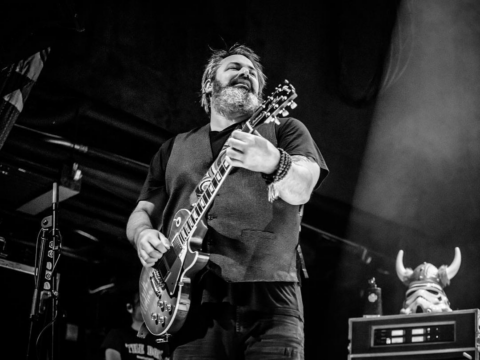
Four is not just its hits either; it’s a platinum blend of ballads and funk-bombs, with an emphasis on the latter, and sometimes in the same song. It’s paced throughout by Popper’s trademark harmonica and rumbling vocals, by Kinchla’s slashing ornamentation on guitar, and by a tight and expansive rhythm connection between Sheehan on bass and Hill on drums.
The unexpected success of the album was a bit of a culture shock to the band. But they were down for it, Kinchla added.
“Because the album was such a hit, we got all these fans that were more just casual music fans. I do think there’s a little culture shock there,” he said.
“In the end, it might have messed with that one road [as “neo-hippy” jam band], but it also gave us opportunities to do so many interesting cool things, like Saturday Night Live, and playing all these cool different shows and events. I mean, it opened up a lot of really cool doors,” he said.
It’s been a fun ride ever since, he said. “It was good to make a little money, and be able to realize we could do this for a living. And it’s nice to have a national brand like we do now.”
Blues Traveler is still at it, touring nationally throughout 2024, with several regional dates scheduled for August.
“Bringing the rock to the people for the summer, that’s the focus now,” Kinchla said.
“As I always say, the longer I do it, the more I like it. I love just playing guitar in a cool rock band. That’s always been my dream since I was a little kid, so I’m still enjoying that.”
Blues Traveler released their 15th (!) album last October, Traveler’s Soul, while Kinchla’s side project, W4RHORS3, has its debut album coming this November, called The Horse You Rode In On.
Kinchla lives in Los Angeles now, where there are endless places to play and great musicians to play with, he said. He makes it back to Princeton every few years.
“I love going back,” said Kinchla. “I just walk. My dad was a professor at Princeton, so I grew up a university brat. That’s my part of town. I grew up right across the street from McCarter Theater. The Wawa down there… But every time I go, I try to walk across the campus, just because that’s kind of my backyard,” he laughed.
“The whole town, it really hasn’t changed all that much. It’s a little fancier. It’s a little less ‘70s, ‘80s. But all the streets, everything is laid out the same. They keep the basic colonial feel to it,” he noted.
“And the university, of course. So they’ve built some huge new buildings, but it’s a top-flight university. But I do like how Princeton, my dad always used to call it ‘Brigadoon,’ the city in the mist that never changes,” he said, recalling the title-city of that mid-century musical.
For a band that travels — it’s in the name, after all — and that really learned to gig in New York City, it is unique that they proudly claim Princeton atop their website: “Est. 1987 – Princeton, NJ.”
They could cite New York City, or no place at all. But Princeton is the place. I pondered this curiosity to Kinchla over the phone.
“We’re a high school band, really,” he said, matter of factly. “We’re a Princeton High School band.”
Coming soon to a keg party near you. Or rather, visit bluestraveler.com for the latest news, notes and tour dates.
Bennett Kelly is a music journalist and author from Princeton. His rock and roll novel “Sensation Blues” is out this fall.