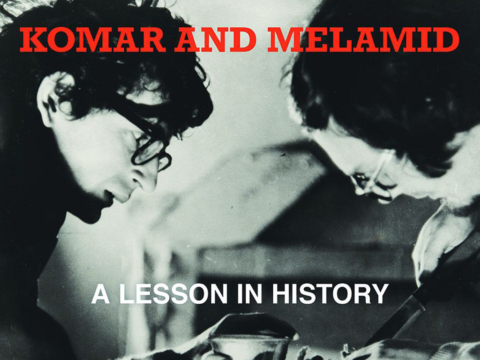
The Zimmerli Art Museum’s exhibition “Komar and Melamid: A Lesson in History” ends on July 16.
For those interested in contemporary art and who haven’t seen it, it is worth a visit — and apologies for not addressing the exhibition sooner.
Yet, given its political and conceptual (and text-driven) nature, the following may provide some context for those interested in getting to know these two artists and viewing their first U.S. retrospective since the late 1970s:
Vitaly Komar and Alexander Melamid are two artists born in the Soviet Russia, respectively years 1943 and 1945.
A passage from the exhibition-related book of the same name explains that “Komar and Melamid met during the 1960s at the Stroganov Academy, where they received a solid academic grounding. Their first joint exhibition, ‘Retrospectivism,’ was held at the Blue Bird Café in 1967. In 1972, they invented the ‘sots-art’ movement, with which their names are largely associated.”
According to the Zimmerli, sots is a style of art that employed an ironic approach to expose the absurdities of the official art of the Soviet Union and of the regime. A paraphrase of American pop art’s reaction to the overproduction of consumer goods in the United States, sots-art was a reaction to the overproduction of ideology.
That definition, by the way, was informed by exhibition curator Julia Tulovsky, who selected work from the Zimmerli’s vast and unparalleled collection of Russian and Soviet dissident art.
The book edited by Tulovsky continues to note that “during this early period of sots-art, (the artists) were especially interested in slogans, which they interpreted as conceptual socialist realism. At the same time, the artists formulated for themselves the principle of endless innovation in directions, methods, and styles.”
As Melamid once told an interviewer in another publication, “We have deconstructed Socialist Realism as an ideology and discovered it as an art” — a witty and subversive one.
In the book’s foreword, Zimmerli director Maura Reilly says she rates Komar and Melamid “among the most compelling artists in the history of conceptual art” and points to their use of “humor and satire to lambaste Soviet officialdom and the hypocrisy of Western consumerism. Their work is topical — ridiculing Soviet official culture and American contemporary life — but it is also grounded in history, in the complexities of the Soviet era and their effect on the artists’ personal lives. Their art offers ways of dealing with the past and points the way forward in a changing world.”
Their artistic critique of America began when they immigrated to United States and became part of the 1978 New York City art world.
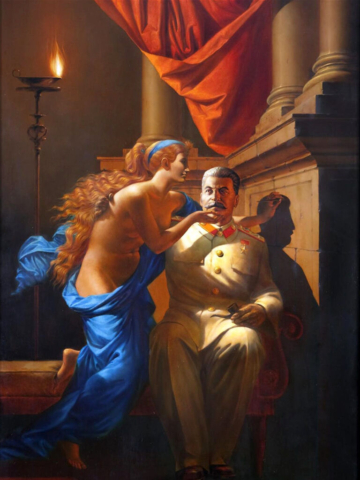
I became aware of them shortly after when they began producing highly romanticized Soviet propaganda-infused paintings of Joseph Stalin, including one where the dictator and arts censor is honored by a muse-like figure — demonstrating how art can be simultaneously seductive, appealing, ridiculous, and dangerous.
That the two artists had set up a studio in Bayonne (where I also briefly lived at the same time), they interacted with the same New Jersey’s industrial landscape that had inspired other 20th century boundary-pushing artists. That includes earth artist Robert Smithson, who wrote about the “ruins of Passaic”; Fluxus founder Allan Kaprow, who coordinated such events in New Brunswick; pop-art influenced sculptor George Segal, who also created photo essays along the industrial U.S. 1 highway region; and others.
For example, take the following passage by a New Yorker writer who met Komar and Melamid for a 1989 article: “We are on a residential street in Bayonne (a town that the most successful aluminum-siding salesman in the history of the trade must once have passed through). Down the street is a Russian Orthodox church, with several onion domes. (Melamid) stops the car and says, ‘On this block we find the question that confronts all mankind at the end of the century: Where do we go to escape the modern? Modern is no good, we know. Big mistake. Huge mistake — ugliness and cruelty and horror and squalor and publicity. Modernism wanted to change the world, and it achieved nothing. In Bayonne, there is nothing modern. Brass foundries. Hardware stores. Churches. No movie theatres. No modern architecture. People say to us, sure, it’s a little pocket of the 19th century. Cute. Then we realize: No, no, no, no, no, no, no. This is a real city. Real place. This is going on right now. This is the big secret of 20th-century life: Real life is a century behind words.”
After a brief commentary on Soviet Revolutionist Vladimir Lenin’s attempt to use words to “make a country for imaginary proletariat” only to create “death, starvation, horror,” Melamid connects his New Jersey setting to the language to describe the contemporary: “Same thing now. Everybody says the Industrial Age is over, service-and-information economy now, blue-collar workers gone. But here is Bayonne! Here are guys working for a living in a brass foundry. At the end of the 19th century, the world was still really in the 18th century. At the end of the 20th century, the world is really living in 19th century.”
And while the statement and Zimmerli exhibition are also part of the 20th century (the duo ceased collaborating in 2003), their ideas maintain an evergreen wit that bites into various political and artistic ideologies.
That includes Zimmerli creating an “Arts Belongs to the People” event where an artist creates while being guided by a committee — something the two artists also presented in the Soviet Union with predictable results.
Then there is the Legends series that explores how narratives affect art viewing and social value. A Zimmerli example features a painting the two found in the trash on a Russian street. The two then concocted a mock romantic and socially relevant history about the artist: He was born in a field and lost an eye during a fight with an avant-gardist. The combination of found piece, faux history, and factual information demonstrates how ideas and narratives can shape perceptions that, in turn, shape social and economic value.
The clash of ideas and reality may be best exemplified in their 1993 People’s Choice project. And while not an obvious part of the exhibition, it helps put their work in perspective.
The artists, who were also trained sociologists, were funded by the Nation Institute to work with several noted opinion poll organizations to create a survey of art preferences in 10 countries.
As related by the late American-born philosopher of art Denis Duton in the book “The Art Instinct: Beauty, Pleasure, and Human Evolution” (where I encountered the project), “All participants (in the survey) were asked what they would like to see a picture of, whether they preferred interior or landscape scenes, what kinds of animals they liked, favorite colors, what sorts of people they enjoyed seeing depicted — famous or ordinary, clothed or nude, young or old — and so forth. Extrapolated to the general populations of the countries polled, the graphs and tables of figures produced by Komar and Melamid’s People’s Choice project claimed, not unreasonably, to be a reliable report on the artistic preferences of ‘close to two billion people.’”
But the project produced more than numerical preferences: “These talented artists (they were originally trained as socialist realists) then went on actually to paint most-wanted and least-wanted paintings for every country in the study — pastiches based on favorite colors, shapes, and subject matters for each nationality.”
The result, notes Duton, is that “the least-wanted paintings are bad news for anyone hoping someday to see modernist abstraction achieve mass acceptance. People in almost all nations disliked abstract designs, especially jagged shapes created with a thick impasto in the commonly despised colors of gold, orange, yellow, and teal.
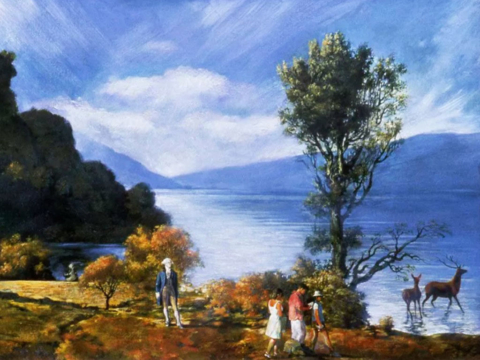
“This cross-cultural similarity of negative opinion was matched on the positive side by another remarkable uniformity of sentiment: almost without exception, the most-wanted painting was a landscape with water, people, and animals.”
Since the world’s overwhelmingly favorite color was blue, “Komar and Melamid used blue as the dominant color of their landscapes. Their “America’s Most Wanted,” the painting based on the poll results from the United States, combined a typical American preference for historical figures, children, and wild animals by placing George Washington on a grassy area beside an attractive river or lake. Near him walk three clean-cut youngsters, looking like vacationers at Disneyland; to their right two deer cavort, while in the water behind Washington a hippopotamus bellows.”
That the artists delivered what people ordered caused Dutton to note, “To consider the survey seriously and then turn to Komar and Melamid’s painted results is to realize you’ve been conned.”
Well, not exactly, all joking aside, Melamid says the project “might seem like something funny, but, you know, I’m thinking that this blue landscape is more serious than we first believed. Talking to people in the focus groups before we did our poll and at the town hall meetings around the country after … almost everyone you talk to directly — and we’ve already talked to hundreds of people — they have this blue landscape in their head. It sits there, and it’s not a joke. They can see it, down to the smallest detail. So, I’m wondering, maybe the blue landscape is genetically imprinted in us, that it’s the paradise within, that we came from the blue landscape and we want it . . . The blue landscape is what is really universal, maybe to all mankind.”
Hmmm. Seems like the exhibition’s lesson is that there is some sort of joke going on. And it is on — and in — us.
Komar and Melamid: A Lesson in History, Zimmerli Museum of Art, 11 Hamilton Street, New Brunswick. Through July 16, Wednesday, Thursday, Friday. 11 a.m. to 6 p.m., and Saturday and Sunday, noon to 5 p.m. Free. zimmerli.rutgers.edu.
Also available as the exhibition book, “Komar and Melamid: A Lesson in History,” edited by Julie Tulovsky, 288 pages, $50, Hirmer Publishers.