In a fight that is as central to the New Jersey experience as the middle region’s disputed existence is to the state itself, Central New Jersey is an aptly named gray area that wages a war far greater than the food-related discourse known to divide the proudly distinct Northern and Southern communities—the battle to be on the map, let alone bicker over the nuances between them, continues to pit people against each other in a “friendly competition” of identity and indignation.
Whether someone’s personal stance stems from ignoring or being from that area whose heart beats outside of the conventional territorial lines, this oft-dismissed region is receiving new traction on the economic front thanks to new legislation that passed both Houses on Friday, June 30, and is awaiting Governor Phil Murphy’s expected approval.
Murphy, who spent almost two decades as a resident of Middletown Township before beginning his first term in office, even took the debate to Stephen Colbert’s The Late Show with the June 2018 segment “Is Central Jersey A Real Place?” featuring the host and governor, as well as Lawrenceville native Jon Stewart, whose resounding “yes” echoed the sentiments in Murphy’s inaugural speech earlier that same year: “We are one New Jersey — North, Central, and South — an extended family striving for success.”
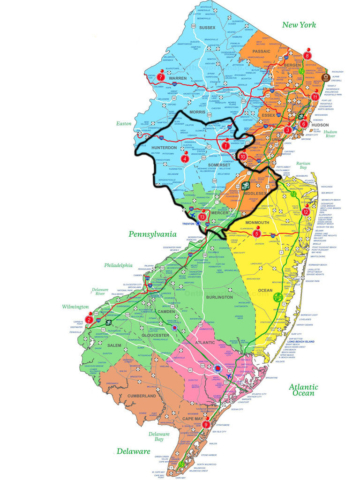
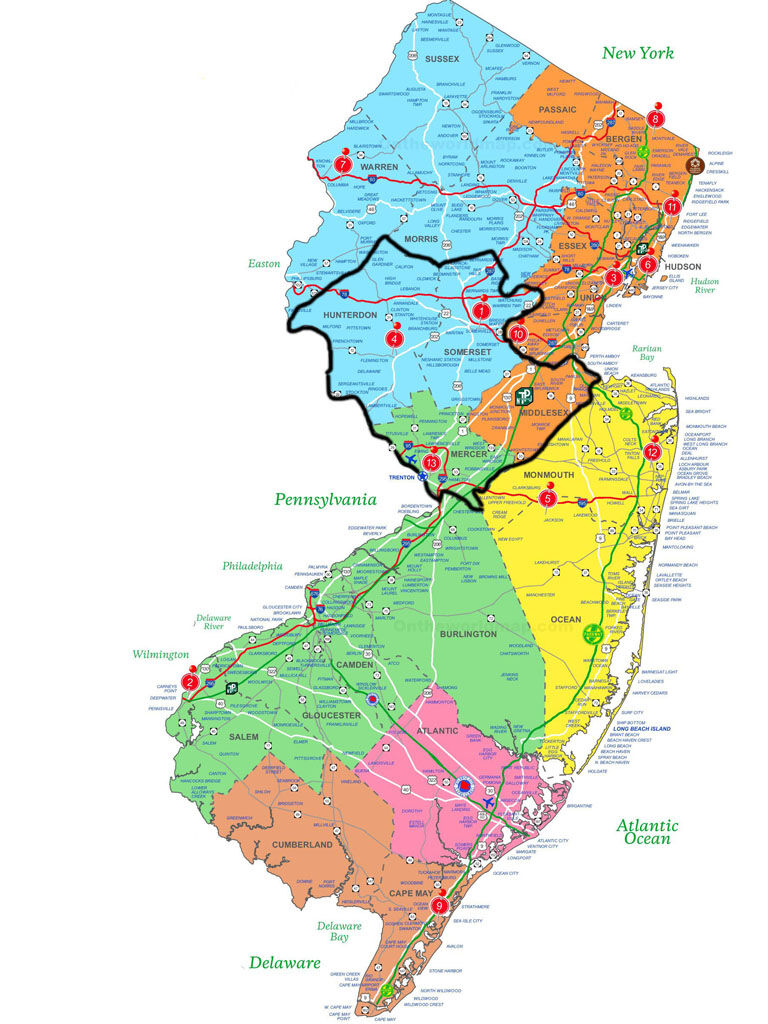
Bill S3206 encompasses the counties of Hunterdon, Mercer, Middlesex, and Somerset “at a minimum,” according to the NJ Legislature website, and “requires [the] Division of Travel and Tourism to re-draw [the] tourism map to promote Central Jersey,” as well as encourage the booking of “overnight stays.” The flexible phrasing allows for other counties like Union, Monmouth, and Ocean to possibly join the lineup of areas dictated as Central New Jersey in the future.
The bill was introduced on October 13, 2022, and was sponsored primarily by Senators Andrew Zwicker (District 16 – Hunterdon, Mercer, Middlesex, and Somerset) and Bob Smith (District 17 – Middlesex and Somerset), as well as Assembly members Roy Freiman and Sadaf Jaffer, both of District 16, and Anthony Verrelli (District 15 – Hunterdon and Mercer).
After making its way through the Senate’s State Government, Wagering, Tourism & Historic Preservation Committee with amendments, the bill was approved by the Senate (36-1), then referred to the Assembly Appropriations Committee, where it emerged victorious (76-1-1). Only two lawmakers — Senator Ed Durr of Gloucester and Assemblyman Brian Bergen of Morris, respectively, from South and North Jersey — voted against the bill.
The current state tourist map divides the state into six regions rather than observing the two sides of north or south: the Delaware River, Greater Atlantic City, Skylands, Gateway, Shore, and Southern Shore, with Central Jersey a composite of sections from the Delaware River, Gateway, and Skylands.
“While the very existence of the middle of our state has long been the subject of debate, we are long overdue in designating Central Jersey as the hub of tourism, innovation, and history that it is,” Senator Zwicker states in NJ.com’s July 5 article, “Central Jersey will soon be proclaimed real under state law. But the arguments will rage on,” by Brent Johnson. “This legislation would promote travel to our quaint river towns and canal villages, scenic walking sites, harvest festivals, breweries, and more Revolutionary War sites than you’ll find anywhere else,” he adds.
As stated in the first reprint of the bill on behalf of the Assembly Appropriations Committee from June 22, the goal is “to incorporate the new ‘Central Jersey’ region in all regional marketing activities, including in publications and on the VisitNJ.org website,” the online tourism hub for the state that hosts information on the latest on things to do, places to stay, events, trip planning, beaches, and more.
Locations that would now be marked as being within the new tourism area, the NJ.com story continues, are “the site of the Battle of Princeton, the Red Mill in Clinton, the state capital in Trenton, the rolling Somerset County hills, [and] spots along the Raritan Bay and Raritan River.”
In terms of the potential fiscal impact, “the Office of Legislative Services estimates that this bill will increase State costs by up to $1 million in [the] first year the bill is in effect, and by an indeterminate amount every year thereafter…to the extent that the promotion of tourism in Central Jersey leads to an increase in travel and tourism to New Jersey, the State and local governments could potentially experience an increase in annual tax revenue from these visitors,” the document adds.
Now noted as an identical bill substituted for S3206, A4711 was introduced in October 2022 with provisions that “would have required the state to dedicate federal tourism funds to regions most in need of economic relief, change requirements for tourism grant funds, and dedicate at least 10% of [the] state tourism division’s annual budget to promote agri-tourism,” according to Johnson’s NJ.com article. Another proposal, A5098, sought to “establish new tourism regions and subregions in New Jersey” before being withdrawn from consideration on June 8.
Governor Murphy will either accept or reject the legislation, but with the decision likely to be a success for his fellow believers and businesses in Central Jersey, this recognition might pave the way for the state’s midsection to move beyond the tourism map.