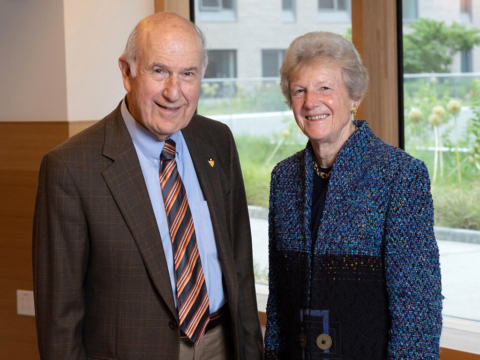
Couple Gilbert Omenn and Martha Darling, two Princeton University alumni, have made a major gift to launch a new bioengineering institute named for them at Princeton University as part of the Venture Forward campaign, which addresses the institution’s “strengths in the liberal arts, pushing the boundaries of knowledge across disciplines, and collaborating to champion inclusion, science, art, the humanities, public policy, and technology,” according to the Princeton University Alumni page for the initiative.
Omenn is a member of the Class of 1961, and Darling received her master’s degree in 1970.
According to a press release from the university, “the Omenn-Darling Bioengineering Institute will promote new directions in research, education and innovation at the intersection of engineering and the life sciences while serving as the home for new interdisciplinary bioengineering postdoctoral, graduate and undergraduate programs.”
“This extraordinary gift from Gil Omenn and Martha Darling will accelerate bioengineering innovation to address some of the 21st century’s most critical challenges,” Princeton University President Christopher L. Eisgruber says in the July 18 press release. “Given Gil and Martha’s exceptional leadership and their scientific and policy achievements, it is especially fitting that the Omenn-Darling Bioengineering Institute will be named for them. This new institute will amplify the University’s strengths at the intersection of engineering, machine learning, public policy, and natural sciences, with interdisciplinary collaboration yielding significant benefits to human health and the environment.”
The Princeton Bioengineering Initiative was established in 2020 under the leadership of Cliff Brangwynne, a professor of chemical and biological engineering, whose research, as the press release explains, “has changed how scientists understand cellular organization by linking biology with materials science and engineering, leading to foundational insights about cell functions and suggesting new ways to treat diseases such as cancers, ALS, and Alzheimer’s.”
The work at PBI, a campus-wide collaboration of minds from the School of Engineering and Applied Science, the Princeton Neuroscience Institute, the Lewis-Sigler Institute for Integrative Genomics, and the departments of molecular biology, physics, chemistry, ecology, and evolutionary biology, will live on through the Omenn-Darling Bioengineering Institute.
“Gil and Martha recognize that Princeton must play a leading role in bioengineering, one of the most important fields for humanity this century,” Brangwynne says. “Their fantastic gift will have a major impact on Princeton students and faculty for generations to come.”
The focus of the Omenn-Darling Bioengineering Institute will be on “cellular engineering, biomedical instruments and devices, and computational bioengineering,” with its proposed building becoming a part of Princeton University’s vision for new environmental sciences and engineering facilities, known as the ES + SEAS neighborhood, that is estimated to be completed sometime in 2025.
“The Omenn-Darling Bioengineering Institute will accelerate Princeton’s leadership at the forefront of this exciting engineering frontier, with unlimited potential for positive impact on health, medicine and quality of life,” Andrea Goldsmith, dean of the School of Engineering and Applied Science and the Arthur LeGrand Doty Professor of Electrical and Computer Engineering, adds in a quote. “The institute will bring together the most innovative faculty and students in the field and provide them with the foundation needed to enable transformative research and teaching. With its world-class faculty across relevant areas and its robust culture of interdisciplinary collaboration, Princeton is now well-poised to shape the trajectory of bioengineering long into the future.”
According to the Princeton alumni feature story by Jeff Labrecque, Omenn met Darling while he, a White House Fellow for the Nixon and Ford administrations, was sent on a diplomatic mission to India and France following the former nation’s 1974 nuclear detonation, as well as the latter nation’s promise to share nuclear information with Pakistan.
The issue was eventually resolved in Paris, where Omenn met Darling, who was working as a freelance consultant to the Organisation for Economic Co-operation and Development, an intergovernmental organization that develops economic policies. As a graduate of Reed College, Darling earned her master’s degree from what is now known as Princeton’s School of Public and International Affairs, becoming “one of the first female graduate students” to do so.
Prior to her positions across national and state policy, including her own White House Fellowship, Darling was a senior manager for Boeing and then served as the assistant to the Governor of Washington, the executive assistant to Secretary of Treasury W. Michael Blumenthal, and then as a senior legislative aide to U.S. Senator Bill Bradley.
She is currently a member of the White House Commission on Presidential Scholars and chairs the National Wildlife Federation’s Board of Directors, where she was recognized in 2016 as its Conservationist of the Year.
As a physician and researcher in both the public health and biomedical fields, Omenn obtained his bachelor’s degree from Princeton University in 1961, where he would return as a visiting professor two decades later. He received his M.D. from Harvard University and his Ph.D. from the University of Washington, later serving as the dean of its school of public health from 1982 to 1997.
Early on in his career, he discovered what is known as Omenn syndrome, a severe combined immunodeficiency condition for infants where genetic mutations can cause, in the absence of treatment such as chemotherapy, death.
In his ventures with national policy for President Carter’s administration, Omenn was the associate director of the White House Office of Science and Technology Policy and then of the Office of Management and Budget.
A past president of the American Association for the Advancement of Science, Omenn chairs the Human Proteome Project, a global initiative from the Human Proteome Organization to further the research of proteomics technologies, or work pertaining to the study of proteins.
Omenn is currently the Harold T. Shapiro Distinguished University Professor at the University of Michigan and the founding director of its Center for Computational Medicine and Bioinformatics.
“Supporting Cliff Brangwynne and other Princeton researchers with the Grand Challenges fund in bioengineering really captured our imagination,” Omenn says. “The more that is learned in this field, the more we realize we have yet to understand, [is] a common experience. This is an exciting area where new technologies, basic biology, chemistry, physics, mathematics, and computational sciences all need to be brought together. This emerging institute will do exactly that.”
“Pairing biology and engineering together is very intriguing to us, especially because of Gil’s professional contributions in the fields of computational medicine and bioinformatics,” Darling says. “In addition, Princeton is uniquely positioned to highlight in-depth exploration of the ethical and policy implications of this rapidly evolving field. Princeton faculty are very aware of the larger societal context that is involved in some of these technological breakthroughs.”
“We believe in investing in the best possible people you can: We need people with brilliance, determination and purpose in all fields,” Omenn adds. “Princeton provides that. Plus, Princeton represents a deep, meaningful relationship for each of us. This gift is significant because it is from us together — Martha and me — to Princeton.”
For more information, visit www.princeton.edu.