Winter holiday traditions have a sneaky way of becoming part of our annual experiences. Sometimes they come from centuries of practice, such as the ancient Norse use of mistletoe and yule logs during the winter solstice or the 15th century German practice of decorating trees at Christmas. Then there are the more recent additions, such as the late 18th and 19th century American additions with writers coining the name Santa Claus and providing the descriptions that turned into visual references, including the now accepted image of Santa created by illustrator Haddon Sundbloom for a 1931 Coca-Cola advertisement.
And while many of our own regional traditions certainly come from the past and faraway places, others are surprisingly homegrown — both literally and figuratively. In fact, they are now so common, it is difficult to believe that they were once new and even innovative.
Not convinced? Then look for yourself.
Washington Crossing
History is clear that George Washington crossed the Delaware River on Christmas Day 1776 to surprise British forces in Trenton.
But what about the annual phenomenon of thousands of people showing up on Christmas Day to witness an army of uniformed re-enactors replicate the crossing?
In their recent book, “Washington Crossing,” Ewing historians Bob Sands and Patricia Millen provide the details and some surprising history.
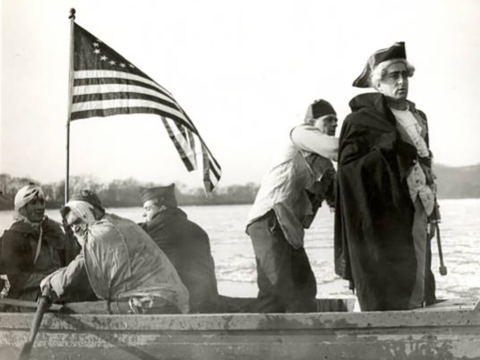
That includes noting that regionally based “actor St. John ‘Sinjun’ Terrell began the first modern re-enactments of the crossing of the Delaware in 1953. With six friends in rented costumes in a half-scale Durham boat built by Lambertville carpenter Elmer Case, he staged Emanuel Leutze’s iconic painting.”
Interestingly, the “first modern” reference suggests another between Washington’s 1776 original and Terrell’s reenactment-turned-annual tradition.
Even more interestingly, the authors write that “on January 23, 1947, some 40 pledges of Phi Sigma Nu fraternity from Rider College staged a re-enactment of Washington’s crossing the Delaware. The non-hazing event was the idea of two Rider students — Frank Ewart and Donald Reynolds — as an entertaining way to draw attention to the fraternity.
“In keeping with the historical accounts of the Christmas night crossing, George Chafey, portraying Washington, led his band of ‘Colonial’ fraternity brothers up Continental Lane to Bear Tavern. Chafey, who was fearful of horses and nursing a bad cold, chose to ride a bicycle.”
The event also got into the pages of Life magazine, which ran a four-page photo spread of the event, and perhaps inspired the more polished theatrical event now celebrating its 75th anniversary.
Christmas Trees Farms
If heading out to a Christmas Tree farm conjures days of yore in far off places, it’s time to adjust the memory. Rather than a far-off farm in some rural countryside, the first holiday tree farm was in Hamilton Township.
As the New York Times reports, “In 1901, a farmer named William McGalliard planted about 25,000 Norway spruce seedlings on a plot of land outside Trenton.
“By 1907, when Mr. McGalliard’s trees had grown only to about 8 or 10 feet, there was a sudden Victorian vogue for trees in homes at Christmas time. Until then, the rich had often brought in a Douglas or Balsam fir from a nearby patch and decorated it. But the growing middle class wanted in on the rage and Mr. McGalliard, like any good businessman, seized the opportunity and began advertising his crop for $1 each — come and cut on your own.”
The Times article concludes with New Jersey Christmas Tree Growers Association president John Perry saying, “As far as we know, that is the first Christmas tree farm anywhere. The Norway spruce may be unique to New Jersey as a Christmas tree because of that.’’’
Ghosts and Christmas Carol
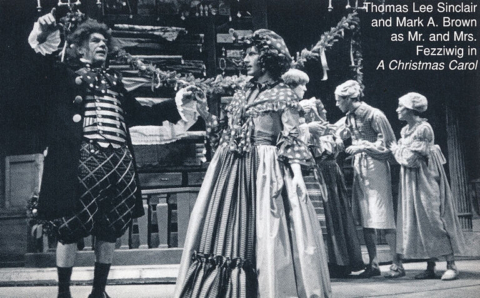
A McCarter tradition since former artistic director Nagle Jackson presented it in December 1980, the 1843 story of a cold-hearted miser who, after a personal journey, sees the inner light and opens his heart and wallet to others, is rooted in author Charles Dickens’ own personal experience with poverty. It also touches on the horrors of the child labor laws of his era.
But what about ghosts and Christmas? Historians note the connection was forged by none other than William Shakespeare. The plot of his c. 1600 “Hamlet” is propelled by a ghost wandering a castle in the days before Christmas.
As one historian noted, “Shakespeare seems to have invented this belief: in the fireside tradition ghosts were particularly active at Christmas — and would remain so once Dickens had re-energized the convention in ‘A Christmas Carol.’”
Given the reality that McCarter’s “A Christmas Carol” has been going strong for 43 years, there is more than a will to believe.
The Messiah
The “Messiah” was born during a dark time in the composer George Frideric Handel’s life. When he started working on his 1741 masterpiece, originally written for an Easter presentation, the composer was dealing with both a sagging career and a serious illness. But when he completed the famous “Hallelujah” chorus section, he sensed that something an awakening and wrote, “I did think I did see all Heaven before me, and the great God himself.”
The work became a critical and box office success and some presenters began using selections or the entire work for Christmas presentations.
Then, according to a musicologist at the Phoenix Symphony Orchestra, “It was in America that ‘The Messiah’ came to be more closely linked to Christmas. There were some choral societies in the early to mid-1800s in the United States that just established a tradition of doing it on Christmas . . . The Handel and Haydn Society in Boston, in 1818, gave a complete performance. I think it was the first complete performance in the U.S. And that was done on Christmas Day. So now you have a tradition. Major city, major choir. And from that point on, people started getting used to hearing it at Christmas.”
“How many pieces of music are there that are popular to listen to at Easter?” asks Thomas Bookhout, chorus master for the Phoenix Symphony. “It’s really not a season that people go out to concerts like they do at Christmas. I mean, if it didn’t work as a Christmas piece also, it might have disappeared.”
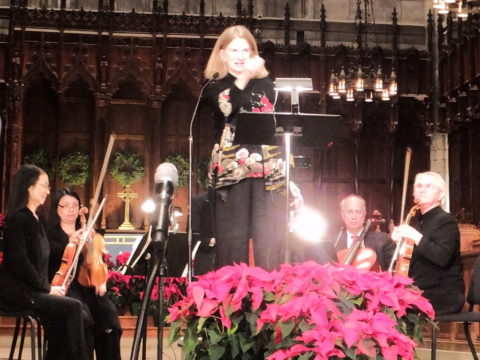
So, that brings us not only to the annual regional presentations of the “Messiah” but to annual Messiah Sings at the Princeton Chapel.
The popular participatory event was started by Penna Rose, a director of chapel music.
In a past U.S. 1 interview, Rose says she initiated the Messiah Sings when the late Joseph Williamson, dean of the chapel, asked her to plan events that would draw people in to experience the newly renovated pipe organ.
As she recalls, “He said, ‘I want you to do anything you can to get people in to hear the organ. They’re not going to come to a service because not necessarily everybody in the community is going to come to a service here. Everybody has their own churches, denominations, whatever, or they’re not into that. So, he said, ‘Do anything you want to do, but just get people in here to hear this organ.’”
“Messiah sings were very popular, and so we did that,” Rose says.
Lionel Trains
Just how did a several-thousand-year-old holiday of light and hope become entwined with toy steam locomotives?
Part of the answer is in the Garden State — where there are more connections than one realizes.
As previously reported by U.S. 1, Montclair State University journalism professor and director of Jewish American studies program Ron Hollander tells the holiday-train connection story in his book “All Aboard: The Story of Joshua Lionel Cowen and Lionel Train company.”
Cowen, obviously, was the man behind the Lionel Company and the one the New York Times called “the father of the toy electric trains that run on thousands of miles of miniature trains track in homes throughout the world.” He is also credited as making his company’s name “the third wing of Christmas along with the evergreen tree and Santa Claus.”
The Lionel train trip starts in 1877 when Cowen (original name Cohen) was born into a Jewish immigrant family run by a sometimes cap maker in New York City. It was an era dazzled by train power.
Cowen seized on using electric power early on but not for running toys; he was focused on selling miniature trains as moving signs that would be placed in department store windows to attract buyers for others’ products. However, people liked his trains and began purchasing them at $4 (when the average wage was $4.30). Soon a series of sales led Cowen to enter the toy train market.
The company was called the Lionel Manufacturing Company, with Cowen saying he used his middle name because “I had to call it something.”
Several factors aligned to help Cowen’s efforts: the expansion of electric power across the nation, the eruption of World War I, and the elimination of toy exports from Germany, and marketing — especially for Christmas.
“Trains have always been inextricably linked with Christmas. Real trains chuffing through snowy landscapes brought people home for this major holiday,” writes Hollander. The sentiment is echoed by Elvis Presley in his 1971 song “I’ll Be Home On Christmas Day,” when he longingly sings, “Be on that train tomorrow, I’ll be home on Christmas day.”
But it was Cowen’s conviction that Americans — especially boys (girls would be later targeted) — wanted to have Lionel Trains and his astute understanding of marketing techniques that are at the heart of the American Christmas train phenomenon. One technique was the highly successful Lionel Trian Catalog.
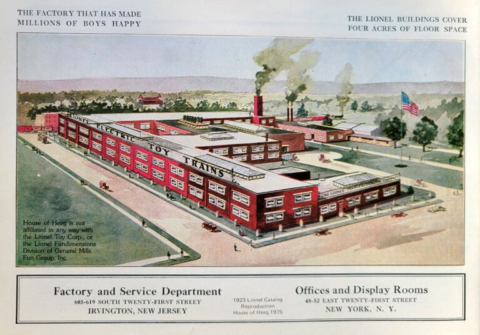
In 1914 the company moved its manufacturing operations from New Haven, Connecticut, to Newark, New Jersey, close to its corporate headquarters and showroom in New York City. Other expansions followed with plants set up in Irvington and then in 1929 in Hillside, New Jersey, where Lionel stayed until 1974 and at one time employed 2,000.
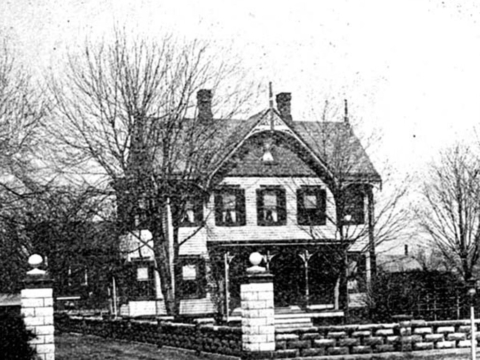
Yet the train connection hits home in many Garden State train displays. As Hollander says, “Many of the Lionel executives lived in New Jersey, so they named the cars after towns: Irvington, Madison, Chatham, and so on. And some of the Lionel model houses are modeled after the executives’ actual houses. They used their houses as prototypes.” The company also used its factories as models for a train layout.
Christmas Lights
The first electric lights used to brighten up the holidays were switched on about 35 miles north of Princeton near Route 1 in Menlo Park. And, yes, Thomas Edison has everything to do with it.
As the Library of Congress reports, “Thomas Edison, the inventor of the first successful practical light bulb, created the very first strand of electric lights. During the Christmas season of 1880, these strands were strung around the outside of his Menlo Park Laboratory. Railroad passengers traveling by the laboratory got their first look at an electrical light display. But it would take almost forty years for electric Christmas lights to become the tradition that we all know and love.”
The above report notes that before electric Christmas lights, families brightened their Christmas trees with candles. They would also accidently cause house fires.
It was Edison’s partner Edward H. Johnson who is credited with creating the first string of electric Christmas tree lights in 1882: 80 hand-wired red, white, and blue Edison’s Illumination Company light bulbs.
However, continues the LOC note, “the world was not quite ready for electrical illumination. There was a great mistrust of electricity and it would take many more years for society to decorate its Christmas trees and homes with electric lights. Some credit President Grover Cleveland (another Jersey guy) with spurring the acceptance of indoor electric Christmas lights. In 1895, President Cleveland requested that the White House family Christmas tree be illuminated by hundreds of multi-colored electric light bulbs.
“(Then) on Christmas Eve 1923, President Calvin Coolidge began the country’s celebration of Christmas by lighting the National Christmas Tree with 3,000 electric lights on the Ellipse located south of the White House.”
For those wanting to get a charge out of a regional electrical lighting display, take a ride to “Martel Family’s Christmas Wonderland” in Hamilton.
Nearing its 40th year, the local hot spot featuring more than 100,000 lights and hundreds of glowing figures was featured nationally on ABC’s “The Great Christmas Light Fight.”
During a U.S. 1 interview, wonderland mastermind Bob Martel noted the following about his inspiration: “I had two Italian uncles who decorated with lights and figures on South Broad Street in Trenton and in Ewing in the 1960s. I used to get a kick out of it. You know, it grows on you. And I said, ‘If I ever did this, I’d overkill.’”
And while the display gets brighter and flashier each season, a set of plywood choir boys painted more than 50 years ago by one of the uncles connects it to its roots and spirit.
Martel says the display that starts at Thanksgiving and continues to January 1 is “all about community” and attracts an estimated 10,000 visitors annually.
The Nutcracker
The creation of the popular seasonal ballet “The Nutcracker” is a story about things being dispersed and then finding a home.
The dance was originally performed in words, a fairy story created by in 1816 by a popular German romantic-era writer of supernatural tales, E.T.A. Hoffmann. His “The Nutcracker and the Mouse King” deals with a young woman’s magical encounter with a Christmas gift, a soldier nutcracker.
Since Hoffmann’s stories are often dark and sinister (young girls meeting men-like rats in the dark!), French popular novelist Alexandre Dumas, author of “The Count of Monte Cristo” and “The Three Musketeers,” adapted it into a more family-friendly version in 1844.
It was the lighter and more commercial story version that attracted Russia’s Imperial Theater director Ivan Vsevolozhsky, who decided to bring it to the stage with the talents of choreographer Marius Petipa and composer Pyotr Tchaikovsky.
“The Nutcracker” ballet premiered on December 6, 1892, to poor notices. The music was considered too symphonic for a ballet. There was lack of complexity and cohesion, and it seemed more for children.
Although the work continued to be performed in Russia and the Soviet Union, the ballet was considered a minor piece and was little known in Western Europe, except for connected excerpts from the second act, “The Nutcracker Suite.”
The first full Western European production of the ballet was in 1934 in London. Former Imperial Theater dancer and theater manager Nicholas Sergeyev, who left Soviet Russia in 1918, choreographed by using notes that he had made and taken with him.
The music preceded the ballet in the United States. And while it was sometimes performed in concert halls, it reached mass audiences in 1940 when Walt Disney’s film “Fantasia” used animated fairies, flowers, and mushrooms to dance to the suite.
Four years later the American “Nutcracker” tradition started when San Francisco Ballet’s William Christensen produced the first full version. His work was informed by a discussion with expatriate Russian dancer Alexandra Danilova and choreographer George Balanchine (soon to emerge as one of the world’s most important choreographers and theater artists).
Balanchine, who performed several roles with the original choreography in St. Petersburg, then produced his own version of the ballet in 1954 for his New York City Ballet. Balanchine not only established an American production that could claim direct roots to the original but brought the ballet into American living rooms when he adapted his production for a television special in 1958.
All of these elements took root in Princeton, where the American Repertory Ballet is heir to a 60-year tradition — one of the oldest in the nation.
It was started by Audree Estey, the Canadian-born founder and director of Princeton Ballet Society that, after a few name variations, became the professional American Repertory Ballet (which maintains the Princeton Ballet School).
After a typical nomadic dance experience, Audree Phipps married Lawrenceville School English teacher Wendell “Bud” Estey and moved to the Princeton area in 1933.
Here she began providing classes at the Lawrenceville School and seemingly any place she could use, including the garage of physicist J. Robert Oppenheimer.
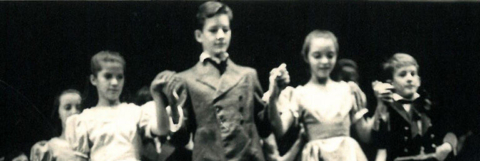
In the early 1950s she began working on creating a company and using full-length ballets for dance recitals. In 1956 the Princeton Ballet Society presented “The Nutcracker,” featuring Estey’s choreography, accompaniment by piano and harp, the Madrigal Group of Miss Fine’s School, and, according to the program, “150 dancers from the age of 5 to 18, all girls but one, and 12 adults.”
The notes also add that “scores of parents and friends of the society have helped in preparation of the sets, the program, and on other backstage problems,” setting the stage for the future company and the regional ballet tradition.
Several years later, in December 1964, Estey proposed establishing an annual Christmas “The Nutcracker” presentation. Ballet Society member and later McCarter Theater special programmer William Lockwood embraced the idea and forged the partnership between the society and the theater (initiating what is now known as Dance-At-McCarter).
And, obviously, enriching our region with just one of several homegrown traditions.