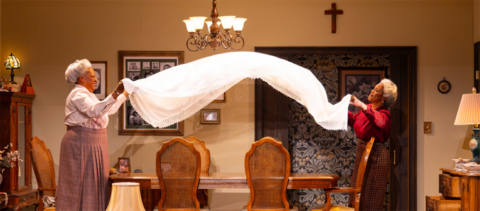
Emily Mann is a shrewdy. Rather than build a traditional fourth wall for her play, “Having Our Say,” she employs the format in which the story of two centenarian sisters is originally told, a conversation directly to the listener.
At George Street Playhouse, the actual listener is the audience, but as Mann constructs “Having Our Say,” the specific listener is Amy Hill Hearth, the author of the book Mann works from. The way the conceit works, Hill Hearth has come to the Delany Sisters’ door to broach the subject of a book, and those scrappy sisters invite her in, serve tea, and start talking.
That’s when the charm begins. Sadie and Bessie Delany (Inga Ballard and Rosalyn Coleman), age 103 and 101, reveal a century of memories. They are so cordial and entertaining, the two-and-a-half hours they spend with can double in time, and I think the George Street audience would remain rapt for the duration.
Ballard and Coleman weave a powerful spell as they tell Hill Hearth about Delany family history, which includes slavery, open coupling between the races (because miscegenation laws forbid marriage), being two of nine children, receiving college educations, taking up advanced professions, being active in the civil rights movement, and taking care of their mother in her last years.
The revelations remain natural and worth hearing. Ballard and Coleman each convey an individual personality, but the beauty is seeing how Sadie and Bessie act so often as a unit, enjoying what the other has to say and seconding memories from another century, the heyday of the Harlem Renaissance, and their later years, which are the last decade of the 20th century.
Laiona Michelle, as she proved last season with “Her Portmanteau” and off-Broadway in her portrayal of Nina Simone, “Little Girl Blue,” is fastidious in her productions. Scene changes and transitions occur seamlessly. Surges of personality, as when Sadie consciously retains her calm or Bessie abandons calmness or any facsimile, come organically and completely fit the moment to which they give texture. Michelle’s entire production is a tribute to discipline that is so well learned, it becomes relaxed and artless.
George Street’s “Having Our Say” is a thing of beauty. A lot is said, a lot is done, and none of it seems wasted, extraneous, or showy. In addition to listening to the sisters recount lives that include close acquaintance with Booker T. Washington, W.E.B. DuBois, Ethel Waters, and Eleanor Roosevelt, we see them prepare their father’s favorite meal, as Hill Hearth arrives on the Delany patriarch’s birthday, February 5.
Sadie was the first teacher of domestic sciences in New York City high schools, and you can tell both Inga Ballard and Rosalyn Coleman know their way around a kitchen as they nonchalantly baste a turkey, fasten pineapples to a ham, mix macaroni and cheese from scratch, and chop numerous vegetables. Michelle keeps her actresses and their characters busy, yet they never miss a beat or lose their story while multi-tasking.
We not only get to hear the Delanys’ fascinating tale. We are treated to a slice of their lives.
They tell us their routine, which includes drinking gallons of water, eating five vegetables and seven fruits a day, and practicing yoga (at which Bessie sometimes cheats).
A relationship is established, a story is told, and a dinner is cooked, and all as if in Sadie and Bessie’s stride.
Ballard and Coleman are adroit at defining their individual characters.
Sadie is referred to as her mother’s child, one who followed her mother around as if she was attached to her and who took on her gentle disposition.
Inga Ballard exudes an inner peacefulness as Sadie. She gives Bessie sly, disapproving looks at times, especially when she catches her adding a half-pound of butter to the mac and cheese she’s so carefully prepared. But she never loses her temper or her knack for diplomacy.
Bessie is a tad more demonstrative. When something gets on her nerves, even something from 70 years ago, she rails and raves. Rosalyn Coleman shows us what a pistol Bessie was in her day, in all of her days, and how she didn’t take much guff from anyone, even when it was dangerous to speak her mind, as when she was living in or visiting the South. Sadie comments it’s a wonder Bessie was never lynched, especially after she sassed a man at a Southern train station.
Coleman is amazing in portraying all of Bessie’s moods and making them arise and disappear as naturally as she plays Bessie’s unemotional sequences.
Bessie’s moods include sporadic but sudden bouts of the blues, a depression that drives her to tears and makes her body shake. Coleman brilliantly plays one such eruption with Ballard being equally moving as Sadie works to caress and sooth her.
That’s why Bessie calls her “Sweet Sister Sadie.”
The Delanys relate how they dealt with Jim Crow laws, prejudice, and unfair practices. The story of how Sadie became a high school teacher is especially good.
Revealing how they both lived to be 100 – Sadie dies at 109, Bessie at 104 – they mention their family’s history of longevity, then Bessie blurts out, “It’s because we didn’t have any husbands or children to worry us to death. Sadie laughs, Bessie follows, and when Rosalyn Coleman lets loose on one of Bessie’s big laughs, you can’t help laughing with her.
“Having Our Say” contains everything. It’s warm, but some of what happened to the Delanys can make you angry. It’s funny but not when it talks about the laws that followed the Plessy-Ferguson decision of 1896 that changed everything in the South by sanctioning segregation and bigotry.
Kudos all around to Emily Mann, Laiona Michelle, Inga Ballard, Rosalyn Coleman, and George Street Playhouse for creating such a rich, textured experience. This is one production to be savored.
Mann and George Street have made a particularly auspicious start to the 2023-2024 season, Mann’s “The Pianist” and “Having Our Say” being two of the finest productions of any year.
The designers are as meticulous as Michelle and her cast. Shobo Kambara’s set is tasteful and creative yet has a lived-in look. Pictures are strategically placed on walls and tables for the Delanys to show us. The furniture is perfect for the women, traditional and respectable but not stodgy. The kitchen is ergonomically efficient, as a domestic science specialist’s would be. Wallpaper choices give a kicky touch to the kitchen and upstairs walls. One element I questioned was a pair of steps that lead from eating areas to the Delanys’ sitting room. As I watched Ballard and Coleman negotiate them, the steps stopped looking like a design oversight and became a tribute to the sister’s independence and dexterity.
Ari Fulton’s suit for Bessie Delany was especially smart, giving Bessie the air of the professional, a dentist known throughout Harlem as Dr. Bessie, she is. Sadie’s dress was more modest and a tad old-fashioned. It suited her perfectly. Projections by Zavier A.L. Taylor brought the entire Delany family and the people they knew close to the audience. Lighting by Jason Lynch and sound by Karin Graybash enhanced Michelle’s production.
Having Our Say, George Street Playhouse, Arthur Laurents Theatre in the New Brunswick Performing Arts Center, 11 Livingston Avenue, New Brunswick, through Sunday, December 17, Wednesday through Saturday, 8 p.m., and Thursday, Saturday, and Sunday, 2 p.m. $45 to $90. 732-246-7717 or www.georgestreetplayhouse.org.