In 1951, Gian Carlo Menotti was commissioned by NBC to compose the first opera that would have its premiere on television. The work would also inaugurate a new series of seasonal special programs, “Hallmark Hall of Fame.”
History begets history as Menotti’s opus, “Amahl and the Night Visitors,” seen first in December 1951 remains a staple in the opera repertory, especially at Christmas, given that the “night visitors” are the three kings of Orient, the three wise men, or the magi, whichever you prefer. Menotti makes a joke of the various references in his libretto.
Stepping out of its usual theater setting, Boheme Opera of New Jersey is presenting “Amahl and the Night Visitors” at three different churches this month. The debut performance, at Mary, Mother of the Church Parish (St. Mary’s) in Bordentown, reinforced two of my impressions. Menotti’s opera is a sturdy piece that blends piety with humor and human generosity with human failings to both warm and entertain. It naturally receives a fine production from Boheme Opera, a company that strives for and achieves excellence and pays attention to theatrical detail while making the stories it tells resonate.
To be frank, while churches are often used for musical performance, and churches deserve credit for cultivating music and other arts, they do not always offer the best acoustics. The vastness of St. Mary’s swallowed some of the vocals, especially by singers in the higher ranges. The music soared up but not always out to the house.
No fear. Artistry, and sharp diction, won out. Boheme earns a reputation for casting singers whose voices are particularly engaging. It also has a knack for casting singers who can act. The quality of their performances, individually and as an ensemble, retained and conveyed the spirit, compassion, comedy, and overall goodness of “Amahl.” Points made about charity, faith, wonder, and seeking the possibly miraculous come through. So do Menotti’s jokes about Amahl telling so many tall tales, his mother doesn’t believe him when he tells her three kings are at their door and his use of hard-of-hearing King Kaspar to confuse some situations. Joseph Pucciatti is a strong director and conductor. He knows how to elicit drama and jesting from his actors. He also conducts meticulously.
The Boheme orchestra, if anything, benefited from St. Mary’s nooks, arches, and caverns. Choral work also received a boost from the church’s space and openness.
“Amahl and the Night Visitors” has a religious theme – The kings are following the unusual Star of Bethlehem in search of the special child they hear has been born there — but it goes beyond religious lore to the basic components of drama.
Amahl and his mother live in poverty. The kings are fatigued and famished from their day’s journey and see only a shelter where they may obtain food and rest. They do not notice the meanness of Amahl and his mother’s hovel. They expect a warm room while Amahl’s mother cannot afford the wood to light a fire. They expect repast while Amahl’s mother has had to sell the sheep she and Amahl once tended to provide the little sustenance they have.
The kings, travelling as they are to seek an extraordinary being, a rumored Messiah, are open-minded. When they see the poverty, they respond. So does the community around Amahl, which arrives with food his mother cannot provide. A rash but understandable act is understood and mercifully excused. Belief or, more the point, generosity, does lead to a miracle.
Menotti tells a lovely story, one he is alleged to pulled out of his musical hat just days before his live opera was to be broadcast on NBC. Pucciatti, his cast, and orchestra realize that story. “Amahl and the Night Visitors” merits its place as a Christmas staple.
Realizing the individual characteristics of the three kings is the key to Boheme’s success with “Amahl.” Kevin Patrick, as the witty and quickest to comprehend King Melchior, provides a tone for Pucciatti’s production by signaling a merry spirit while conveying empathy for the situation he sees in Amahl’s dwelling. Martin Hargrove, as the stately King Balthasar, expresses the majesty and dignity of the magi while joining with Melchior in being kind to Amahl. Mathew Tartza amuses as King Kaspar, whose difficulty in hearing precludes him from keeping up from all that is going on. He also begins the opera’s generosity by offering Amahl a piece of licorice and forgiving the rash trespass mentioned earlier.
As Amahl, Courtney Neiman displays her character’s mischievous side but also shows how taken Amahl is with the kings and their stories, how brave he is in defending his mother at a critical moment, and how he is moved to make his own gift to the child in Bethlehem once he learns of the magi’s intention.
Alyce Daubenspeck is delightfully wry as she listens to Amahl speak of an unknown star and doubts his report of three kings at her door. Her transitions as situations change and her inner debate before committing a desperate act show Amahl’s mother as a knowing woman who is aware of her son’s tendency to exaggerate, conscious of what the kings can do for her family, and willing to take a risk to ensure some security for her and Amahl.
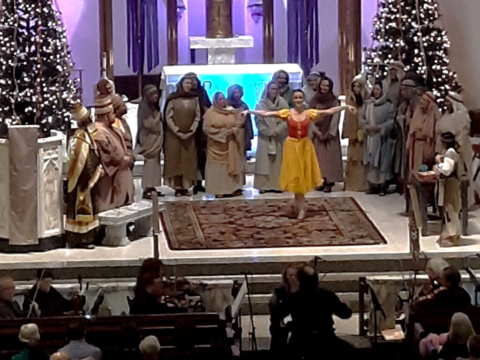
Dante Doganiero is watchful as the kings’ page and displays a fine voice when his character has to change to sing with passion. Marika Kossakowski provides as much diversion for the Boheme audience as she does for the kings when her character is called upon to dance for Amahl’s guests. No choreographer is listed, but Kossakowski does a dance reminiscent of those Agnes DeMille created for Rodgers and Hammerstein musicals and Aaron Copland compositions.
The Boheme orchestra is integral to the success of “Amahl” and of a brief cavalcade of holiday music that preceded it. It is difficult to single out special members of the troupe, but it was particularly sweet when oboists Nicholas Gatto and Emma Coleman-Ratini played the tune Neiman mimed Amahl playing on his pipe.
The set was simple and used the altar of the church, unadorned for the most part. The costumes, especially among the chorus, were quite well done, summoning the Biblical time in which “Amahl” is set. They are another testimony to the attention Boheme gives to each component of a production.
“Amahl and the Night Visitors” has two more performances, at 6 p.m., Sunday, December 10, at the Church of St. Gregory the Great, 4620 Nottingham Way, Hamilton Square, and at 6 p.m., Saturday, December 16, at St. David the King Parish, 1 New Village Road, Princeton Junction.
Tickets for both performances are $30 for adults. Children, ages 12 and younger, may attend for free. Tickets can be obtained at www.bohemeopera.org.