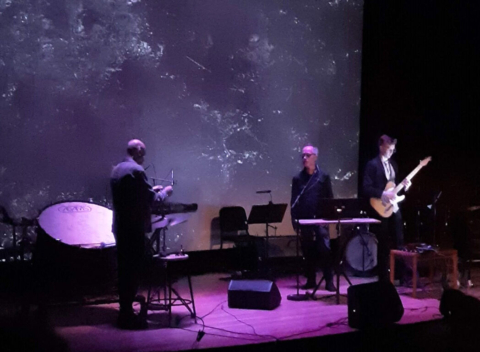
The Princeton Sound Kitchen is post pandemically reasserting itself a place for musical exploration and innovation.
Currently organized by Irish composer and Princeton faculty member Donnacha Dennehy, the Sound Kitchen offers performances by active accomplished composers and musical artists participating in the university’s graduate efforts. It also involves guests artists, ranging from cutting edge experimenters to masters of specific cultures or approaches.
Its most recent session on October 24 provides the apt illustration. The presentation of eight new works included the following performers: So Percussion, the internationally known innovators who have a presence in New York City as well as being artists in residence at Princeton University; and the New York/New Jersey-based The Hands Free acoustic quartet.
Also presenting were performers Van-Anh Vo, an Emmy Award-winning composer, đàn trahn (a type of Vietnamese zither) musician, and musical collaborator who’s engaged with noted concert hall musicians including Yo-Yo Ma and the Kronos Quartet; and Iarla Ó Lionáird, an international noted performer whose range includes the Irish Sean Nos Song (old song style) to contemporary opera and musical experimentation.
The program opened with “Ghost School,” a work composer James Moore developed during the So Percussion Summer Institute in Princeton, conducted during the 2020 pandemic. As the program explains, the poem is the convergence of several elements. It was inspired by the poem of the same title by Korean writer Kim Hyesoon and developed with musicians employing traditional instruments and technology to maintain COVID protocols.
With the percussion ensemble emphasizing array of found natural sounds and composer/musician Soo Yeon Lyuh performing on a haegeum (a Korean string instrument), the work had a freshness that belied its original birth in technology and established the mood that dominated the evening – one filled with innovation but more soulful and often having an affecting beauty, the latter of which being something that had been dropped from new music years ago, yet seemingly rediscovered over the past few years.
Also present in the program was a connection to spirit pulled from various religious tradition. Soo Yeon Lyuh and Van-Anh Vo’s “Love, Life, Loss, You, Me, and Us,” was, according to the artist in a program statement, a vocal and instrumental soundscape where they aimed “to create a sense of belonging “and create a work in memory of lost family members.
Add to that Gulli Bjornsson’s “Salm 51” and “Salm 55” (Psalm 51 and 55). Accompanied by Bjornsson on guitar and electronics and So Percussion’s Jason Treuting on percussion, O Lionaird’s sang the confessional text with stoic and restrained acceptance that heightened the emotionality of the piece.
Also contributing to this moment were the theatrical production elements present throughout the evening, but in the use of abstracted images suggesting waves and landforms created a visual poetry that elevated the mood.
The final work, “Ciest na Teangan” (The Language Issue) seemed to be a final statement of a mood that had been established early and maintained throughout most of the program – except for the composer Hope Litwin’s “Let go, Echo,” a lively and engaging rhythmic video-dance work.
The final work was also by Moore and likewise involved a poem, “Ciest na Taeangan” by contemporary Irish poet Nuala Ni’Dhomhnaill. The presentation was made by O Lionaird along with The Hands Free musicians Caroline Shaw providing accompanying voice and violin, James Moore on banjo, and Eleonore Oppenheim on double bass.
With music rooted in Irish-American folk music traditions and O Lionaird’s slow and melodic release of the lines in Irish and shadowed by Shaw’s repeating in English the author’s placing her “hope on the water in this little boat,” the song evoked hope and longing.
Sung first in Irish by O Lionaird and then answered by a Pulitzer Prize-winning composer in an English translation by Pulitzer Prize-winning Irish-born poet Paul Muldoon, the work was achingly beautiful.
It also easily demonstrated the high level of artistic engagement that the free Princeton Sound Kitchen offers those looking to engage with new music, sounds, and ideas throughout the year.
Princeton Sound Kitchen, Taplin Auditorium in Fine Hall, Princeton University, next presentation is SEO ‘Toy Store,’ with new works performed by violinist Jingoo Cho and harpist Parker Ramsey, November 29, 8 p.m., Free. www.princetonsound.