Nationally noted U.S. 1 region artist Mel Leipzig recently became the subject for the most recent Artists Magazine issue for both his artistry and for something reflective our current issue — his productivity at the age of 87.
Artists Magazine editor-in-chief Anne Havener introduces readers to the issue by pointing out a phenomenon that many reporting on the arts have observed: Artists often continue painting and working at an age when many in other professions have stopped.
Havener starts by looking back into art history and notes that “even with his vision greatly diminished by cataracts, impressionist painter Claude Monet continued to paint well into his 80s. At home, in the quiet seclusion of his beloved gardens, in Giverny, the artist centered his interest, almost obsessively, on painting the beautiful lily ponds. His longtime fascination for color and light, and the beauty of the natural world, continued to excite his muse, and the artist created several hundred compositions in the final decades of his life.”
She then turns her glance to today and says that this issue celebrates several contemporary artists, including Leipzig, “who, like Monet, continue to make and exhibit their artwork well into their late 80s and 90s.”
Artists Magazine writer Cynthia Close dips deeper into the theme by writing, “During my first conversation with New Jersey-based figurative artist Mel Leipzig, he immediately launched into an excited description of a portrait he was painting of a musician he’d recently met — a guitarist, dressed for the painting in a fabulously patterned Nigerian garment. Leipzig’s total immersion in his work was electric. His barely contained energy and enthusiasm for sharing his discoveries drove the interview forward.”
While Close’s article provides details of Leipzig’s personal and professional history, both frequently reported in past U.S.1 issues, the artist’s own comments about his method of painting point towards something that is a key to creativity and engagement: a willingness to change.
As he tells Close, “Years ago, I’d make elaborate preparatory drawings, but in the early 2000s, I started painting directly on canvas from life and finishing the work in one sitting.”
He also has added to the limited color palette he used for decades and incorporated a new approach to making a vibrant and imaginative use of color and design, sparked in part by his interaction with Trenton graffiti artists as well as tattoo artists, including his son, Joshua.
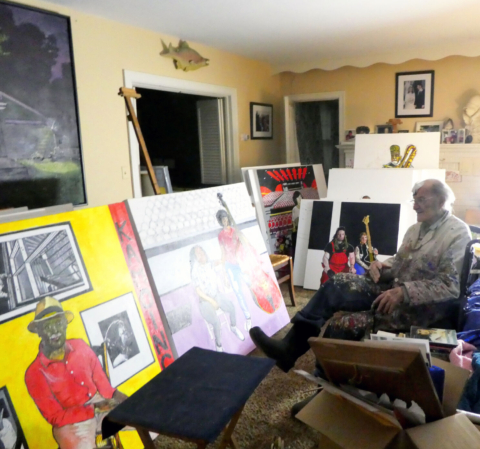
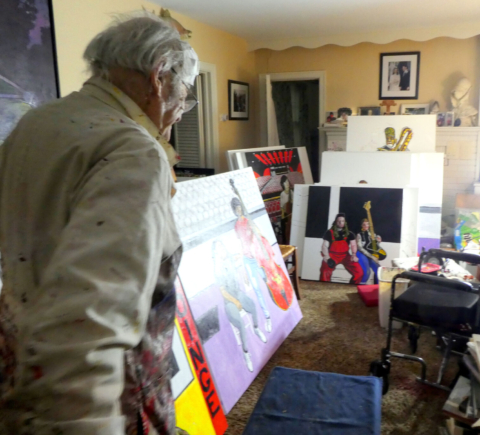
A recent visit to Leipzig’s Trenton home shows the artist deep at work — surrounded by approximately 25 works-in-progress depicting models who come to his house to pose.
Currently, subjects are curated by a few friends who know Leipzig’s interests and connect him with the models.
One such individual is Trenton-based arts collector and dealer Lawrence Hilton, who will be participating in the November 30 Arts Council of Princeton panel discussion “Restoring the Overlooked History of Black Artists in Princeton and Trenton in the Later 20th Century Through Local Research, Preservation, and Oral History” as part of the ACP’s current exhibition “Retrieving the Life and Art of James Wilson Edwards and a Circle of Black Artists.”
In addition to introducing Leipzig to a good number of jazz musicians that he knows through years of scheduling the jazz series at Trenton’s Candlelight Lounge, Hilton, a retired senior himself, also has arranged sittings for several area political leaders, arts supporters, or interesting members of the community.
Additionally, there are paintings of area artists working in different media and approaches, such as the Trenton-based artist Flykickz, who creates art using sneakers.
“Where would I get such models?” says Leipzig who after years of traveling to paint artists around the region now paints exclusively in his living room.
So what’s the secret formula that gives artists an edge as they age?
Havener offers a thought, “Perhaps the productivity stems from a continued curiosity with the world and, as the 20th-century writer Franz Kafka suggested, an ability to see the beauty in it. To this, I would also add an unstoppable drive not only to observe but also to express — to bring to life their creative vision — and to share it.”
But as Leipzig often says, “I don’t know what I would do if I didn’t paint…just sit around?”