Aubrey J. Kauffman at the Arts Council of Princeton
New Jersey photographer Aubrey J. Kauffman’s “Constant Repeating Forms” exhibition at the Arts Council of Princeton uses bold and silent images to remind viewers of the power of pure photography and call attention to the reality that the artist is a master.
While the photographer and I have had a long personal and professional association — we were both involved with the Trenton Artists Workshop Association projects and Kauffman is a contributor to U.S. 1 — I have also had a longtime respect for Kauffman’s dedication to capturing forms that engage viewers and provoke reflection and wonder.
Several years ago, the photographer asked me to write a statement for one of his exhibitions. I started off by connecting him with a visual artist and find the following helpful to put him and his current exhibition in place:
“In his groundbreaking book ‘Paterson,’ American poet and New Jersey resident William Carlos Williams called for readers and fellow artists to see images — including those of his northern New Jersey environment — as a means to communicate the interior world of thought and feeling:
Say it, no ideas but in things –
Nothing but the blank faces of the houses
And cylindrical trees
Bent, forked by preconception and accident –
Split, furrowed, creased, mottled, stained –
Secret – into the body of the light!
“Williams’ call was soon taken up by other artists, including Newark-born poet Allen Ginsberg, who forged a direct link to Williams and conjured word images of his own ‘No Where Zen New Jersey’ landscape, and Passaic native and innovative sculptor Robert Smithson who pulled inspiration from the urban New Jersey landscape, prompting him to ask in his essay ‘The Ruins of Passaic,’ ‘Has Passaic replaced Rome as the Eternal City?’
“Trenton, New Jersey, photographer, Aubrey Kauffman seems to understand Williams’ argument and the other artists’ attraction.
“As both a visual artist and photojournalist for New Jersey Network, Aubrey Kauffman has physically and spiritually grown among the ‘ideas,’ ‘things,’ ‘blank faces,’ and ‘light’ of the New Jersey urban landscape.
“And while many of us hurry through our lives and places, Kauffman has carefully and caringly stopped, studied, and captured the ‘things’ that surround us, creating a history of our collective, and often forgotten, glimpses.
“By placing these silent shapes, stark patterns, and planes of light in exhibitions and publications, the photographer quietly shares with us the opportunity to see anew, recall half-remembered scenes, and discover the ‘things’ that have shaped our ‘ideas.’
“As Williams strove in his poetry to create images that would resonate, Aubrey Kauffman’s images suggest poetry and provide visual cues to help the viewer stay connected to the world … and one’s self.”
The photographer explains his work with, “Urban studies have long been a major part of my photographic practice. My work extends from abandoned urban structures and shopping malls to building facades, parks, and ball fields. I have created images of several sites including basketball courts, stadiums, and soccer and lacrosse fields. In all cases they are devoid of activity and human interaction. I am drawn to these unoccupied spaces because of the architecture and the visual interaction with the surrounding landscape. I am also intrigued by the vision that takes shape in my viewfinder.’”
In addition to exhibiting at Rider University, the New Jersey State Museum, Allentown Art Museum, Newark Museum, and 7th Street Gallery in New York City, Kauffman was a longtime photojournalist for New Jersey Network and gallery manager for Mason Gross School of the Arts Gallery in New Brunswick.
As noted, Kauffman has been an active artistic presence in Trenton and central New Jersey.
As president for the Trenton Artists Workshop Association, he coordinated the regionally important Trenton City Museum exhibition and publication “Trenton Takes: 24 Hours in the City.” For that project Kauffman coordinated a team of photographers to capture a simple day of life in the capital city.
Born in Princeton, Kauffman grew up in Lawrence. His father worked at U.S. Steel, and his mother was a clerical worker. He graduated from Lawrence High School in 1971, took classes at Mercer County Community College, and received a degree in broadcast production from Jersey City State College.
He says that it was the broadcast curriculum that connected him to the art form for which he is known. “Photography was required, and it was a way to express myself. I had never taken any art. It was a new experience.”
Kauffman credits Mercer County Community College instructor and veteran photographer William Barksdale for opening a world to him. “He had a great influence. He was like one of the old masters. He had been teaching for years so he knew how to get a student to understand what good photography was.”
That, he says in his well-known soft voice during a past interview, “is a (technically) well executed print, with a well rounded idea, one that helps you see your feelings and ideas and intuitions come across in what you’re trying to portray. You can look at a certain artist’s work and know it’s by that artist.”
Kauffman says that after graduating from Jersey City he attended Philadelphia College of Art, now the University of the Arts, and met Ron Walker, the eventual chairman of the photo/film department.
“He introduced me to the work of others who had accomplished what I was trying to do. In a sense, he helped me find my voice. I consider Ron my biggest influence as both a friend and teacher. We’ve kept in touch over the years. He’s now a vice president at Rider. One of my photographs is hanging in his office.”
For years Kauffman — who lives in Ewing with his wife, Michele, and has a studio in Trenton — labored to create crisp black-and-white images that frequently celebrate structures found along New Jersey highways and roads. Recently he has carefully introduced color into his arrangement.
“Occasionally I’m shooting things in color — it’s not the main focus. I’m looking at visual elements, like how I compose things in a frame. What is your relationship to the object?”
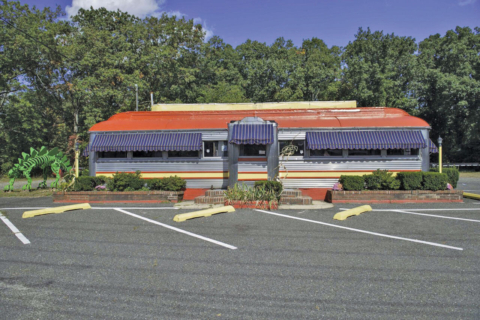
Kauffman also does not focus on the human experience, though they may appear in his photos. Rather the emphasis is on urban landscapes — often adding sly touches of wit — as in the current exhibition’s new images of an everyday diner with a dinosaur construction next to it and the empty lot behind a large used car sign.
While these colorful images certainly show the artist’s ability to play, his real skill is in creating visually intriguing scenes out of the ordinary, such as the “Blank Wall,” where he uses existing planes, lines, colors, and shadows to show the poetry of an everyday scene.
Constant Repeating Forms, Arts Council of Princeton, 102 Witherspoon Street, Princeton. On view through October 9. Monday through Friday, 9 a.m. to 5 p.m., Saturday, 9 a.m. to 4 p.m. Free. 609-924-8777 or www.artscouncilofprinceton.org.
Kenneth Kaplowitz at the College of New Jersey
“My Camera is Always With Me: Professor Emeritus Kenneth Kaplowitz 50 Year Retrospective Exhibition,” featuring more than 100 works, is a celebration of career in learning and sharing the art of seeing through the lens.
Kaplowitz says in a U.S. 1 interview that his life in art started when he was three years old. That was when his first drawing of a horse made his mother so proud that she showed it to everyone in the apartment building where their family lived above his father’s cabinet store on Springfield Avenue in Newark, New Jersey. It then earned a proud place on the family refrigerator.
Kaplowitz, the oldest of three boys, is Newark born and raised — attending several schools in Newark before graduating from Arts High, which was the first high school in the nation to be devoted to arts and music.
During an interview at his home in Pennington, Kaplowitz, 80, says the four years of studying art four hours each day at Arts High led to him being a “seasoned painter” by the time he graduated. In fact, one of his high school paintings was selected to be in the first New Jersey Bi-Annual Exhibition at the Montclair Museum.
“I was very shy,” says Kaplowitz. “So going outside to play with children was not my favorite thing to do. I was a recluse in a sense. I stayed in the house and I got very bored doing that, so my mother gave me crayons and paper, and I kept drawing.”
After the school years of developing skills, drawing covers for the elementary school yearbook, winning competitions for his drawings, and creating cartoons for a weekly school magazine with a fellow classmate and having it featured in the Newark Star Ledger, he received a BA in art education from Montclair State University and began his teaching career.
He started at an elementary school in Irvington, New Jersey, and — after receiving a MA in film and television production from NYU and an MFA in sculpture from Rutgers University — eventually joined what is now the College of New Jersey in 1970 as the college’s TV coordinator and then teaching photography, multi-media and TV production, and filmmaking.
In 1980 Kaplowitz moved to the art department, where he taught drawing, figure drawing, and photography, served as photography coordinator for 14 years, and started his 45th year of teaching at TCNJ this fall.
Kaplowitz — who was also involved with theater and playwriting as a student — shrugs off the renaissance-man label by saying, “I like all the arts basically. I can’t dance.”
After moving through different mediums and styles, he found that photography was the form that best suited him and for practical reasons. “It was difficult to store sculpture, ceramics, and paintings. You just had to have more space, and I wound up with less and less space over the years. Then the digital revolution came along in photography,” he says, adding that he can store thousands of prints in less space than one piece of sculpture.
A long-time exhibitor dealing with a lot of styles — he once filled a gallery with hanging rubber inflatable sculptures — Kaplowitz says his interest in the abstract and surreal have served him well with the evolution of his work.
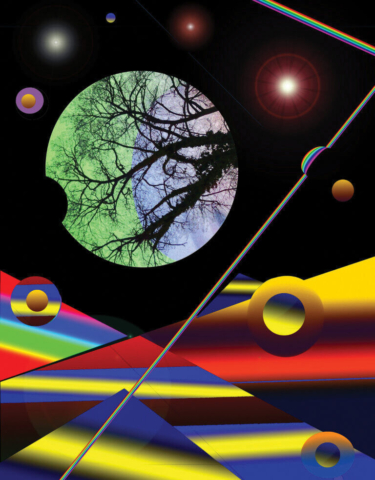
His process is to use layers of different photographic elements to create a single work, using digital information to compose an image or construct a scene like a painter would on a canvas. The canvas in this case is the computer screen.
Some images can have 50 different layers or more. Kaplowitz says it can take weeks or even months to complete each one. He takes hundreds and sometimes thousands of pictures each month and then takes a portion or an element from each image to create a story. “It’s much like taking puzzle pieces and putting them together in a different arrangement.”
Kaplowitz’s main tool is a Canon G15, a pocket-size camera carried in a pouch on his hip. “I find it very convenient because wherever I am my camera is with me. I can take a picture of the grill of a car and use it for a face, a light in my room and use it as lighting in one of my pictures. I literally take pictures of everything. I never know what I’m going to need.”
My Camera is Always With Me: Professor Emeritus Kenneth Kaplowitz 50 Year Retrospective Exhibition, TCNJ Art Gallery, Art & Interactive Multimedia Building, College of New Jersey, 2000 Pennington Road, Ewing. On view through October 17. Tuesdays through Thursdays, noon to 7 p.m. and Sundays, 1 to 3 p.m. Free. 609-771-2633 or tcnjartgallery.tcnj.edu.