The relationship between scientists and the public is in a strange place. Public opinion polls continue to show that Americans overwhelmingly trust and support the scientific community, at least when asked about it as an abstract concept. But on specific issues, there is a huge gap between what the scientific community has learned and what the public believes.
For example, a 2016 poll by the Pew research center showed that 88 percent of scientists believe that it is safe to eat crops that were bred using genetic modification. However, only 37 percent of the general public believed the same thing. What explains the gap, and how can scientists better communicate their findings to the public, when their voices must compete with clamoring charlatans on social media?
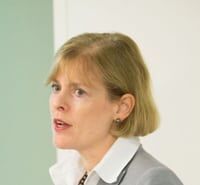
Denialism among the general public is just one of the many issues facing scientists as they strive to advance the frontiers of knowledge. Princeton professor Angela Creager, a science historian, will discuss this topic at an upcoming “Science Cafe” talk on Thursday, June 28, at 5:30 p.m. at Princeton’s Frick Chemistry Lab. Tickets are $15. For more information, e-mail weintraubr@gmail.com.
Creager, together with moderators, will discuss how scientific progress has changed over the years, from the days of individual “giants” like Galileo, Newton, and Curie, to modern team-based science, and how science can persevere in the face of societal appetite for instant solutions.
At Princeton Creager studies the history of 20th century biomedical research. She earned her undergraduate degree in biochemistry and English at Rice University in 1985 and a doctorate in biochemistry in 1991 at Berkeley and retrained as a historian of science as a post-doc at Harvard and MIT. Her first book, “The Life of a Virus: Tobacco Mosaic Virus as an Experimental Model,” 1930-1965 (2002), shows how a virus that attacks tobacco plants came to play a central role in the development of virology and molecular biology. Her second book, “Life Atomic: A History of Radioisotopes in Science and Medicine” (2013), traces how and why artificial radioisotopes were taken up by biologists and physicians, and examines the consequences for knowledge and radiation exposure.
She is also the co-editor of three volumes, most recently “Science without Laws: Model Systems, Cases, Exemplary Narratives” (2007). She currently directs the Shelby Cullom Davis Center on the theme “Risk and Fortune” and is writing a book on science and regulation in the 1960s through 1980s.