Two architectural announcements this week are note worthy. One for what is happening in our region, the other for what is going to stop being here.
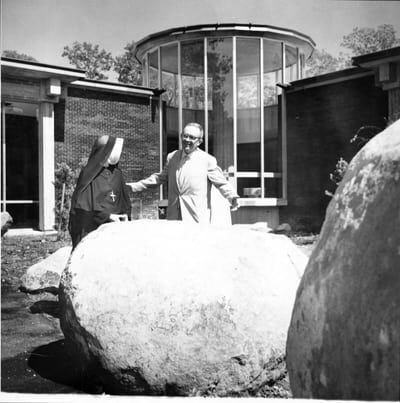
The former is the Sunday, February 2, Stuart Country Day School of the Sacred Heart lecture and tour, “Labatut’s Stuart.” The event highlights the career and vision of internationally known architect and Princeton University professor of architecture Jean Labatut, designer of the school that is celebrating its 50th anniversary.
The program features guest speakers architect J. Robert Hillier and historic preservation architect Jorge Otero-Pailos.
Labatut was born in 1899 in Martres-Tolosane, Haute-Garonne, in southwest France and began his architectural studies in 1919 with L’Ecole des Beaux-Arts in Paris.
A practicing architect by 1924, Labatut gained an early international reputation, serving as a consulting city planner for Havana, Cuba; an associate architect and landscape designer for the Spanish town Castillega de Gusman; and an educator with the American Summer School of Fine Arts at the Palais de Fountainbleau, France.
His design work during this period garnered several awards that include the 1925 medal of the Societe des Artistes Francais, and the 1926 Premier Second Grand Prix de Rome.
Labatut joined Princeton University as a professor of architecture in 1928 and continued for nearly 60 years, serving as director of graduate studies in architecture and becoming the first recipient of the award for distinction in education sponsored jointly by the American Institute of Architects and the Association of Collegiate Schools of Architecture.
Labatut lived with his wife, Mercedes, on Snowden Lane until his death in 1986.
Among Labatut’s United States projects were the water, light, and sound displays at the 1939 World’s Fair in New York City, the founding of the university’s Bureau of Urban Research in 1941, and the designing of Princeton’s architectural laboratory in 1949.
The Stuart school was built in 1963 and incorporates what Labatut called Eucharistic Architecture: structures that use a variety of design approaches — including the mixing of familiar references and approaches with abstraction — as the means for the visitor to have a larger or spiritual experience. His ideas were stimulated at Princeton, where Catholic philosopher Jacque Maritain came after fleeing Nazi-occupied France.
A guided tour of the Stuart building will be part of the program. Princeton-based architect Hillier studied under Labatut at Princeton University and served as Labatut’s designer/drafter on the Stuart project. Hiller, in addition to being a visiting lecture at Princeton’s School of Architecture, is widely known for founding Hillier Architecture in 1966. The firm received more than 300 state, national, and international awards before merging in 2007 with RMJM from Scotland to create the third largest architecture firm in the world. And in 2009 Studio Hillier was established — with Barbara Hillier — as a “human-centric, research-based architecture and urbanism practice.”
Otero-Pailos is an architect, artist, and assistant professor of historic preservation in Columbia University’s Graduate School of Architecture, Planning, and Preservation. He is the founder and editor of the journal Future Anterior and the author of “Architecture’s Historical Turn: Phenomenology and the Rise of the Postmodern,” which traces the intellectual origins of postmodern architectural theory.
The free and open lecture and tour are set from 1 to 3 p.m., starting at the Stuart Little Theater, 1200 Stuart Road in Princeton.
Celebrate Jean Labatut, Stuart Country Day School, 1200 Stuart Road, Princeton. Sunday, February 2, 1 to 3 p.m. Free. 609-921-2330, ext. 262. www.stuartschool.org.
Famed American architect Frank Lloyd Wright’s only home in the U.S. 1 region — the Bachman Wilson House in Millstone — has been sold and will move to Crystal Bridges Museum of American Art in Bentonville, Arkansas, early next year.
As detailed in the “For Sale: A Special House in Need of a Home” (U.S. 1, October 24, 2012), the house was commissioned in 1954 by Abraham Wilson and Gloria Bachman to honor Gloria’s brother — an apprentice to Wright — who had died in a car accident.
The building, an example of Wright’s Usonian, or every day home, is currently owned by architects Lawrence and Sharon Tarantino, who bought it in 1988 for $400,000. The couple has an expertise in working with Wright architecture and restored and maintained the structure.
The house was built in a manner to harmonize with its surroundings, including the Millstone River. However, it is no longer harmonious. While flooding was not a problem when the house was erected in 1955, subsequent decades of overbuilding and changes in weather patterns made serious flooding became a regular occurrence and a direct threat to the house.
“We took a lot of time to investigate mitigating the flooding, but it is useless. As the river level comes up so does the water table. Raising the house on a berm would be too high and would not pass regulations, and stilts would ruin the integrity of the design,” says Lawrence.
When Hurricane Irene brought six feet of water into the Bachman Wilson House on August 28, 2011, it was clear to the Tarantinos that to save the house they would have to sacrifice it by finding a safe site with new owners.
Since they had participated in moving other Wright houses, the Tarantinos devised a way to move the building and put it on the market in 2012 for a reported $1.5 million.
Sale of the house was contingent on moving the structure to a location that met the design of the home.
Crystal Bridges was founded by Wal-Mart heiress Alice Walton in the town where Walton’s Five and Dime started in the 1940s.
The Wilson-Bachman House will be reassembled on a 120-acre campus that includes woods, ravines, and streams, near the museum that boasts a collection of art that includes works by Benjamin West, Georgia O’Keefe, and modern masters such as sculptor Mark Di Suvero. If given the choice, the Tarantinos say they would simply leave the house where it is and continue life as they have done so for so long. After all, the couple have followed the designer’s original intent and used house as their living space longer than any other occupant.
“We talk about moving it, but it is very emotional. We saw ourselves living here to when we die,” says Sharon.
It is also sad to know that the only example of home by Wright in our area is leaving.