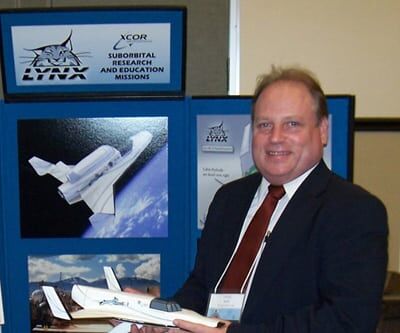
George Bunk says he dreamed of being an astronaut ever since he was three years old and his father took him to the tickertape parade for John Glenn, who in 1962 was the first American to orbit the earth and the fifth human being in space.
Bunk hasn’t gone into space — yet — but he did get to work with his hero at the Kennedy Space Center in 1998. Bunk was managing the offline laboratories for the space shuttle Discovery. Glenn was 77 then, and NASA sent him up a second time to study the effects of space on the elderly. “I got to work with him for a day, familiarizing him with the different experiments on the flight,” says Bunk.
Bunk will speak at the Princeton PC Users Group on Tuesday, August 27, at 7 p.m. at the Lawrence headquarters of Mercer County Library. His topic: “The Next Space Age: the Rise of Personal and Suborbital Spacecraft.”
Bunk hopes to soon have his own chance to go into orbit — well, almost into orbit. He has just finished a two-day training for a suborbital flight. These flights, he explains, go up 60 miles and stop just short of going into orbit, which requires an altitude of 100 miles. “You go straight up and straight down, like a giant rollercoaster. It takes 10 minutes to go up, 10 minutes to go down, and you get 5 minutes of weightlessness on top. From the maximum height, you see 99 percent of the earth’s atmosphere.”
Normally this trip would cost $200,000, but his expenses will be paid by a University of Texas medical research study. Except for Glenn’s history-making second flight, astronauts have had to be at the peak of health. But because opportunities are opening up to anybody with deep pockets, UT scientists are studying what happens to space adventurers with mild but chronic conditions such as diabetes and high blood pressure.
In preparation for the flight, Bunkwill undergo two days of training at the National Aerospace Training and Research (NASTAR) center in Southhampton, PA. After taking baseline data, he had two experiences with the centrifuge on the first day and two sets of simulated suborbital flights in the centrifuge on the second day.
Two aircraft can offer twice daily suborbital flights to joyriders or scientists. Virgin Galactic Spaceship II and XCOR Lynx 2 Seater. Both go up to 380,000 feet. He will travel with Virgin Galactic.
Bunk grew up in Linden, where his father was an electronics technician and his mother a hairdresser. All but one of his four siblings is in an electronics or technical field. He graduated from New Jersey Institute of Technology in 1982 and has a master’s degree from Florida Institute of Technology. He worked on Aegis radar transmitters for Raytheon in Massachusetts and was an electronics test/design engineer at Harris Corporation before landing at NASA’s Kennedy Space Center in 1987 as a space shuttle and space station payload processing engineer for Boeing/McDonnell Douglas. He left the Kennedy Space Center in 2001 for a job at a New Jersey aerospace firm. He also teaches astronomy and physics at Burlington County Community College.
Charter flights: the $100,000 plus experiments. In addition to offering an adventure to paying riders, suborbital shuttles beckon to scientists. “Now you can very quickly fly your experiment into a suborbital trajectory,” says Bunk. In contrast, it might take up to three years to get an experiment on a rocket. A researcher could charter a Virgin Galactic shuttle for herself and her racks of experiments.
“In Virgin, you can get out of your seat and operate your experiment, going back to your seat for the return.” This aircraft is guided by a pilot and copilot. Each of six passengers would pay $200,000 or so — to charter the entire flight would be about $1 million.
Cubesats: the $5,000 experiments. You can build a small satellite, the size of a Rubik’s cube, for as little as $5,000 and send it on a suborbital shuttle as a secondary payload. These small satellites, called cubesats, are being used by colleges and universities for student projects as well as by research organizations. “Last week the Japanese launched a supply vehicle to the international space station,” he says. “The cubesats were with the main payload, and were ejected into orbit after the main payload.”
Bunk says that Cubesats stay in low orbit for about three months. They are monitored through ground stations that the users can set up, or by contract.
Potential uses include environmental monitoring (with cameras taking photographs) and pharmaceutical and biomedical discoveries. “Such possibilites weren’t even thought of when we started building a space station,” says Bunk. Completely by accident scientists discovered that, in a space station, bacteria growth accelerates.
Current studies include studying the growth gene in salmonella — and how to turn it off. “One of the hot items is that they are close to identifying how to turn off the growth gene in MRSA, the antibiotic-resistant bacteria.
Bunk champions the education of young space scientists. He lectures at least twice a year to elementary and middle schools in south Jersey. He hopes to start a tradition: Between January 28 and February 3, take a child or a group of children to a science or nature museum to honor the memories of the Challenger and Columbia crews. “I had met Christa McAuliffe three months before her flight, and I had worked with both Will McCool (pilot) and Kalpana Chawla (mission specialist).”
Bunk’s Facebook page reveals his “best” present. It was one he gave to his niece, Charlotte. “I got her a cardboard spaceship, similar to what I used to build when I was a boy. When all the other kids fit into it, it was so cool to hear them all shout “3,2,1, BLASTOFF!”