Kate Graves opens her kitchen door and a surprise paradise comes into view. Orange trumpet vine cascades alongside the doorframe. The lush garden contains a sofa and various of her metal sculptures on pedestals — last seen on the Mill Hill Garden Tour. Two fig trees bear fruit, a tomato grows wild, and off in the distance one glimpses the EZPass signs at the toll plaza on the Pennsylvania side of the U.S. 1 bridge. This combination of the wild natural world and the hard edges of an industrial city is what Graves and her artwork are all about.
From the front of her Morrisville, Pennsylvania, home one sees the river, the capital city, and the Trenton Makes Bridge, all lit up at night. At the same time, her front porch contains three kayaks — she makes frequent trips along the Delaware, right in her front yard. A squawk is heard — it’s Ivan, the crested Amazon parrot. The green-plumed pet, native to the jungle, is voicing a welcome from the kitchen.
Paddling the river is one way she has become aware of its historic aspects, learning, for example, that the first commercial steamboat in the U.S. operated between Philadelphia and Trenton in 1787. And it is where she has observed many of the buildings for her series “Trenton: A Post Industrial Survey,” on view at the Gallery at Chapin School through Friday, September 27, with a reception Thursday, September 12, 5 to 7 p.m. The exhibit also includes two of her sculptures of Trenton landmarks.
Her house is filled with art, both Graves’ creations — which range in materials from the hard to the soft: iron, bronze, watercolors, and quilts — and the artwork of others, including a Hoosier cabinet made by Michelle Post. The panels are constructed from jigsaw puzzles, a favorite pastime to Graves, and it is filled with her own interesting “objets.”
A native of Santa Barbara, California, Graves came to Trenton to work as an apprentice at the former Johnson Atelier Technical Institute and School of Sculpture in Mercerville. From her artist statement: “The foundry was a sculpture mecca amidst the urban detritus that rims this notoriously depressed city. Upon a cursory exploration to the East Coast, the history and accretion of civilization hit me upside the head. Taking the train from Newark, through Trenton, to Philadelphia I had really never seen anything like it. Staring into a pot of melting bronze, I could sense a blood level connection to those who had come before, those who melted and poured metal to make something. I felt like an alchemist, staring at the jagged detritus of the Rust Belt, and refining the dross of its steel and iron scrap into sculpture.”
Then residing in Trenton’s Mill Hill, Graves would bicycle to the casting and fabrication facility. Her careful eye took in all of the city, from its architecture to its industrial heritage.
She moved across the river for the best view of Trenton. To help raise awareness about the importance of reconnecting Trenton with its riverfront heritage, she is working with the Port of Trenton Foundation on a traveling exhibit made from letters that had once been on the Trenton Makes Bridge and were replaced: an aluminum “T” and an “I” — the I-beam, used in skyscraper construction, was developed in Trenton.
So what was it like, leaving the sunny skies and Andalusian Moorish architecture of Santa Barbara, for the post-industrial charms of Trenton?
“I was craving diversity,” she says. “My artwork is informed by the natural and built environments. Trenton has amazing buildings and factories, even before the Roeblings manufactured what our country is built on.”
Graves is a walking expert on Trenton, so excited about the recently restored Petty’s Run, between the Old Barracks and the State House. The site, once covered over with row houses, was nearly filled in by the DEP until it was named to the top 10 list of most endangered historic places by Preservation New Jersey, and the DEP and Mercer County split the cost to save it. The creek was employed to power one of the first American steel furnaces in 1745, and the steel was used to forge weapons for the Revolutionary War. South Jersey was the source of a critical steel component, bog iron.
From one of Graves’ Facebook posts: “Trenton. Magic. In August 1995 I moved here from California … arriving with only my sewing and coffee machines. Floating on the Delaware made the thick heat and humidity bearable, I fell in love with the river then. This place has heart, soul, grit, and grace. (And some serious issues.) Relentless life and nature working it out, weaving us into and around each other. Love, time, trouble, sediment, acceptance, resistance…”
Soon Graves veers to another favorite topic: sturgeon. “The ancient and wondrous Acipenseridae calls to me from the river when I paddle my kayak on the tidal waters, watching the endless variety of textures and reflections, wondering what lies beneath,” she writes on a handout titled “Returning Sturgeon to the River.” On view at Artworks Trenton, along with the AbOminOg International Arts Collective, she has on view a 10-foot sturgeon, covered in oyster shells.
The sturgeon interest developed in 2004 while visiting Oregon’s Bonneville Dam on the Columbia River. Sturgeon, like salmon, swim up river to spawn, but because of the dam, the two populations can’t mix, she explains. Graves found herself watching a huge sturgeon swimming in circles. Viewing the legendary Herman the Sturgeon in a viewing pond, he seemed to look at her through the glass and say, “You did this, human,” she recounts.
“I felt terrible. It was trapped. I resolved to document this with sculpture.”
The sturgeon — with its armored rows of bony shields, a sort of Wooly Mammoth of the water — is a bottom feeder, can live to be 100 years old, and due to habitat destruction is at risk of extinction. The Delaware River is home to a genetically distinct population of Atlantic sturgeon, one now seriously compromised by 19th-century caviar harvesting and pollution from heavy industry along the river, according to Graves’ handout.
Her 10-foot sturgeon is based on a taxidermy in the archives of the New Jersey State Museum. She has also created 10-inch versions in bronze, stainless steel, plaster, and resin, and two cast iron sturgeon have been “returned to the river,” in a sort of guerrilla art project. “I would like to return a 10-footer,” she says.
But back to those factory buildings, hulking shells of former industry, rendered in a flowing watery medium. It harks back to her days cycling on East State Street, where she first saw, and photographed, the burned and boarded up back of the house where Mary Roebling once lived — now the headquarters of the New Jersey League of Municipalities. That was back in 1997, and it was only recently that Graves knew she would paint them.
While still at the Atelier — after her two-year apprenticeship, she worked as purchasing agent and was on the foundry’s teaching staff — she created her Zero Tolerance Area series.
“I would see those signs while riding my bike and didn’t know what it meant,” she says. Areas designated Zero Tolerance incur the maximum penalty for any illegal activity.
She learned about casting and welding while working on these, drawing on paper, then using wax to create textures for brick. “It was important to me to do all the work myself,” she says. “It took about a year to create each one.”
She credits her father, who had worked as an engineer for Raytheon, making vacuum chambers. As gifts for his daughter, he made a perpetual motion machine and a gyroscope. “He got me into how the three-dimensional world works. I’ve added time, the fourth dimension. Imagination comes with thinking about time.”
Graves’ mother was a miniaturist who made tiny pictures from embroidery floss, 500 knots per three square inches. Her mother also made doll houses, and while Kate never had an interest as a child, “I’m making big bronze doll houses you can’t get inside.”
Two of these bronze doll houses will be in the Gallery at Chapin.
She created five of the houses before the Atelier closed, and decided it was a good time to stop. To continue working in metal she joined AboMinOg, but started working in watercolor as well, first on a series of trees in and around Trenton, where she focuses on details of rot and fungus.
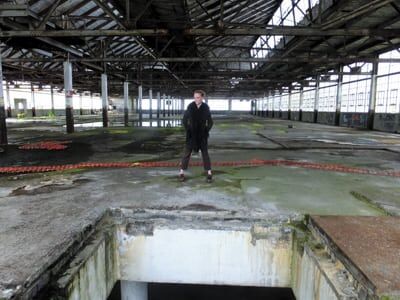
Graves’ introduction to watercolor came from her British grandmother, who specialized in English gardens. In 2012 Graves’ friend Suzanne Dinger was working on her portfolio for the Pennsylvania Academy of Fine Arts master’s program. Together Graves and Dinger visited the sites and painted en plein air. All the paintings were produced on site from direct observation. Compared to the plein air artists who experience cold weather and snow to capture the experience on their canvases, Graves spent many hours “in the silent presence of these cathedrals of industry, documenting buildings held in the flux of unseen forces.”
The buildings have air handlers on top, like little houses, from which air circulates. Other appended structures to the red brick factory buildings are water towers and other structures, even a fire hydrant and a truck — echoing Graves’ bronze doll houses. Having rejected the Andalusian Moorish architecture of Santa Barbara — “it doesn’t exist in the world but is made a recognizable hybrid, an almost cinematic architecture” — she is trying to create her own architecture, based on remelting detritus. She quotes J.G. Ballard: “I believe in the power of the imagination to remake the world.”
Again, the natural world juxtaposes with the hard edges, as leafy vines find their way up the sides of the buildings. “When the factory is abandoned or the house is torn down, people who recognize them in my work remember them, allowing them in this way to live on.” She hopes her sculpture will lead to a deeper appreciation for what endures.
“These buildings aren’t scary or ugly — they’re beautiful. All the noise and machinery that hummed through — they’re at rest, waiting for what comes next.”
Kate Graves, Trenton: A Post Industrial Survey, The Gallery at Chapin School, 4101 Princeton Pike, Princeton. Opening Thursday, September 12, 5 to 7 p.m. Continues to Friday, September 27. Free. Exhibitions can be viewed during school hours by appointment by calling 609-924-7206. www.chapinschool.org/The-Gallery-at-Chapin.