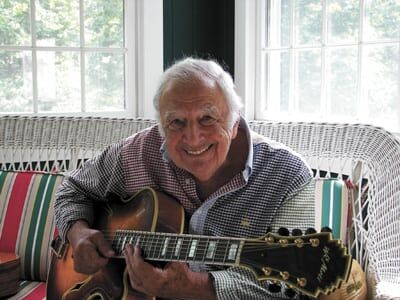
Bucky Pizzarelli’s virtuosity on guitar has taken him far. Long ago he left his native Paterson to play uncountable one-nighters in cities and towns across the U.S. He managed to find fellow GIs to jam with in Europe during World War II, and when he came back home he found that he was still a sought-after guitarist on the big band stage.
He performed on radio, where a bygone generation once tuned in to hear the stars of their day, and then on television, most notably in the Tonight Show band, when it was led by Skitch Henderson and, later, Doc Severinson. He enjoyed a prolific career in New York recording studios as a leader and session musician, and now, at age 87, he travels regularly to gigs throughout the country and abroad.
The road always returns Pizzarelli to his home in Saddle River, where he and his wife, Ruth, live in a part of northern New Jersey that turns wild in a matter of a few miles and eventually refuses to acknowledge lines drawn on a map. The modest home where they have lived for 50 years is just far enough from the urban Route 17 corridor that a six-point buck can be seen scampering down the driveway during daylight. A sun-drenched room looks out from the back of the house to where the Saddle River’s west branch courses over a spillway. Guitars await on a wicker sofa, and, on a nearby coffee table, there are stacks of sheet music.
Pizzarelli’s itinerary includes a stop in Princeton on Sunday, September 15, when he and his quartet appear at the 22nd annual Princeton JazzFeast in Palmer Square. He has performed at JazzFeast before, and he will be joined onstage this year by longtime collaborators Ed Laub, Jerry Bruno, and Bob DeCaro. Laub, a guitarist from Wyckoff, has performed with Pizzarelli for 12 years. Drummer Bob DeCaro is also from Wyckoff, and Bruno is a bassist who lives in Fort Lee. He is 93 and was in Vaughn Monroe’s big band when a 17-year-old Pizzarelli got his start.
“That’s how I met him,” Pizzarelli said of Bruno.
Pizzarelli is one of the greatest swing guitarists of all time, and the path he took to achieve that stature is well known. His parents ran a grocery store in Paterson. “We lived in the back and had a million laughs,” he recalled.
He had two uncles who nurtured his early musical talent, taking him to lessons when they finished work. “My younger uncle played with all the big bands; so I got some stuff that the other guys didn’t,” Pizzarelli said.
Pizzarelli’s given name is John, so where did “Bucky” come from?
“My father was a cowboy when he was a teenager,” he said. “He hitchhiked from Paterson to Odessa, Texas, and worked as a cowboy for a few years. When he came back he got married and his firstborn had to be a cowboy — me.”
The Pizzarelli family included two girls, and one of Pizzarelli’s sisters still lives in Haledon. In January he and Ruth, who was a registered nurse, will be married 60 years. They have two sons and a daughter, all involved in the music business. John is a noted swing guitarist in his own right and has recorded dozens of albums with his father, his brother, Martin, a bassist; his sister, Mary, a classical guitarist; and numerous other artists.
As a 17-year-old in 1943, Pizzarelli got a job with Vaughn Monroe, who was a rich and famous bandleader and singer at the time. “We would get on a bus and play one-nighters, we’d travel 250 miles a night,” Pizzarelli said. “I got a taste of the big band sound, and I said, ‘That’s it for me.’”
But history intervened. Pizzarelli left the band to serve a two-year hitch in the Army just as the Allies were pushing through the Ruhr Valley in Germany. He served as an MP and says he got shot at from time to time. In between the action he played in impromptu campsite bands. When he was not needed in Europe anymore he was deployed to the Philippines, where he and thousands of other GIs waited for the inevitable invasion of Japan. Then, history intervened again.
“When I got out I wanted to go back with the Vaughn Monroe band,” Pizzarelli said. “He had called and my mother, she said, ‘He’ll be back next week,’ and he said, ‘When he gets back tell him to meet us in Boston.’”
By this time, in addition to the road dates, the band was featured on a radio program, sometimes doing two shows a day.
“Those shows had every act you can think of — Art Tatum, Jack Benny, Rosemary Clooney, Peggy Lee,” he said. “We made one movie with the Vaughn Monroe band, ‘Carnegie Hall.’ All the great classical musicians were in it. Harry James was in it and our band.”
In 1953 he left Vaughn Monroe’s outfit to play in Kate Smith’s band. By then he was known for impeccable chops as the consummate swing guitarist — a reputation he still enjoys. Rock’n’roll came and went for Pizzarelli after doing session work for Dion and the Belmonts and Del Shannon. Next came a steady gig with the NBC Orchestra, led by Skitch Henderson most notably when it played for the Tonight Show. Pizzarelli said that when Johnny Carson moved the show to Los Angeles in 1972, he stayed on the East Coast. He continued to make records, his own and for others.
“When you’re in a band you play one way, and when you’re in the studio you play another way,” he said. “You play with the best musicians in the world and you learn a lot from them. I did studio gigs through the ’70s. I would do three recording dates in a day back then.”
The Pizzarelli discography is hard to beat. The artists he recorded with comprise a Hall of Fame unto themselves: Sarah Vaughn, Etta James, Rosemary Clooney, Dizzy Gillespie, Benny Goodman, Wes Montgomery, Hank Jones, Gerry Mulligan, Zoot Sims, Gene Ammonds, Stanley Turrentine, Joe Venuti, and Milt Hinton.
He is also listed among the musicians playing on Roberta Flack’s iconic “First Time Ever I Saw Your Face.” And in 1979 he recorded the Black and Blue Sessions with violinist Stephane Grappelli, recalling the swing sound of 1930s Paris when Grappelli had famously collaborated with the legendary guitarist Django Reinhardt.
There aren’t too many musicians alive who have bridged the eras of radio and YouTube, and there is a seemingly endless list of online videos showing Pizzarelli at different stages of his career: with Benny Goodman and Buddy Rich on the Merv Griffin show in 1979; trading “try-to-top-this” licks with Les Paul and Tal Farlow at Rutgers in 1985; with his son John; quite recently with guitarist Stanley Jordan at a New York City club; with orchestras, small combos, and at festivals.
In 1999 he performed the Django-inspired guitar parts for Sean Penn’s character in Woody Allen’s “Sweet and Lowdown.”
“You just go to a studio and do guitar solos,” he recalled, “but they’re not in the movie in their entirety. But it was exciting being in the same room as Woody.”
In 2010 he appeared on National Public Radio’s “Piano Jazz” program, where his son, John, was guest host, subbing for the late Marian McPartland. Also that year he went into the studio again to record for Paul McCartney’s album, “Kisses on the Bottom.” But, he said, recording long ago stopped being lucrative enough. So he is still on the road.
“I play Japan, Europe, Canada, South America,” he said. “Maryland next week; when I come back, Boston. I’ll play a week with John in Palm Beach. I was in Seattle with John and Martin — John’s group. In and out, that’s my schedule these days.”
Also, he has always painted. He uses acrylics now and his canvases hang throughout his home. The subjects are dramatic wartime scenes, the Hindenberg disaster, and landscapes both local and from various locales around the world.
He sticks with the standards in his performances and that will be his repertoire at the JazzFeast. He picks up his guitar and starts into a typical number, then announces that it was a song by Bix Beiderbecke, the sublimely talented cornetist of the 1920s who burned out quite young and, as legend has it, gave his last performance while visiting Princeton in 1931.
“The American Songbook,” he said. “We’re getting away from that. Now they play one note and a guy sings 30 verses.”
The Princeton connection jostles another memory.
“The Triangle Club, back in the ’20s,” he said. “I knew some of the guys who belonged to it. It was a big thing back then. Tommy Dorsey’s manager was a member. They used to bring in Benny Goodman to play, Bix Beiderbecke.
“One member, William Priestley (Class of ’29), went on to become an architect in Chicago. They called him ‘Turk.’ He played cornet, but he also invented a 19-string guitar. It had two necks and all the strings came down to one spot. I had it for awhile. It was very difficult to play. He called it ‘The Monster.’”
Conversation moved a little farther down memory lane. President Nixon and his wife, Pat, moved to Saddle River in 1981. Had he ever met the former president?
Pizzarelli smiled.
“We ran into his bodyguards one day. They were waiting in a shoe shop while Nixon was getting his hair cut next door. They asked if we wanted to play back at the Nixons’ home. It turned out it was his birthday. I said sure. We had a gig that night, but we went there early, me and John. He was very nice to us. It was just the family and that big money guy. What was his name?”
Bebe Rebozo?
“That’s it! That’s the one!”
Admission to JazzFeast is free. Area restaurants will be represented, selling food on Palmer Square West, said Anita Fresolone, marketing director for Palmer Square Management, which handles leasing of stores and residences around the square. A stage and seating will be set up.
“It has just become a signature event for Palmer Square,” she said, “and seems like a great way to kick off the fall. It’s always such a great crowd and great people and brings in a lot people from all over. It’s good for Princeton and represents Palmer Square really well.
22nd Annual Palmer Square JazzFeast, Princeton. Sunday, September 15, noon to 6 p.m. Admission is free. Noon, Princeton University Jazztet; 1:15 p.m., Alan Dale and the New Legacy Jazz Band; 2:30 p.m., Mark Shane Trio with Holli Ross; 3:45 p.m., Bucky Pizzarelli Quartet; 5 p.m., Bria Skonberg Sextet. www.palmersquare.com.