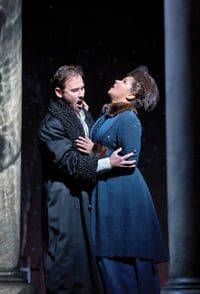
The Met: Live in HD, the Metropolitan Opera’s live transmissions to the AMC in Hamilton, resumes on Saturday, October 5, with a new production of Tchaikovsky’s “Eugene Onegin.”
The transmission of a live event for a world audience is both a local and global phenomenon.
According to the Met, the presentations reach 748 movie theaters in the United States, 167 in Germany, 112 in Canada, 91 in France, 175 in the United Kingdom, and 152 in Sweden. Adding in smaller numbers elsewhere, the Met’s final count is more than 1,950 theaters in 64 countries.
That is a considerable expansion beyond Lincoln Center’s 16-acre site and the Met’s 3,975-person capacity (broken down on the Met’s website as 3,800 seats and 175 standing room spots).
Using emerging technologies to reach both new and established audiences is an established practice. Film and television broadcasts have brought works from the stage to millions, but seldom live.
The transition has also resulted in praise, scorn, or mixed feelings.
While purists may not even consider the option, one long-time reviewer for Opera News said that he enjoyed watching the HD versions more than viewing the production in the theater. The reasons cited were convenience, sound, and clarity of view (no problems with large-headed guys, women playing with hair, and couples snuggling and whispering).
Convenience seems to be at the top of the list for many area opera goers who would rather head to the multiplex cinema than up the turnpike to Manhattan.
Expense is another one. HD viewings cost what one would pay for family circle seat or standing room at the opera house, with no travel related expenses.
Another benefit offered by music promotion professionals is that it enables people living in the U.S. heartland or in some tundra town to experience live opera on a grand screen scale and share an experience with thousands of others around the world.
All of it makes sense. Yet there is another consideration.
While opera is a musical text realized through a visual spectacle, the use of a camera transforms this singular art form from a sensory presence in time and space into a film or television hybrid, where another individual decides what is important to emphasize visually.
As HD transmissions continue, an emphasis on screen visuals will probably follow.
While opera, like Kabuki Theater, has never been an art form to try to replicate reality, there have been some trends to make things more visually appealing or more lifelike. That is especially true in the case of female opera singers being required to slim down and look the part, as if svelte spear carrying demigoddesses actually roamed the earth.
Opera, like professional wrestling, requires that the viewer suspend disbelief and let the mind play. It is an art form visually and aurally layered with artifice, one that somehow awakens the spirit and the blood in ways that realism — or perhaps even a more restrained or life-like presentation — could never do.
With the launch of the new opera season and the HD broadcasts, U.S. 1 invited former New York Daily News editor and opera reviewer, longtime opera lover, and Trenton resident Sam Graff to attend both a live production and his first live transmitted opera and offer his thoughts (see accompanying review).
For those already sold on HD or wanting to have a high art experience, the following is a listing of the live Saturday broadcasts and an opportunity to join others in the community and around globe for a live world-class performance, close to home:
Saturday, October 5, 12:55 p.m., Tchaikovsky’s “Eugene Onegin,” Pushkin’s famous tale of thwarted love, with Anna Netrebko and Mariusz Kwiecien star as the love struck Tatiana and the imperious Onegin, Deborah Warner’s new production, directed by Fiona Shaw, Valery Gergiev conducts. Running time: 4 hours.
Met Live in HD, AMC Hamilton 24, 325 Sloan Avenue, Hamilton, 609-890-4900. Tickets $24 to $18.
For more information on the operas, including other viewing locations, visit www.metopera.org/hdlive.
#b#HD Opera Review: ‘Giulio Cesare’#/b#
by Sam Graff
One Monday night last spring, I got on a train at the Clinton Street Station (in Trenton) shortly after 5:30 p.m., arrived at Penn Station 87 minutes later, caught the 1 Train uptown to 66th Street, and arrived in time for a 7 p.m. curtain at the Metropolitan Opera to see its production of Handel’s “Giulio Cesare.”
Cost?
I don’t want to know, but with a drink and a bite at intermission, it approached $200.
A couple of Saturday afternoons later, I got in my car, drove about 15 minutes to Sloan Avenue (in Hamilton), parked in the large, free lot, walked the equivalent of two blocks to the AMC movie house, and saw the same production.
Cost?
A little gas, $25 for the ticket, a couple of bucks for a soda at halftime, and I was home in time for dinner.
The production in both cases was much the same, a little camp for my taste, a little more so with the TV camera work.
Of course the show was asking to camp it up, with a female mezzo, Alice Coote, singing the part of an adolescent boy; countertenor Christoph Dumaux as Ptolemy, the bad guy; and even another, David Daniels, as the veni, vidi, vinci dude himself.
In a bit of verismo casting, a third countertenor, Rachid Ben Abdeslam, is a hoot as he sings the eunuch Nirenus.
Soprano Natalie Dessay was undoubtedly female as the seductress queen Cleopatra, as was mezzo Patricia Bardon as Pompey’s widow, Cornelia.
Whew, what a relief!
All the singing was terrific, by the way, though I found the live version much more compelling.
The production was borrowed from Glyndbourne (Opera Festival in England) and expanded, but its scale didn’t really come across in the movie house, where everything is 30 feet high and 50 feet wide, whether it’s a fleet sailing into Alexandria or Cleopatra’s profile and left arm.
Since it was a British concept the whole thing was set in the late 19th century with the evil Roman conquerors as British imperialists, complete with red-coated soldiers, taking over India, the Middle East etc., and the Egyptians as a motley crew of sub continentals, Arabs, Persians, and Turks.
That’s another idea that was easier to figure out in New York than in Hamilton Township, because, despite the size of the screen, I never had a real sense of scale, either of the people involved or of the real size of the setting.
Naturally, the 18th-century audience would have known the real history of Pompey’s murder by the Romans, Cleopatra’s seduction of Caesar, and all that stuff, so they wouldn’t need a lot of info in the program, which modern audiences get at the Met but not at the movies.
Also missing at the film showing was the buzz of excitement that a live audience generates at even a bad performance, the sense that something real is happening, something that you may see again but that will never be the same again. It’s a buzz that I’ve felt for almost 40 years, seeing and writing about operas in places from Newark to Vienna and from Washington to Milan.
To be fair, between scenes at the movie opera you get interviews with singers and backstage people — just like TV — instead of drinks and chatter, an improvement, depending on your taste. And AMC did provide a popcorn-and-bathroom opportunity, a necessity in a four-hour-plus show.
Undoubtedly the Met-at-the-movies is cheaper, closer, and more convenient — and you get close-ups of the singers.
On the other hand, it’s a TV show on a giant screen. The sound is compressed and digitally recreated, and you have to see what the TV director wants you to see, like the fact that Dessay had gained about two ounces since she originally wore the body suit in the naked-lady scene and the left strap was cutting into her 20-foot-wide right shoulder.
Hmm. Maybe the director didn’t want you to see that. I’m pretty sure she didn’t.