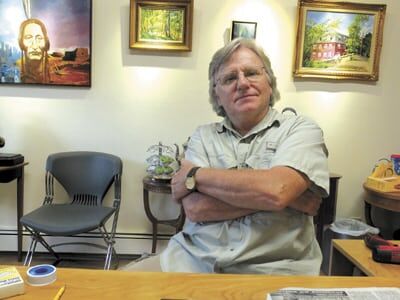
Ryszard (Richard) Druch sits back and gazes at a set of paintings that he and his students have created and neatly lined along the walls (or placed on a handful of easels) in his small art studio gallery in Trenton. After thinking for a moment, he says, with a noticeable European accent, that the art work is “very traditional painting. I prefer not, but Polish people live very traditional still life with flowers.”
Druch should know. A Polish native who came to this small enclave of Polish immigrants two decades ago, he has slowly sculpted a life for himself and others in the arts and is marking the 20th anniversary of his graphic lettering business and the 10th for his gallery.
“From 2000 I organize for Polish and American artists every month from September to May,” he says at his storefront Druch Studio at 920 Brunswick Avenue in the North Ward of the city. “I open my concert series and organize art salons — special culture for art geeks. Of course I have to move my furniture and put out my 44 chairs to organize concerts, salons, or poetry readings,” says the 62-year-old artist.
“In 2001 I brought this small house,” he says, gesturing to the railroad-styled room. “In 2003 after remodeling it, I could start Druch Studio Gallery. I started my new business like an art school. I have a small group of art class students. Usually I have about 15 people. I have a small group — five or seven or eight kids (ages 6 to 10). I also have a small teenage group from 11 to 18 (years old).”
Druch says that in addition to those formal classes there are informal opportunities to practice art. “I started art meetings every Friday, 6:30 to 9:30 p.m., and organized portrait open studio. We have a live model, and we try to make a portrait. It’s an open studio art painting workshop,” he says.
He also hosts arts events and openings ,such as the Sunday, October 27, reception for the opening of an exhibition of Polish personal artifacts and immigration-related memorabilia that lay hidden in an New Jersey attic for 100 years. The materials were discovered by a U.S. soldier who is also one of Druch’s students.
The sessions, he says, provide something for both participants and community members. “This area has a poor, old Polish immigrant area and other immigrants from Eastern Europe — Russian, Lithuanian, and Czech. Every Friday a couple people come and see what we do through the window. This area is not intellectual, very hard working people. I am very happy that these people are interested.”
Set on the border of Trenton and Lawrence Township, the several-block district around Saint Hedwig Parish has a long connection to Poland. “Our church was built in 1904. This parish is more than 100 years old. The big building was the old parish school in 1923. What it means is 100 years ago the Polish community was in place. It was strong. Now it is a completely different situation. Polish immigrants without visas have a problem. Many Polish people moved back to Poland. Everything changed.”
Druch answers the question about his own history in a unified narrative, like the historian that he was trained to be. “I was born in Poland in 1952. I graduated from the high school of fine arts. It’s a different school than in America. After that I graduated from Opole University, between Krakow and Breslau.” In college he trained as a history teacher. “I have two professions. An artist from the high school of fine arts and teacher from Opole University.”
When asked what he taught, he replies, “Ancient cultures, the spectrum of 2,000 years, you know,” he says.
His father, among other things, served 12 years as a government clerk in the city, and his mother was a typist for a financial department in city hall. Now retired, they live in Opole.
His father, Druch says, was a member of one of the two non-communist parties that existed in Poland from 1944 to 1989.
Druch came to the United States in 1991 to join his wife, who arrived several years earlier. “In 1980s the situation in Poland was poor. My wife said ‘I have a friend in Connecticut and I should try (to find a job).’ She won a green card. After five years I moved from Poland to the United States. I came to Trenton. We had a friend here. He said, ‘Listen. It’s a big Polish area and community, and you can find a job very easily. Twenty years ago it was much better for immigrants than it is today.’
He arrived in Trenton on December 6 and had a shock. “I was about a 40-year-old man, a Polish teacher, no English, only Polish and Russian. I had to start like a commercial painter. I tried this occupation and worked a couple months as a roofer. I would work as a delivery man for pizzas. I had many, many professions in my first years in the U.S. I had to go to school to learn English at Mercer County Community College. Step by step we go up, go up, and in 2003, I begin life as an art gallery owner, a principal in an academy of fine art.”
Over the years he says he has created logos, business cards, and lettering for the Polish area. “I combine many things. Life changes. Things are different. Ten years ago I made a lot of money with signs for a Polish constructor. Then it stopped.” The life changes also include the death of his wife in 1999 (of breast cancer) and the move of his computer programmer son (Bart) to New Haven, Connecticut.
Throughout, though, has been an interest in art. Part of it comes, he says, from a legendary Polish sculptor who is a distant family member and a source of pride, Gustav Hadyna. However, he says a more subtle influence came from an unusual situation. “I lived for six years in this castle,” he says showing a photo of Moszna, a massive, ornate 17th-century stone building. “It is a big tourist attraction 40 kilometers from Opole,” says Druch.
The castle was owned by influential families until World War II, when the Soviet Union took control of Poland and turned the building into a school where Druch’s father taught agricultural science.
“It was amazing,” Druch says of Moszna. “It was like Disneyland. You can find 99 turrets. You can find 365 rooms. It was a big and rich family. Inside was amazing. I think my artistic skills were established inside this castle. Every day I could see sculptures and furniture, many things. Like a king’s palace, you know.”
Then there was an arts project that caught his interest. “I remember I stared my drawing. Six years of age. I remember that in the castle the director of the school — it was in the ’50s, last century — he brought a group of students from Academy of Fine Arts in Krakow and he organized a plein air workshop. I remember they threw a drawing competition for every kid in the castle. My colleague won. I remember that every kid took a box of candies for participating.”
Druch took that interest to the high school of fine arts, which, he says, has a different connotation than in America, saying that it was more a vocational school. “My major was souvenir design. Fine arts means painting, photography, sculpture not like a souvenir designer,” he says. However, he received crucial training. “We had drawing classes with a live model and a three dimension model. We had art classes with sculpture and painting, many different art classes. Then in 1986, 10 years after my university diploma, I became a member of the Polish caricature association in Warsaw. It means in Poland that I was a professional caricaturist. I specialize in caricature satirical drawings.” The works are a subject of a book in process and to be printed in Poland.
While caricatures are one his main interests and are part of a book of his, he also uses an image and theme that is distinctly American: Native Americans. “In Poland I read a lot about American Indian, I know Indian stories in the U.S. I saw Manhattan. It’s an unbearable place to live. My memory was founded in Indian roots.” To make the point, he shows a painting where the face of a Native American appears like a ghost between Manhattan buildings. “Its feather leading up to tower. Indian roots; white civilization,” he says, lost in thought.
One of his Native American paintings is also the source of a distinctly American tale, one that brings him an unexpected joy. “I painted an Indian on the back of my car, and the car was stolen when I parked to see a friend on Olden Avenue in Trenton. A few days later I got a call from the police that the car was found. I went to recover and saw that the truck with picture removed. I was very happy. It’s a good situation for an artist to have a picture stolen.”
Looking out the window of his studio, Druch says, “It’s not a section for art. I am the only gallery on this street. Someone told me ‘Jesus Christ, an art gallery in this area!’ But it is my profession. I love painting. I have to do this. When I organize a painting exhibition, it’s not a big deal, but I like it. I can’t live without it. I make and sell portraits. It’s very important, like a gift.”
As he talks about his upcoming events, including — he says, “first year of my art activity an owner of an art gallery I have here a very small audience — 9 or 10 people. Now after a couple of years, I shouldn’t think about audience. I send my digital paper on the Internet and posters in the neighborhood and ad in a Polish paper in NYC. I know my audience will talk about my next artistic gig. I can sleep now, but before it was terrible. I would think, ‘Mr. Druch, you should stop! This area is not for art!’”
Then he says, philosophically, “My activity brings me profit. Now I have my old friends and audience. My friends want to come to my salon for concerts, poetry readings, and art exhibits. I exhibit Polish culture created in this region. It’s not a big school or international, but I am satisfied.”
American Soldier Robert Stodnick and Trunk of His Polish Grandparents, Druch Studio, 920 Brunswick Avenue, Trenton. Sunday, October 27, 6 p.m. Free. 609-532-3676. www.druchstudio.com or druchstudio@comcast.net.