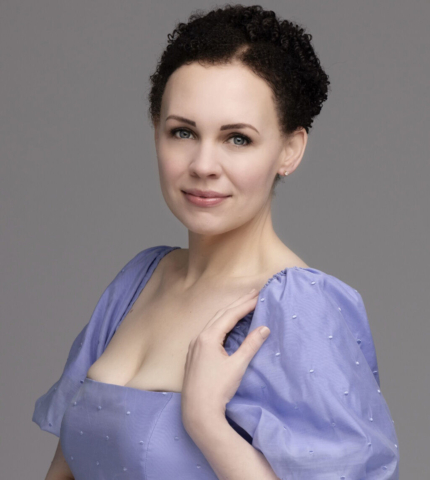
From the first second, when soprano Sara LeMesh enters with a perfectly pitched and significantly soulful wail, you know the State Opera of New Jersey production of Johann Strauss II’s “Die Fledermaus” is going to be a vocal treat.
Make that a vocal feast.
To a chorus member, the State Opera continues the glorious tradition of its progenitor, Boheme Opera of New Jersey and presents a stunning array of beautiful voices that add to the overall joy this production of “Die Fledermaus” exuded.
That’s because the famous 1874 farce by Strauss and librettists Karl Haffner and Richard Genée is realized theatrically as well as musically. LeMesh, for example is as deft an actress as she is a singer. She is not alone in this.
Then, there’s the dancing. During Strauss’s familiar waltzes, this corps of opera singers defies the reputation of divas as dancers and makes a spirited celebration of the bounty Strauss gives them. Two couples, one from the chorus, and another led by the light-footed John Robert Green, the overall best of cast as Dr. Falke, the crafty mischief maker who sets “Die Fledermaus’s” plot in motion, give a particularly graceful and lively zest to the dance scenes. (Unfortunately, the couple from the chorus were upstage right and sometimes were blocked by a less nimble pair.)
The acting by several in the cast brings out the inherent comedy in the book, presented in English, as is the music, with a fine translation that is uncredited (as far as I can see) in the State Opera program.
Far from least is the music. As with the singers, Joseph Pucciatti leads a tight orchestra that adds to the excitement and quality of this piece.
“Die Fledermaus” in general makes an auspicious world premiere for the State Opera of New Jersey, which was recently redesigned from Boheme Opera after 36 years of production under that name.
Pucciatti and director Alison Bolshoi keep their production sprightly and aim for the fun of the piece, never taking any of the farcical elements, such as extra-marital escapades, characters masquerading as different people, and playing a grand practical joke too seriously while keeping the characters and situations real enough to let the comedy breathe and take hold.
Featured cast, orchestra, and chorus are all stars in this production, but Strauss and the lead players render it a great time.
I regard opera as theater and always have a eye towards whether works are acted as well as their sung.
In several cases, yes, but in this case”Die Fledermaus,” the music is so crisp and the vocals so lush and on the mark without being showy, one could close his or her eyes and bask in the richness of the sound.
Every voice is true and pure. They all have personality to go with their perfect tone. Best of all, they display that personality while never indulging modern trends to embellish the music at hand. With Strauss, all a singer needs is there. This “Die Fledermaus” cast went to town with it while staying within its frankly wide bounds.
Much of ‘Die Fledermaus’s music is familiar outside the opera. I am still singing or humming the well-known tunes as I write. They were dashing in performance, Bolshoi’s company bringing the classics to vibrant life.
You could the SONJ cast was having as good a time onstage as they were giving the audience.
The driving plot device in ‘Die Fledermaus” is revenge, a rather elaborate revenge for a comedy.
“Die Flerdermaus” in English means “The Bat.” Years before the scenes presented, Dr. Falke and the opera’s main character Gabriel von Eisenstein attended a costume party for which Falke was dressed as bat. Falke got drunk. Eisenstein was helping him home when he got the idea it would be a funny prank to leave him, dressed as a bat, on a park bench. Falke falls asleep there and is humiliated in the morning to wake and find people staring and laughing at him.
Falke takes his time, but finds an opportunity to turn tables when Eisenstein is about to go to jail for eight days for another prank (hanging a man’s hat on a hat rack with the man still wearing it). Falke persuades to report to the prison late and attend a party a famous prince, in this production a night club owner, is throwing. There he creates illusions of infidelity and other perfidy that leads more to comedy than heartbreak.
The plot works anywhere. SONJ chose to set it in contemporary New York with Prince Orlofsky throwing his lavish soirée is a new popular restaurant he owns. Eisenstein, his wife, their maid, and others are in disguise. Falke’s gambit, besides exacerbating Eisenstein’s legal problems, is for Eisenstein and his wife, Rosalinda, to catch each other flirting with other people. Making Eisenstein squirm when the truth comes out is Falke’s revenge.
The SONJ cast is well up to the task of making the farce work.
John Robert Green as Falke stands out among an excellent troupe because he maximizes every second he spends on stage.
His bass-baritone is one of the clearest and most expressive of the fine voices. Green takes advantage of every nuance is his arias and adds to their fun or purpose with precise, conspiratorial winks, moues, and others signs he is about to play a marvelous joke.
Green is a complete triple threat as his dancing and acting is as sharp as his singing and its comic presentation. He makes you root for Falke to make his rather nefarious joke on Eisenstein pay. He makes Falke’s revenge nasty but fun. You want to see how his plans work out.
My memory is lapsing about whom Green dances with in the extended waltz scene. I believe it’s LeMesh, pretending her character, Adele, a chambermaid, is a budding actress, but it might be Alexandra Branton who plays Adele’s sister.
Either way, the couple is superb.
Sara LeMesh is a delight throughout. Not only does she follow Puccianti’s gleeful overtures with Adele’s first doleful note — doleful because she regrets being a chambermaid instead of a socialite — she carries on with a witty, never-miss-a-trick performance and even gets to wear the best dress of anyone on stage.
LeMesh is constantly in the middle of any comic passage. She practically forces her employers, the Eisensteins, to give her a night off when she gets word of Orlofsky’s party and is encouraged, she thinks by her sister, to attend. She stands up firmly to those employers while she poses as an actress at Falke’s prompting. She has designs on having the best time a chambermaid pretending to be a member of society can, and she makes good on those designs.
Green and LeMesh, though supporting character, provide the center for Bolshoi’s staging.
That doesn’t diminish the fine work by the leads.
Broadway and international opera veteran John Easterlin is shrewdly amoral as Eisenstein who rues his prison sentence but accepts it with stoic humor but as something that must be served.
Eisenstein has avoided reporting to jail so often, a police officer is scheduled to come to his apartment and fetch him if he isn’t behind bars by dusk. He is about to leave where Falke comes and entices him to delay his durance one more evening so he can attend Orlofksy’s party and see the beautiful women who are bound to be there.
Easterlin’s fun-loving Eisenstein is up for anything, including flaunting the law. He is used to having fun and intends to have more. This gives Easterlin the opportunity to be versatile farceur who has no compunctions about courting one of Orlofsky’s charming guests, even if the one he chooses is his wife, also drawn to the party by Falke, in disguise.
Nicole Woodward is an elegant Rosalind, able to convey both the hauteur and practicality of her character.
Woodward’s Rosalinda has no fewer scruples about dabbling extramaritally as her husband does. She kisses an unwanted suitor as she leaves for Orlofksy’s even though she waves a cool goodbye to Eisenstein as he leaves for jail. She does a wonderfully comic turn posing as a Hungarian countess that attracts Eisenstein’s attention at Orlofksy’s.
Like Green and LeMesh, Easterlin and Woodward sing beautifully.
Rachel Deatherage is another whose wit and poise enhances her singing as Orlofsky.
Ian Bethman gets everything right as the prison warden who, in disguise, befriends Eisenstein at Orlofsky’s party. Dylan Davis might have the most divine voice of all as an amorous opera tenor courting Rosalinda. David Smolokoff is funny as the lawyer, Dr. Blind. Aidan Babbitt also amuses as the drunken corrections officer, Frosch. Alexandra Branton acts and harmonizes excellently as Adele’s sister, Sally.
J. Matthew Root uses projections deftly to create backgrounds for the Eisenstein apartment, Orlofksy’s club, and a NYPD station house. Anthony Waltz mashes periods for some wonderful dresses and formal wear.
A couple of cavils that warrant noting. Despite “Die Fledermaus” being sung in English, supertitles would have been helpful. Some stage business is missed that would have made Bolshoi’s production stronger, but nothing that marred the overall esprit of this “Fledermaus.”
“Die Fledermaus” ran on March 20 and 22 at the Kendall Theatre at the College of New Jersey in Ewing. It was presented by the newly renamed State Opera of New Jersey.