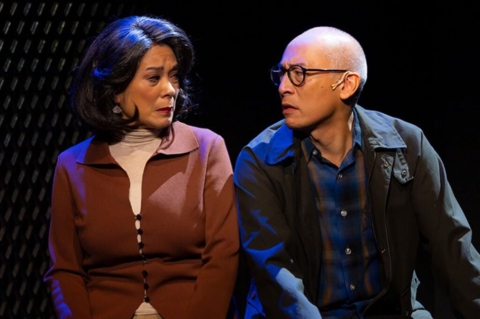
Shayan Lotfi’s “What Became of Us” is less a play than a live audio novel.
Lotfi’s piece, at New Brunswick’s George Street Playhouse through April 5, lives up to its title. It follows the lives of two siblings from childhood to one of their deaths. It delves into their personalities, dissects their relationships, explores their complexities, tells what happens to each, and provides a lot of texture.
The work is complete and well-performed by Christine Toy Johnson and Francis Jue, but something always seems missing.
That something is action.
“What Became of Us” tells a recognizable story. Q and Z, its characters, have traits and experiences that are familiar to us but which stop from being totally poignant or moving because they are being narrated in a contrapuntal dialogue instead of being shown in full theatrical form.
Notice the words. “Show” and “tell.” A play shows. It doesn’t only talk to us. Books or radio do that. Often entertainingly and at times in ways that inspire awe. Theater has a different dimension. It’s more expansive, more immediate, less passive. What’s the use of having actors there if they are only going to recite to you? However well.
What you can’t see triggers the imagination. It makes one picture a setting, a character, and if well-crafted, excite suspense or even good old pity and terror.
Johnson and Jue are expressive and find postures, gestures, and physical movement that add dimension to Laiona Michelle’s production. They are deft storytellers, but “What Became of Us” remains too direct, too prosaic to get past the feeling it’s reading time and not showtime.
It is so plangently novelistic, it doesn’t manage the pull of one-person shows or epistolary plays. Works like William Luce’s “The Belle of Amherst,” Mark Hampton and Mary Louise Wilson’s “Full Gallop,” John Aubrey’s “Brief Lives,” or anything by Eddie Izzard or Bill Irwin have intrinsic levels and passages that veer off to give them variety and balance. Pieces like A.R. Gurney’s “Love Letters,” in which the actors do read from a text, Ken Ludwig’s “Dear Jack, Dear Louise,” or Jerome Kilty’s “Dear Liar,” have performers speaking letters, two of them from podia, but they have a vibrance “What Became of Us” doesn’t seem to muster, in spite of the lovely efforts by Johnson and Jue.
You always think you’re listening to a story or tone poem rather than watching a play.
It might be that “What Became of Us” is too self-conscious.
Shayan Lotfi loves words.
So do I. They’ve been my joy since I started to read, spontaneously, at age two.
In “What Became of Us,” you hear the writing. A phrase or comments sounds a tad precious. The diction tries a bit too hard for an effect. That doesn’t mean Lotfi’s dialogue is not worth hearing, or Q and Z have nothing interesting to say. They do. It all comes out more literary than conversational. I keep going back to the word “recitation.” Even when I cared deeply about something happening to Q, Z, their parents, their partners, or Z’s Golden Child, there was a barrier between being informed and being involved.
The preciousness carries over to other aspects of Lotfi’s play. One can easily see the author’s intent toward universality, the idea that Q and Z have so much in common, they can be from anywhere, be of any ethnicity, live in any town or metropolis, and be of any stature or appearance.
The siblings are immigrants, Q born in what is referred to as nothing more than “the old country, Z born after the family emigrates to “the new country.” Q stays in the unnamed town where he parents settled and had a grocery store. Z ventures out to become a successful restauranteur in some also unnamed big city (although I imagined only New York).
With Johnson and Jue populating the two-hander, one envisioned the old country as being Asian and the markets Q describes as being the colorful tented emporia we see in movies. South Asian, European, Central American, or African actors could conjure a different image.
Lotfi keeps specifics undefined so Q and Z can be the children of any immigrant and have the same experiences as siblings from anywhere on Earth. And possibly beyond.
This gives “What Became of Us” texture but not quite the pulse it needs to make this universality fully meaningful and affecting. The piece turns static and even overly predictable.
Christine Toy Johnson and Francis Jue make you like and care about Q and Z, even to the point of having a sympathetic feeling for the more conventional Q, but there’s always a distance between them and riveting connection that fosters shared hopes, dreams, and empathy.
Things that happen to the siblings are noted and appreciated but not taken to heart.
Z has more resentment, rebellion, and reaction built into his character. He is a child, and adult, full of judgment and a penchant for taking everything personally. His sensitivity makes him more activist and more intense than the calm, accepting Q, who tends to let life flow and feels a stronger sense of responsibility. Q would be happy to sit and read all day. Z has to find vectors for his anger and challenges that assert his talents and individuality.
You can see how much Lotfi put in her play. Now she needs to find a way to make the drama more palpable, the emotion more moving, and the story more immediate than second-hand.
Francis Jue has a remarkable knack in transforming to the ascending ages Z is supposed to be.
Bald and middle aged, Jue conveys the spirit and mischievous boyishness of the child Z is when we first meet him. He’s playful and freer than his sister who aims more to serve and please than to entertain and be noticed.
Z is new-world while Q remains endowed with manners and attitudes from the “old country.”
Jue is equally adept at morphing into a petulant teenager who sees and reacts to the faults in his parents rather than appreciating their struggles and possible disenchantments the way his sister does
He remains consistent as Z baits with a brusque announcement on a visit home. He embodies the rebel and risk-taker who leaves home in a huff, goes to a big city, and chooses to open a restaurant even though Q tells us Z’s never cooked anything in his life.
Jue deftly handles the mellowing of Z and delights with his response to being a father to a precocious lad he calls The Golden Child.
Christine Toy Johnson doesn’t have the collection of transitions Jue has as Z, but she impressed with her stability and her talent for accepting whatever lot Q faces and being fulfilled and satisfied with what Q has even if it’s not what Q wants.
Johnson is staunch as the good, dutiful, responsible older child who doesn’t need a big city and could put her parents in perspective, as much through love and respect as by obligation to keep all going smoothly while her parents have to work and her brother needs raising. She is a picture of resigned contentment, accepting and appreciating, and moving forward one foot at a time instead of chasing after or dwelling much on dreams or common ambitions.
Johnson and Jue contrast each other nicely, always showing a symbiotic appreciation for one another even when their relationship endures a crisis. They make Lotfi’s story sing and provide as much variation as her script allows.
It may allow more than we see. Using another play that has characters talking to the audience more than each other, a second look at “Dear Jack, Dear Louise” showed virtues the production I saw first did not.
Lotfi seems fixed on telling more than showing. Laiona Michelle surprises in being in league with her on that. Jue and Johnson are excellent actors, but they can’t overcome the word-heavy nature of Lotfi’s piece. Michelle makes all clear but needs to find more invention in how to present the piece.
Michelle knows about direct communication to the audience. She wrote and starred one of the most powerful solo shows of this decade, “Little Girl Blue” and riveted audiences with her performance and approach to the life, music, and attitude of the great Nina Simone.
Some of the technique used in that show or some of the charm from her production of Emily Mann’s “Having Our Say” would have gone a long way towards energizing “What Became of Us.”
Shoko Kambara’s set creates opportunities for Michelle to plot some interesting entrances and exits for her characters. Christopher J. Bailey’s lighting makes some of those movements more dramatic. I particularly enjoyed Bailey’s wit in using the side lighting in the walls of the Arthur Laurents Theatre auditorium to give extra texture to a scene.
Scott Killian’s sound also adds a lot to Michelle’s production. His original music sets moods, and a song using Lotfi’s title as its basis, gives “What Became of Us” unifying context.
“What Became of Us” runs through Sunday, April 5, at the George Street Playhouse in the New Brunswick Performing Arts Center, 11 Livingston Avenue, in New Brunswick. Showtimes are 7:30 p.m. Wednesday through Saturday (but not on Friday, April 3) and 2 p.m. Thursday, Saturday, and Sunday (and Friday, April 3). Tickets range from $90 to $64 and can be obtained by visiting www.georgestreetplayhouse.org or calling 732-246-77i7.