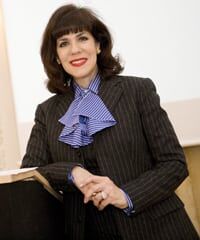
First impressions are formed within 30 seconds of meeting. Tamara Jacobs, founder and CEO of Tamara Jacobs Communications Inc., forms hers in the first six. “I’m checking you out. Do you look put together? Are you representing your brand?” Handshakes hold a lot of weight. Jacobs’s is cordial yet authoritative, lots of eye contact.
She looks exactly how you would imagine a personal image consultant should look. Her gold chain necklace coordinates with her gold chain bracelet; her taupe nails match a thread of the plaid in her jacket and scarf; she even has two matching Pekingese dogs — although Charlie, the puppy, is much larger than the full-grown Hoppy. “Details matter,” Jacobs says, while giving a brief tour of her large home on Library Place in the western section of Princeton, and her belief in that statement is apparent in every inch of crown molding, precisely placed portrait, and perfectly draped curtain.
Jacobs’s home was once owned by the painter Howard Russell Butler, who died in 1934. Butler was the founder of the American Fine Arts Society, and persuaded Andrew Carnegie to build Carnegie Lake. Butler’s addition to the original structure included a large white room with no windows and a ceiling of skylights. Jacobs now uses the room, complete with podium and descending projection screen, for viewing speeches, as her own studio for shaping and molding clients.
Jacobs communications company has an impressive list of corporate clients listed at its website, www.tamarajacobs.com. And Jacobs has a high profile in the media, including a blog at the Huffington Post (see sidebar, page 28).
Step number one for Jacobs’s new clients is to fill out a self-branding questionnaire. To be successful a brand must be three things, Jacobs says: known, trusted, and used. “Once your personal brand is known, trusted, and used, you’re a commodity and people will seek you out.” But first that brand must be defined. Jacobs tells clients to describe themselves in three words, which a lot of clients struggle with. “People cheat,” she laughs, “throw in hyphenated words and you can squeeze in 20, but if you’re honest with yourself and just pick three, it can be a very effective form of distillation.”
Jacobs quotes Mark Twain, “people forget headlines, but stories stay with you. Tell your story in three words.” Another piece of advice: “If you want to sound smart, quote three people: Mark Twain, Abraham Lincoln, and Will Rogers. If you quote those three, you’re a genius.”
Jacobs’s story began in Michigan. Her mother was a college professor at a time when that was not a popular thing for women to do and her father was a world-renowned violinist who died at a young age from a stroke. In the Midwest, she says, people are taught not to “declare,” that deeds speak for themselves, and to always be humble.
But after coming to school in the East (Mount Holyoke, then Dartmouth her junior year, before graduating from the University of Michigan), she quickly realized that the “aw shucks, gee whiz, oh that old thing” mentality would get her “not only passed by, but trampled on.” Tamara Jacobs was not one to be trampled on. Her mother’s college roommate was a Broadway producer for “Do Patent Leather Shoes Really Reflect Up,” and Jacobs did a stint performing around the country as Sister Helen. When that run ended, she worked as a broadcast journalist for stations around Michigan — Lansing, Flint, Detroit — and then around the country.
Be nice to everyone, Jacobs recommends, because you never know who could end up being a huge help in your career. Jacobs was friends with a public relations executive in New York, who approached her and said that they really needed to start a media department. Jacobs was the person for the job. Through her media work, she built a strong relationship with an executive at Johnson & Johnson, who made her the VP of Communications. When he became the president of Janssen Pharmaceuticals, he took her with him.
She did this for years, until the strain of having an infant, a baby girl named Avery (now a senior studying performance theater at Syracuse University), in addition to a four to five-hour daily commute, became too much for her. And then Jacobs, who specializes in helping clients get raises, asked her boss for a demotion. That way she was able to become a consultant, and when clients branched out, they were able to take her with them.
Soon Jacobs realized that she needed to do some branching out of her own, hiring staff and starting a company. She was able to focus on conception as well as execution, not just presentation skills and media training, but also strategic communications and message creation. Jacobs applied the distillation skills she had learned in her journalism experience, drawing on the idea that you should start with the end in mind.
“In journalism we think of macro before micro. The outcome is in the headline. So why don’t we talk like that?” Jacobs doesn’t believe in the “dribble and build” phenomenon in which the presenter dribbles and builds, dribbles and builds, until the final five minutes, ta-da, and done.
These days the most precious commodity anyone has is his or her time. Jacobs says that the quickest and most effective way to communicate is to establish that you have a mission, and that the other person can benefit from that mission. “If you don’t know where you’re going and you can’t provide me with value, I don’t want to hear you, because that’s time I can’t get back,” Jacobs says.
Be an entertainer, be precise, and be strategic. Jacobs created an approach that anyone could follow, copyrighted the ideas, and wrote a book titled “Be the Brand.” She plans to have a new book coming out sometime in 2014 called “Success Is a Planned Event.”
“Success comes from strategy,” Jacobs says, “Hope is not a strategy. People who like to play it safe think that saying ‘no’ is safe, but it’s not. It’s a missed opportunity. Experiment with yes.” Jacobs told her husband, David, an investment banker, “no” multiple times before she finally said yes. “He would ask at the worst times,” Jacobs laughs. One of those times being right after her apartment had been robbed.
The two met while working for the Bluehill Troupe, a New York theater production company. “I was performing on the front stage and he was building sets on the backstage — appropriate! He took me roller-skating and I thought, ‘Eeew, who goes roller-skating?’ but David did! And we didn’t do flashy New York things, we did unexpected things, which was even more unexpected coming from an investment banker.”
Jacobs attributes the lesson that changed her life to her mother and her dog, and it was a lesson about dealing with the unexpected, going with the flow. Growing up in Michigan, Jacobs had a Boston terrier named Tippe. He was fearless, but inflexible. He locked his eyes on the target and refused to budge. Once, while fetching sticks in the lake, Tippe missed the target and grabbed onto an immovable rope line instead. He kept tugging at it, refusing to let go. He soon exhausted himself and would have drowned if Tamara and her sister had not swum out and saved him. So when a member of the family was acting linearly and refused to adjust, her mother would warn, “Don’t pull a Tippe.”
However, her mother was fearless and flexible. She was a Michigan housewife who made beautiful meals and kept a gorgeous home and yet no one cared. She went unappreciated and became demoralized. So she went back to school and got her masters degree. She wanted to become a professor, so she went to the dean of Lansing Community College and said, “You need a speech department and I’ll start it.” By the time she retired, she was the head of the department and one of the most popular professors on campus. Her mother’s ability to reinvent herself has always been an inspiration to Jacobs, who makes it her job to help others reinvent themselves.
“I can take anyone and polish them,” Jacobs says. “I can make them a better them. And they have to be satisfied with that. All I’m doing is developing their potential — emphasis on their own personal potential.” She quotes Oscar Wilde this time: “Be yourself, because everyone else is taken.” Among her advice to people seeking to improve their own brand in the new year:
Don’t wear a new suit to an interview. That’s like bringing a stranger into the room with you. Bring an old friend.
Turn a deficit into an attribute. By declaring it, you prove that you’re human. People don’t like perfect, it’s unrelatable. You may want to go see a movie of Brad Pitt and Angelina Jolie, but you might not want to have a beer with them.
Be inclusive. Everyone likes a team player. Have ownership, but it’s endearing to use inclusive pronouns. “We the people” — it’s the first line of the Constitution.
And think of Bob Fosse. The legendary Broadway choreographer and director, says Jacobs, “was a drunk, very dissipated, but he would pull himself together every time before leaving his dressing room. He’d put his hand on the doorknob, look at himself in the mirror, and say, ‘It’s show time.’ It’s always show time.”