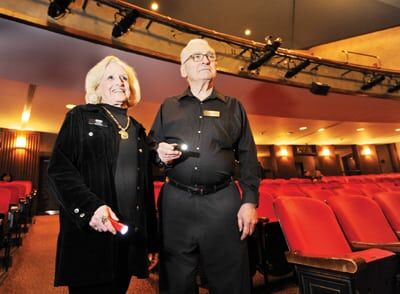
Ushering at area cultural venues is a popular activity, especially among the senior set who don’t have to get up too early the morning. And it’s the kind of activity that is valuable both for theaters and for individuals.
McCarter Theater, for example, has a group of 500 ushers, of which 250 are “active,” meaning they usher more than once in a three-month period. “They are a great resource for us as volunteers,” says Tricia Bitetto, house services manager at McCarter. “We couldn’t be who we are without our ushers.”
Ushers who do their job are in some sense invisible. “We are here for our patrons,” says Bitetto, “but they should be remembering the beautiful work on stage. We are fostering that, complementing that — serving our patrons and their passion for the arts.”
McCarter needs ushers both for its season of five plays and “A Christmas Carol” as well as Princeton University shows and 35 to 40 special, one-night-only events.
Les Simon, who has been ushering at McCarter for about 14 years and has 722 ushering hours under his belt, generally ushers at more than one performance of a play during its run, sometimes on short notice. The reason is simple: McCarter can sometimes be short on ushers at the end of a long run, which is why they have a rule that a person has to usher at two plays in order to do a single special.
Looking back on his experience in a variety of ushering venues, which also include Richardson Auditorium, Bristol Riverside Theater, Kelsey Theater, and Passage Theater, Simon says, “At the beginning it was just to see performances, concerts, and plays. Then it got to be more than that.”
The “more than that” includes socializing with other ushers and chatting with patrons about any extra needs, answering their questions about the upcoming performance, or just conversing. “It has made me a more outgoing person than I was — the social part of it,” he says. “We have a nice bunch of people who we talk to all the time , before performances and during intermissions.” Often the people he meets have similar interests, and he sees them outside of ushering, for example, when they go to museums together.
Simon has also learned to appreciate the arts more than he ever had before. One friend got him interested in classical music and opera, which has pushed him to attend more concerts and to “change my radio-station style,” and another got him interested in theater.
Even seeing a play more than once has its benefits. “I never get the whole thing the first time,” he says. “If you just don’t hear something, it’s gone forever, plus you don’t get it all. It’s easier to understand if you see it twice.”
He describes what he got out of seeing “Vanya and Sonia and Masha and Spike” four times. “You get a little deeper into what’s really behind it other than the plot — some philosophy of the playwright or even learning possibly about the history of the era it was set in,” he says. For that play, he also got to meet Sigourney Weaver at the opening-night reception.
Joyce Galanter, who is a little ahead of her friend Les, at 733 hours of McCarter ushering, is someone who has always enjoyed the arts. “It started with rock and roll; in college I added jazz and then some classical music; and as I got older classical music took precedence.”
She got her start ushering at Richardson Auditorium when, at a performance of Concert Royal in a subscription series, she and her late husband had been assigned the wrong seats. “It was my first experience with house management,” says Galanter. “After all the concerts and subscriptions we had, I never particularly noticed the people who were running the show — until that time. I got into a conversation with the guy in charge, and it opened our eyes and we said, ‘Gee, we could do this.’”
About ushering, she says, “It’s a lot of fun; the people I have met are really great — the people who work there and other ushers. I’ve made friends there, and you look forward to seeing the people you know.”
In contrast, when she had a subscription, she might get a little acquainted with the people with seats next to her, “but then you get up, leave, and go home,” she says. “This is a much more social event, plus the music or the play.”
“If I like the play, then I want to see it again,” says Galanter, “but I try not to see a play too often.” She notes that some other events, like student productions, also count as “plays” at McCarter, so she tries to sign up for as much variety as she can.”
As an usher, Galanter says she has learned a lot about how theater management works. “You see things from a different point of view, and you see what the logistics are of getting people seated on time for a show.” For example, patrons sometimes complain about not being able to enter the theater when they expected to, but now she understands that sometimes things get delayed, for example, by problems with sound or other equipment.
Bitetto, who started at McCarter as an usher, is now in charge of the audience’s experience during the performance — “from the front of the stage to the sidewalk,” she says.
The usher’s job is pretty straightforward, and McCarter’s ushers are well prepared.
“The job of the usher is to welcome people, show them to their seats, answer questions about amenities, and be a friendly face when people come to the theater,” says Bitetto.
Interested individuals sign up on the theater’s website, then attend a training session to pick up the tricks of the trade — basic theater etiquette, how to welcome patrons, arrangement of seats, and the dress code, which at McCarter is solid black attire. “The training is hands on and conversational, with a lot of feedback,” says Bitetto, who knows most of the 250 active ushers by name.
At meetings right before a performance, the ushers learn about handicapped seating, late seating, any special events that evening, and what kind of audience is expected.
McCarter also has an usher council, which includes seasoned ushers who work to find better ways to engage and listen to the usher community.
In the case of an emergency or a difficult patron, both rare, ushers are instructed to get a staff member. “As the house manager, my role is to be face of the theater and treat every patron with respect and make sure I do everything I can do to make sure a patron is satisfied,” says Bitetto.
Bitteto, who grew up in Ringoes, comes from an artistic family: her father, now retired, studied ceramics in college then worked as a programmer, and her mother went to art school and was head of the arts department at Nottingham High School in Hamilton.
Bitteto’s high school, the Villa Victoria Academy in Ewing, had a great theater program, including a fly system like McCarter’s where ropes are used to lift scenery off the stage. Her first role was Odysseus, and she also acted in “Peter Pan.” At Juniata College in central Pennsylvania she played the role of Pippin. “I thought about majoring in politics or communications,” she says, “but I didn’t want to leave rehearsal.” Her degree is in theater and performing arts management.
Her first job out of college was as sales associate at the Wilma Theater, where she gained experience doing a variety of odd jobs. During a vacation from her job managing a coffee shop insider Border’s, she started to volunteer at McCarter, ushering and updating volunteer records, then was asked to manage the cafe they would be opening, Terra Teatro.
Simon was a fifth-grade teacher in Newark, then drove for a limousine service for 25 years, until 2007. Aside from ushering, he makes daily checkup phone calls to the elderly as part of Contact of Mercer County; he is also part of RSVP, the Retired Senior Volunteer Program.
Originally from New York, Simon has been in New Jersey since 1949 and in Mercer County since 1978. His parents became chicken farmers in the Freehold area when he was 10 and later owned a small retail store.
Galanter, who used to be an elementary school teacher in East Windsor, also volunteers at Grounds For Sculpture and Learning Ally (formerly Recording for the Blind). She grew up in the Bronx, where her father, a Romanian immigrant, worked for a furrier sewing skins together. Galanter was the first to go to college in her family, graduating from Hunter College.
Galanter says she is awed by the motivation she sees among arts consumers, who come to the theater with their canes, walkers, and other devices. “There is something special about people interested in the arts — they make the effort to get out there and are not content to sit home and watch television,” she says.
She especially admires ushers who will come to play after play simply because the theater needs help — “not because they want to see the play six times.” These people are making an important contribution to a worthy cause. “I think places like McCarter are something we need in our society, and I do whatever I can to help,” says Galanter. “So often the first things to go are the ‘frills’ — the arts. Even beyond the arguments that they bring in business, the fact that they exist is very important.”
#b#Lighting Up Theaters and Galleries#/b#
‘An ideal volunteer is one that is considerate, has a sense of humor, is passionate about the arts and loves to help out,” says McCarter Theater’s house services manager Tricia Bitetto. As an individual responsible for providing a visitor’s first impression of the theater, Bitetto says that she is there to contribute to her organization’s artistic vision and to create a welcoming space for patrons to enjoy live theater. That includes volunteers who serve as ushers. “When I work with an usher who also understands this, my world lights up,” says Bitetto. “Good ushers complement the theater experience.”
Good volunteers also light up museums, schools, and numerous other nonprofit cultural and educational programs.
While interest and knowledge in the arts may be a help, a willingness to learn and embrace the institution is more of a value.
A case in point is the recent testimony by David Tierno, a retired senior partner with Ernst & Young, president of the Friends of the Princeton University Art Museum, and now a volunteer docent.
“I retired at the beginning of the millennium and began looking for a new challenge,” Tierno says in a recent edition of the museum’s quarterly publication, Princeton University Art Museum. “My wife, a longtime docent at the Princeton University Art Museum, suggested that I consider applying to the docent program. The museum had recently hired a curator of education and academic programming who planned to introduce a more formal training program for docent trainees, so it was a propitious time. I was accepted as part of the first class to participate in the new program.”
Of his learning experience, Tierno says, “The next year was one of the most challenging and interesting periods of my life. By the end of the program, I was able to discuss the cultures represented in the museum’s collections, artistic styles and movements, and the objects frequently displayed. Most importantly, after receiving a great deal of instruction and guidance from our instructor, experienced docents, and especially my wife, I began to understand how to look at an object and see what the artist was trying to represent and communicate. I learned to ‘speak for the art’ to museum visitors.”
“It has been a decade since I became a museum docent, and my life has been significantly enriched,” says Tierno.
For those inclined to follow Tierno’s path, the following provides information on are volunteer programs.
Princeton University Art Museum volunteers serve as docents, who conduct tours or staff the information desk. New docents attend an intensive one-and-a-half year program that involves twice a training week during the academic year. Successful docents will have the time and energy required to complete the course, an interest in sharing art and history with diverse audiences, and willingness to assume several years of service. Interviews are usually conducted in the spring, and applicants are notified of the committee’s decision prior to summer. Note that the association does not take a new class every year. E-mail bbatchel@princeton.edu.
New Jersey State Museum, 205 West State Street, Trenton, has a need for several types of volunteers. First, educators to work with school groups and provide guided tours of the museum’s exhibits and be able to point out elements that would be of interest to school-age children. Ideally, museum educators should have a background or a degree in early childhood education and a comfort level with speaking to groups or leading object-based classroom exercises.
Second, docents receive training in order to talk to visitors about an exhibition or a particular aspect of the exhibit. The museum says docents are expected to provide a level of information that is more detailed than the printed materials — often providing information that “brings to life” a particular object or exhibit. Docents should be comfortable with speaking to small groups. And third, gallery volunteers to welcome the general public to the museum and provide basic information. Call Melissa Kelly at 609-292-6319 or E-mail melissa.kelly@sos.state.nj.us.
Grounds For Sculpture, 18 Fairgrounds Road, Hamilton, offers a volunteer program that provides opportunities for learning about contemporary sculpture and life at a sculpture park and museum. Volunteer programs include docent guides who provide educational tours; reception and information desk staff; and museum shop volunteers. Call 609-586-0616.
For other volunteer opportunities:
The Princeton Senior Resource Center has a page for volunteer opportunities to provide support to its various programs, including book readings, science cafe lectures, art talks prior to field trips, origami workshops, and a range of other topics. Visit www.princetonsenior.org or call 609-924-7108.
The Association of New Jersey Volunteer Centers is the statewide association of volunteer centers and provides information on volunteer opportunities. Visit www.volunteernewjersey.org.