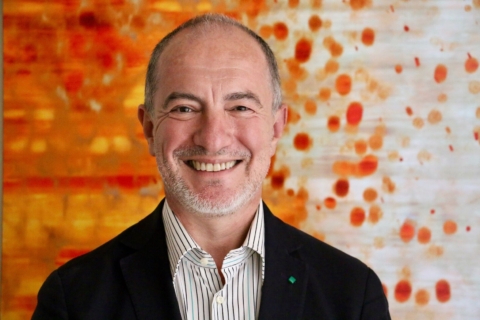
Long before Rossen Milanov became a conductor and music director of both the Princeton Symphony Orchestra (PSO) and the newly reconfigured Princeton Festival, he was a singer.
“Many instrumentalists hear the music through the instruments. [For] me, it’s through the voice,” he says.
So, while Milanov has assembled a dazzling array of chamber music, jazz/cabaret, pops, choral programs, and a Stephen Sondheim tribute during the 16-day festival beginning June 10, it is no surprise opera is central to his love of the performing arts.
Milanov’s musical odyssey began when he was a boy soloist with the Bulgarian National Radio Children’s Choir. When his voice changed at the age of 15, it was suggested he take up the oboe, the instrument closest to that of a singing voice.
Milanov majored in oboe and conducting at the Bulgarian national conservatory. He then came to the United States to earn a master’s degree in oboe performance at Duquesne University, a diploma in conducting from the Curtis Institute of Music, and a master’s degree in orchestral conducting from the Juilliard School.
For six years in the 1990s, Milanov was a professional oboist. The realization that the oboe has only one line of a musical score drew him to the art of conducting, with its command of multiple complexities. Yet his love of singing never wavered.
“I love the voice as an instrument,” says Milanov. “I enjoy opera because I adore singers.” It is no coincidence that five of the festival’s evenings will be devoted to three operas, and that the festival will debut with a non-staged performance of Kurt Weill’s “Seven Deadly Sins,” a chanté (sung) ballet.
Milanov, who is also chief conductor of the Slovenian RTV orchestra in Ljublana, has collaborated with Komische Oper Berlin in performances of Shostakovich’s “Lady Macbeth of Mtzensk,” Opera Oviedo with the Spanish premiere of Tchaikovsky’s “Mazzepa” and Bela Bartok’s “Bluebeard’s Castle” (which was awarded best Spanish production for 2015), and Opera Columbus’s “La Traviata” by Verdi.
Milanov also sees himself as a champion of contemporary works, including those by minority and women composers. “I have always been open to the music that has been created in our own time. Even before Black Lives Matter, with many of my other orchestras that I have worked with, we have explored voices that are not traditionally present on the stages to the same extent as white men, most of them dead. I feel music is music; everybody has a talent and a purpose. If something speaks to me, if I feel that I could share it in a way that I could give justice to the work itself but also to the audience to be introduced to something else, then I program it. I have no fear of doing that, of learning a new piece, of helping composers to hear their pieces live. This is something I have always done and plan on doing for as long as I can.”
Accordingly the Princeton Festival will present Derrick Wang’s comic one-hour opera, “Scalia/Ginsburg,” composed in 2015, when both Supreme Court justices, Antonin Scalia and Ruth Bader Ginsburg, were alive.
An attorney and professor of music at the Peabody Institute, Wang deftly explores the celebrated ideological differences and mutual love of the opera, for which these two monumental figures were known.
Having seen Scalia/Ginsburg performed last summer at the Chautauqua Festival, where he is also music director, Milanov knew he wanted to program it for the Princeton Festival. In fact, two of the principals at Chautauqua will reprise their roles in Princeton.
Derrick Wang “gauges very carefully what are the topics of the day…It was great to see an opera sourced from a place that you normally [would] not necessarily look,” says Milanov. “The music is absolutely spectacular. The orchestra that he uses is very colorful, not very big, certainly featuring a lot of percussion instruments.” There is also an ingenious “mastery of dipping into the different styles of Rossini to Gilbert & Sullivan, Puccini to Mozart, Richard Strauss and Mendelssohn.”
Performed on three separate evenings, “Scalia/Ginsburg” will be accompanied and preceded by Mozart’s one-act comic opera, “The Impresario.” “When you do an opera which is only one hour long, which ‘Scalia/Ginsburg’ is, you always try to find out what would be an interesting pair, something else that we could do in order to lead the audience to that magical world of the opera,” says Milanov.
Mozart composed “The Impresario” late in his career, as a competition piece against his rival Salieri. The latter won the competition, but it is Mozart’s wit, his mockery of the opera world, prefaced by a glorious overture, which has reigned supreme.
“The Impresario” is an example of singspiel, the early form of German opera consisting of spoken dialogue interspersed with song. Audiences will hear a contemporary libretto sung in English. In fact, while all the operas in this summer’s festival will be sung in English, supertitles will be used.
“It’s a question of diction, of singing,” says Milanov. “Even in English, there might be something that you will not understand because things happen very quickly, so we will use projected supertitles. The clarity is important particularly when you’re dealing with dramatic material that just needs a little bit more attention to the details. If you miss something, you might not quite figure out what’s going on later. I think those are important conveniences for our audiences.”
Milanov explains his decision to pair “The Impresario” with “Scalia/Ginsburg.” In the former, he says, two prima donnas are auditioning for the same role. “The very neat parallel is that the actual singer who is going to be singing the role of Ginsburg will have sung one of the soprano roles in ‘The Impresario.’ She’ll be the real connection between the two operas.”
A physical connection will also be made between the two operas. During “The Impresario,” “the set onstage is going to look as if you are backstage, because you’re going to see only the back of the sets for ‘Scalia/Ginsburg,’” says Milanov. “So this entire intrigue — two divas trying to compete for the same role — is happening on the other side of the wall of the stage that you don’t see.”
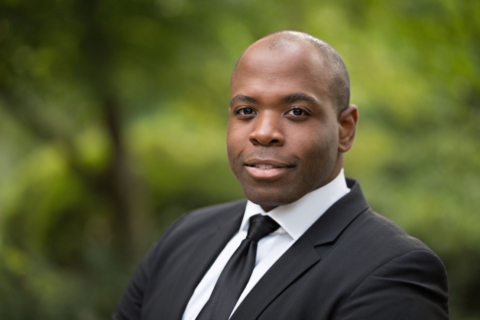
Milanov will also present the opera “Albert Herring” by Benjamin Britten, whom he considers to be one of the greatest opera composers of the 20th century. He is particularly excited about the casting of the title role: Joshua Stewart, an African-American tenor whom Milanov knew during his years at Curtis. Stewart recently completed his debut as Rodolfo in “La Bohème” with the Columbus Symphony, which Milanov also conducts.
“A little unusual casting, but he’s going to be absolutely tremendous. It’s a diverse cast, that makes me very happy because the cast will look pretty much like the world around us, rather than the Victorian England (in which it was originally set). It happens in its own time, but the spirit will be there.”
Albert Herring takes place in an “idyllic countryside. I think Princeton has a little of that kind of colonial atmosphere that is of course American but originated in Britain,” observes Milanov.
The challenge of Albert Herring is that, unlike traditional operas where a singer performs his or her aria then exits the stage, “We have 12 people on stage almost all the time, and each one of them has their individual line, their individual agenda, their individual character. They have to sing but they have to act all the time . . . [There] is going to be a lot of interaction, and the staging is going to be quite funny,” says Milanov. The theme is universal, that of a young adult breaking away from a controlling parent. There will be two performances of Albert Herring.
For opening night of the Princeton Festival, Storm Large, of “America’s Got Talent” fame, will star in Kurt Weill’s “Seven Deadly Sins.” “Weill was exploring what Berlin was in [the 1920s] — extremely controversial, full of life’s temptations, prostitution and cabarets, and interesting artistic things happening all at the same time . . . like the movie/musical ‘Cabaret’ by Bob Fosse,” says Milanov, that audiences will readily recognize. Storm Large will sing, dance, and act; Milanov considers her a renaissance woman (she’s also a playwright). “She is respected among professionals and has mass appeal.”
In past years, some musicians from the PSO were contracted to perform during the festival, but now the orchestra has become the official Princeton Festival orchestra.
Milanov says it feels right feels “to have one orchestra that is the mainstay of those performances” and that the festival will continue to be “opera centric.”
It also feels right to add the festival to the PSO’s performance schedule and its Bravo! educational program that introduces thousands of area school children to symphonic music.
“This seems like an incredible expansion, both horizontal and vertical, and I like to think we are everything — we are the festival, we are the orchestra, we are the education. We are a one-stop shop for everything music,” he says.
While previous festival performances attracted up to 8,000 visitors to various performance venues mainly around the Princeton University campus, this year’s festival marks a new geographical approach and location, performance tents on the grounds of Morven Museum & Garden in Princeton, where the PSO launched a series of concerts during the pandemic.
“(The audience) will be much closer to the artists, much closer to the music — you don’t even have to bring your binoculars!”
Reflecting on the festival and the music he selected, Milanov says, “I’m intrigued by complexity in music, and I’ve always liked to organize people and inspire them. I respect the life and sacrifice of musicians. For me it is like a great devotion. Not only is music a universal language, it’s a joint experience, a feeling in community which connects musicians with audiences in a visceral way. I relish the communal experience and the transformative power of music.”
The Princeton Festival, Morven Museum & Gardens and Trinity Church, Princeton. Opens June 10 with “The Seven Deadly Sins,” followed by the operas “Scalia/Ginsburg” and “the Impresario,” June 11, 12, 18, and “Albert Herring,” June 17 and 19, and more. www.princetonfestival.org.