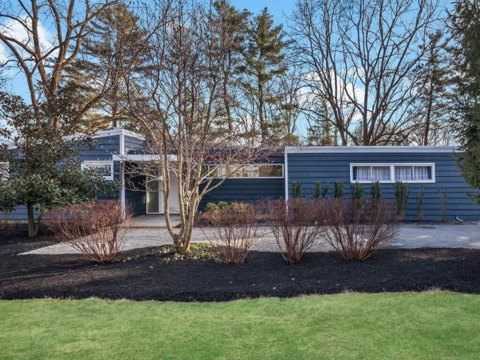
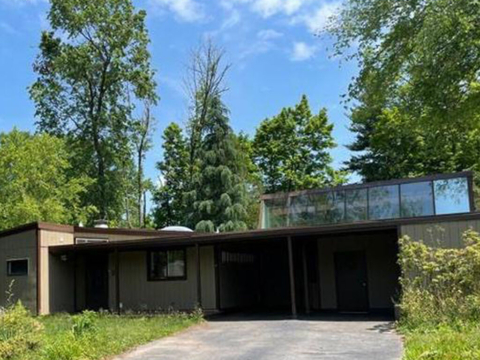
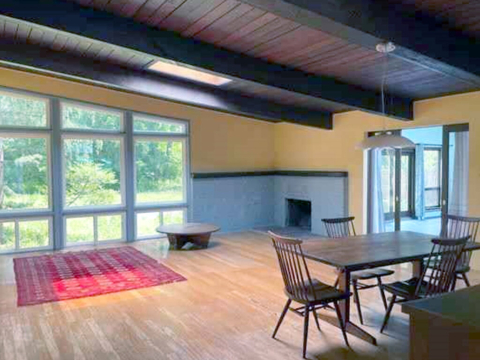
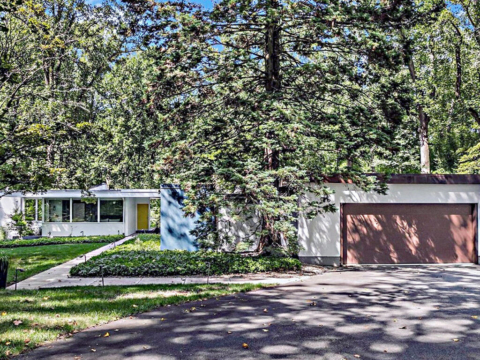
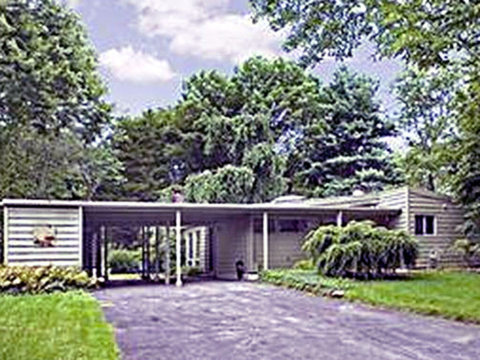
You’ve seen them in your travels around Princeton and environs, those quirky, simple, clean-lined, compact, usually one-story dwellings with flat roofs, expanses of glass, and carports instead of garages. They’re often sited on generously sized lots as well, with mature plantings that may date to the time of their construction, perhaps as far back as the mid-1940s. On closer inspection, you may also note the alterations that many of these structures have suffered as well, in response to the perceived need for more living space and the other amenities of many of their late 20th and early 21st century owners.
Their style has come to be called mid-century modern, a term used as early as the mid-1950s and that is now commonly used worldwide when referring to a (to quote Wikipedia) design aesthetic that is “modern in style and construction, aligned with the Modernist movement of the period. It is typically characterized by clean, simple lines, and honest use of materials, and it generally does not include decorative embellishments.”
Because the style is sought after by some buyers seeking to move into the area, it has also found a place on the radar of some local Realtors, such as David Schure of Callaway Henderson Sotheby’s International Realty in Princeton. Schure’s interest in mid-century modern and other distinctive architectural styles is a natural outgrowth of his academic background and interest in historic preservation. He studied architecture and decorative arts at Columbia University’s graduate program in historic preservation, focused on real estate and marketing in the MBA program at the College of William and Mary, and went on to work for the National Trust for Historic Preservation, the Trenton Downtown Association, and served as chair of the Princeton Township Historic Preservation Commission.
Schure notes that his interest in mid-century modern began when he was a student at Columbia. “Columbia has a fabulous library, the Avery Architectural and Fine Arts Library, and there was an entire section devoted to vintage home design magazines and also Sweet’s catalog of building materials,” he says. “When I needed a break, I’d flip through them. Part of the appeal was how clever the designs were, designed for the way the average person was living then, a break from the grandness of estate homes with servants. The floor plans and sketches, little details like a door from the laundry room outside to what used to be called the laundry yard. My parents were Colonial Revival kind of people so that’s the kind of home I grew up in, homes that had a butler’s pantry.
“I think that one of the propelling factors of mid-century modern when it really broke out as being new and different, was the impact of World War II,” he continues. “One reason was that parts of Europe needed to be rebuilt quickly, and a group of architects became the ‘new masters’ who could fill that need. Also the limitations on the availability of traditional building materials during and after the war called for some creative solutions and necessitated the use of new materials and experimentation with existing materials. For example, using larger expanses of plate glass as it became more available opened up more possibilities for designers.
“And it was important that these structures were inexpensive. I think in a lot of towns where there’s a school of architecture, there are a lot of small, affordable buildings that we would all recognize as something different, distinctive, that’s appealing to the academic community, that the architectural school would be tasked to design as a structure that’s affordable for the average family, particularly in places like Princeton and Cambridge, places where land and housing were already expensive.”
Schure notes that the solutions to finding an inexpensive piece of land called for some creativity and influenced the design of the structure that was built on it. “Perhaps someone would locate a funny little piece of land in the woods that nobody’s used before,” he says. “It didn’t have rolling lawns and a big Colonial-style house on it, so they would design and build something that fits that setting. And the design aesthetic of connecting the interior design to the outdoors began to take shape.”
In fact, two of the textbook characteristics of a mid-century modern home are its simplicity and its connection to its setting; a functional “machine for living” in the words of Le Corbusier, a pioneer of modern architecture, that looks outward to nature versus the tendency of many homes built in more “traditional” styles to look inward, often to cavernous spaces filled with a laundry list of amenities.
“There’s a balance of open space and private space,” Schure says. “One reason there’s a resurgence of interest in mid-century modern is the abundance of open space and a lot of natural light. The open plan works really well. There are also distinctive details, like joining two panes of glass at the corners with no column or as small a column as possible. They’re generally one-story; if there’s a second story it’s often because the structure is hugging a hillside and steps down, or to achieve a sort of observatory that the occupants could step out on, a design element that appears in earlier architectural styles expressed in a new way.”
Schure uses exterior cladding as an example. “Cladding could be a repurposed industrial material like steel, or with traditional materials used in a fresher way, like clapboard,” he notes, “Taking clapboard and using it in a new way, making it wider or butt joint it, or overlap it more or overlap it vertically or change up the pattern in some other way.”
Why did Schure decide to focus on this style as a realtor? “Because I worry about them being lost,” he says. “I worry that the average buyer and the average real estate agent doesn’t really understand the style as much. Many of these homes are aging out; they’re 50, 60, 70 years old, and many of the materials that were tried out when they were built are at the end of their lives and need attention or simply didn’t hold up that well. But they’re often wonderful designs, and in wonderful natural settings.
“The other thing that strikes me is the inside-to-outside connection, when the lines and use of materials inside carry through to the outdoors. That really evokes a sense of place to me. I’m concerned that we’re losing the feeling of connectedness between our living spaces and the outdoors.”
Have you mapped out all the mid-century homes in Princeton and environs?
“I haven’t specifically mapped them out, but I think I know them by ‘touch,’ by driving around town as much as I do. I have a very good sense of where they are. It’s a kind of looking around — stalking maybe — but on the other hand, I believe I do the owners of these properties a good service by establishing a relationship with them and letting them know that when they need to sell that house that somebody would understand it and help them market it properly.”
Why are these homes under threat?
“On big lots, people see a purely economic opportunity,” Schure says. “And in New Jersey one theory, one I agree with, is the desirability of the town, and the price of living here, driven by the quality of the schools, which relates to quality of life and other factors. So you have people who want to be here who also bring their desire for the kinds of housing they’ve seen and lived in in other places.
“They’re paying a lot to live in Princeton — it’s a chicken and egg thing, the lot is expensive to buy, so the house better be bigger and grander than what’s there now. Even for a buyer who’s paid a lot to live here but doesn’t want a big house, the land has a certain value, and they’re thinking of resale, that maybe they’d better build the biggest thing that might sell to the next buyer. So that’s how some of our mid-century homes, especially if it’s in kind of “strange” condition, or wasn’t a particularly good example of the style, had some odd additions or was poorly maintained — things that can happen to any house — leads people to buy them with the intention of replacing them.
“This is also an area with a fair amount of mobility in and out. Conventional wisdom dictates that many corporate executives expect to live in a certain style and size of home, a home that they expect will appeal to the broadest pool of buyers and sell quickly if they’re transferred elsewhere.”
Which leads to the inevitable question: Why are mid-century modern homes worth preserving?
“Why are any good buildings worth preserving?” Schure responds. “They’re tangible evidence of our history, I appreciate good craftsmanship and good design, whatever the architectural period. But because they (mid-century modern homes) are so unique, there are still elements of mid-century design that are being used in contemporary buildings, like the renovation of Nelson Glass into apartments; the use of expanses of glass as a design element and a reference to the former life of the property. They didn’t feel the need to make it resemble an earlier style, they’ve incorporated some of the design elements we’ve been talking about, an open relationship to the outdoors.”
Given that Schure’s business is selling real estate, not saving real estate, how does he feel when he sells a mid-century modern home that he knows is going to be a teardown?
“It’s sad, it’s very difficult for me,” he says. “But I do sit down and talk frankly with sellers of mid-century modern houses; in most cases a person’s home is their biggest asset, and I’m not going to get in the way of their trying to get the biggest return. My wife worked with the architect Jerry Ford years ago, and he had to experience one of his houses being torn down. It must be difficult to see something that you created destroyed.”
That is not to say that is the fate of all mid-century modern homes in New Jersey, or that it is the case elsewhere. Perhaps the Garden State is behind the curve. “If you take a slightly broader perspective, mid-century houses in California and other parts of the country have a super premium on them,” notes Dr. Sylvia Lavin, author, curator, and professor of history and theory of architecture at Princeton University. “So, in that respect I don’t think they’re endangered at all, they have a premium, and there’s a huge amount of appreciation for various aspects of them.
“If you’re looking at it from a real estate point of view, New Jersey people don’t know what they’re missing, because to a large swath of the population in many areas of the country they have an added value because people appreciate the open plan,” Lavin continues. “People have an appreciation of going inside to outside. People appreciate a lack of pretension; no cheesy columns made out of bubblegum, or extra costs that are there to signal a kind of pretension, references to an era when it was desirable to live in manorial home.
“It’s funny to a historian to hear somebody say ‘I live in a Colonial’ with some pride, because we now remember that ‘Colonial’ doesn’t just mean revolutionary and American, but it also means settlers and plantations and all kinds of things, so there is something more that doesn’t tap into that whole ideology. But I do think that the real issue people who may like the style have with mid-century is that the conditions under which people lived, even fancy people, didn’t meet today’s standards. Kitchens were smaller. Bedrooms for children were smaller. And yet no one felt discomfort. When you see what they’re being replaced by, 7,000 square foot houses for a family of three, it’s unsustainable.”
Not that Lavin fails to see the down side in owning a mid-century home, as she does. “I think that there is something about mid-century that asks people to be mindful of what they need,” she says. “But the other thing about mid-century is that, and this is not fun for real estate people to think about, but, generally speaking, it’s not just that the rooms are kind of small and that sort of thing, but they’re not heated as well, they’re not insulated as well, a lot of them have single pane glass. The trick there is if you invest the money in those kinds of upgrades, you end up with something that looks the way it did when you started, and I think that’s what confuses people. They still don’t have a walk-in closet, they probably have a bathroom that’s smaller than they would want, yet they’ve put a lot of money into it. So it’s tricky.
“I do think that there is a financial value (in mid-century homes) for many people,” says Lavin. For people looking for a mid-century in some cases that is an absolute advantage, and the less you do to mess it up the more value it will have to those people. It’s not for everybody, but to the right people, the more invisible your interventions the better.”
Lavin says she was looking to settle into an architecturally interesting house in Princeton but found the search “enormously depressing” and “almost decided to forget about it and deal with the commute here” until she found a suitable home that happened to be a mid-century modern. “This house was designed and built by a Princeton architecture school graduate for himself. It’s had a few different owners, and there are a few places where you can see that things were updated,” she says.
“One of the window walls was taken out and double glazed and like that, but everything is more or less like it was. I can feel parts of the floor beginning to sink a little bit; I don’t have a basement, I have a crawl space; and there are various things… as you would find with any house that is 75 years old.
“But I’m very happy here,” she says. “I grew up in New York, but I was in Los Angeles long enough that I’m extremely happy feeling that I live in connection to the outside. While it’s not so easy to heat and cool, on the three days in New Jersey where the weather is beautiful it’s got a nice cross-breeze, I am extremely happy just being in the house. I don’t need anything more, it’s a very nice place to be.”