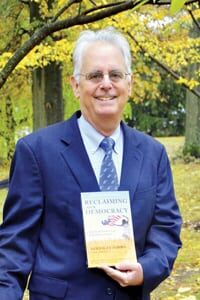
Re-releasing a book titled “Reclaiming Our Democracy: Healing the break between people and government” during a government shutdown is either a stroke of serendipity or evil genius. Either way, Sam Daley-Harris’ timing could not have been better. With Congress’ approval ratings at a historical low of 5 percent as of October, citizens across the country are seething with frustration. Even worse, many people feel powerless to change anything.
Daley-Harris, a Princeton resident, understands this sentiment. “People feel hopeless about Congress, if not downright cynical and disdainful.” Daley-Harris, however, believes that productive dialogues can in fact occur between citizens and constituents. Drawing on three decades of experience as a citizens’ advocate, he has released the 20th anniversary edition of “Reclaiming Our Democracy.” Daley-Harris will speak Friday, November 15, at 6:30 p.m. at One Table Cafe, the monthly community dinner and fundraiser held at Trinity Episcopal Church, 33 Mercer Street, Princeton. To make a reservation, call 609-924-2277, ext. 352, leave your name, telephone number, and number attending.
Many people feel that voting is their main (read: only) way to voice their desires to their government. After voting, they sit back and hope for the best until the next election. They might sign a petition or share a link on Facebook, but beyond that they probably don’t think they have a real chance of affect their representative’s actions. Right? Wrong, says Daley-Harris.
He can understand why people might think they are powerless to influence their government, though. Working as a music teacher and percussionist in the 1970s, he was not exactly the poster child for political activism. And yet by 1980 he had started a group one Congressman called the most “effective organization in terms of raising the important issues of our time for our country and for the world.”
The transition from educator and musician to citizen advocate might not seem that unusual to Daley-Harris. After all, he comes from a civic-minded family. In Daley-Harris’s hometown, Miami, his father edited a community newspaper by himself, went to city hall meetings, and rode in the city parade as Uncle Sam. His mother, a homemaker who almost never left the house, strongly supported citizen voting. “The only time she wasn’t home was on election day when she would volunteer all day,” Daley-Harris said.
Daley-Harris received his bachelor’s and masters in music at the University of Miami. He went on to perform as a percussionist for the Miami Philharmonic Orchestra while simultaneously serving as a high school music teacher from 1969 to 1979. He moved to Los Angeles in 1980 to pursue his career in songwriting while continuing to substitute teach on the side.
Daley-Harris started looking for a greater purpose to life at the age of 17, but didn’t find it until 1978, when he attended a lecture on global hunger. When initially facing the monumental issues he works with regularly today, he described himself as “first oblivious, then hopeless.”
The lecture showed him there were opportunities to solve global hunger, however. “I realized that it wasn’t a matter of not having the solutions. It was that we didn’t have the political will.” He was inspired to share the lecture with the students in his school district, and at the same time started asking them if they knew the name of their member of Congress.
He determined the missing link necessary to create political will was interactions between constituents and their representatives. When he first started his awareness campaign, he asked more than 7,000 high school students who their congressional representative was. “I didn’t ask whether they had ever written them, or if they had met with their representative. I just asked if they knew their name.”
Out of those 7,000 students, only 200 could name their representative. Daley-Harris felt this spoke to a gap in people’s relationships with government representatives and began to focus on building those relationships.
RESULTS, the first of his efforts in citizen advocacy, sprung out of that idea. Daley-Harris and other RESULTS volunteers convened monthly to write letters advocating for increased funding for child welfare issues. Through trial and error they developed techniques to get their representatives to take action.
What had been a mere blip on Congress’ radar became a hot-button issue. In 1986 funding rose from $25 million to $75 million per year. Today approximately $600 million goes towards child survival and maternal health. During RESULTS’ campaign, preventable child deaths dropped from 41,000 per day in the early 1980s to 18,000 per day by 2012, despite an increase in global population.
One of the main lessons Daley-Harris and the RESULTS team found through their trial and error approach was that elected officials are just as human as the rest of us — and respond to human connections. One of the first members of Congress he ever met with was visibly shaken over a video Daley-Harris showed on global poverty. When asked if his constituents ever contacted him about this issue, the representative said there was one person out of the 500,000-plus in his district who had contacted him about global poverty.
It turned out that Daley-Harris’ hunch about developing quality relationships between government officials and citizens was spot on. Members of Congress have told him they give more weight to citizen lobbyists than to professional lobbyists. The citizen lobbyists are, after all, their constituents. Perhaps just as importantly, they realize citizen lobbyists care passionately about an issue, and that they are not being paid to care about an issue.
Daley-Harris eventually identified 13 principles that contribute to the success of citizen advocacy efforts. These principles shape the core structure of the organization:
A powerful structure of support. Daley-Harris states that this is what makes the difference between an interesting idea and action. For RESULTS, the support structure includes monthly conference calls with volunteers and guest speakers, weekly coaching calls for leaders, action sheets, and packets for editorial writers.
Inspiration and idealism. Daley-Harris recommends being comfortable with your idealism and passion, saying they are necessary to inspire others as well.
Selecting the right staff. It is not enough to have impassioned volunteers; it is also imperative to have staff who “own the vision as completely as any great entrepreneur would do and be persistent in the face of opposition.”
Focused, inspiring agenda. Daley-Harris believes many grassroots organizations underestimate the attention span of their volunteers, and therefore diversify their topics to keep people interested. His experience, however, has shown that people enjoy gaining a deep, rich knowledge on a specific, inspiring topic.
Practice and coaching. Real practice and coaching allows volunteers to feel more confident and be more effective when meeting with their Congressman or writing letters to the editor. “People are too busy for gestures, for going through the motions, but there are some who are not too busy to make a real difference.”
Integrity. It is important for the organization to respect volunteers’ time and provide high-quality, timely feedback and support.
Empowering breakthroughs. Daley-Harris says that going outside of your comfort zone to speak with a member of Congress, write a letter to the editor, or call into a talk show empowers people in a way that “is one of the gifts of deep advocacy.”
Enrolling others. This principle ties into the fear of social ostracism from peers for engaging in something potentially perceived as different or not worth the time. Daley-Harris states that “when the commitment to the purpose and vision is greater than the fear of rejection, big things can happen.”
Building deep relationships. Citizen advocacy groups are not interested in having chance run-ins with members of Congress or newspaper editors. Instead, they are invested in building high-quality relationships over time. One Virginia-based activist, Elli Sparks, stated “I see the relationship with the member of Congress as an arranged marriage. A good arranged marriage starts out cold and eventually warms up. That’s different from a love match, which starts out hot and slowly cools down.”
Being vulnerable. Daley-Harris has found when meeting with representatives that they respond more to heart-felt and evocative discussions or materials than to facts and figures. This requires volunteers to be open to engaging on an emotional level.
Partnership, not partisanship. Volunteers are encouraged to view their representatives as partners rather than opponents. Sparks said “I had to let go of a lot of emotional baggage. I could no longer judge [members of Congress] or hold hostility in my heart towards them.” This approach allows for an open exchange of ideas.
Being a visionary. The problems RESULTS tackles are, as Buckminster Fuller said, “[The ones] you see need to be done and that no one else seems to see need to be done.” Being a visionary is part of achieving transformative results, says Daley-Harris.
Humor, joy, and celebration. It is possible to become mired in the heaviness of the issues you are working on, Daley-Harris warns. Instead, he suggests volunteers find joy in making a difference, working with others who care about the same issues, and “being inspired by living a committed life.” “If you can have a group that has a powerful monthly conference call — not a boring one, not a yawner, but an exciting one and an empowering one — and if it’s month in and month out, you are building your expertise on your topic, and that is powerful.”
Daley-Harris says lobbying has changed in one significant way since the advent of the Internet. Twenty years ago no one was E-mailing their congressman and no one was signing online petitions. While that can be a valuable way to alert people to an issue, Daley-Harris says that for issues like global poverty, climate change, and global peace, “mouse-click advocacy” won’t cut it.
As a result, the principles in his book have not changed despite the advent of the Internet and social media in the 30 years since starting RESULTS and the 20 years since he originally released the book. He works on different issues now but uses the same approaches. If anything, online petitions and mouse-click advocacy underscore the disconnect from direct relationships with elected officials by creating a false sense of progress.
Nevertheless, Daley-Harris felt it was time to update his book for a couple of reasons. His recent work with the Citizen Climate Lobby (CCL), a citizen advocacy group focused on creating political will for a stable climate, is featured in a new chapter. Daley-Harris has served as an advisor to CCL since its start in 2006. CCL is using the RESULTS principles in its approach to advocate for climate change reform.
Although the organization is still fairly young, it has been gaining traction. The group has opened 135 chapters in the United States and Canada, had 873 letters to the editor published in newspapers nationwide, and has had 639 meetings with members of Congress and Parliament or their staff.
One of the biggest impacts CCL has had on its participants is a renewed sense of hope and empowerment to enact change. With issues as large and overwhelming as climate change or global child mortality, the road to progress can seem daunting, especially for your average citizen.
Sparks, the Virginia activist and a member of CCL, had experienced exactly that. In fact, she called it “climate trauma.” Over 18 months of working with CCL she developed tools to build relationships with members of Congress and editorial writers. Rather than feeling overwhelmed and paralyzed, she now describes her work as “sacred and profound.”
Daley-Harris was also ready to re-release his book because of a new endeavor he started in 2012, the Center for Citizen Empowerment and Transformation. Now that RESULTS and CCL have shown the advocacy principles can be applied to different issues, Daley-Harris wants to help other organizations adopt the same practices.
Although he outlines the strategies in his book in great detail, Daley-Harris knows that won’t be enough for some organizations. “As I was developing the concepts [for the book], my wife wondered if circulating the list was tantamount to giving away the store.” He isn’t worried, though. “[So] little is understood about true citizen empowerment and transformation that even if I nailed the list on every tree in the nation . . . people still wouldn’t get it.”
Daley-Harris’s path from Miami to Princeton took him through Washington, D.C., where he moved after starting RESULTS and establishing its headquarters there. It was a typical bootstrap start-up. For more than four years Daley-Harris sustained RESULTS by working five days a week as a substitute teacher. “There were many sacrifices. I rented a room in someone’s house. I lived really frugally. And I did my work for RESULTS at night.” Finally, in 1985, he was able to become RESULTS’ first paid employee. Now RESULTS is sustained by a mixture of grants and donations, and has a staff of 40 to 50 in the United States and Canada.
In 1990 he met the woman who would become his wife, the Rev. the Shannon Daley-Harris. She was in Washington at a World Summit for Children candlelight vigil that Daley-Harris had helped organize. A Presbyterian minister, she was representing one of the partners of the World Summit, the Children’s Defense Fund. They eventually moved to Princeton, Rev. Daley-Harris’ hometown, where they are raising their two children, Micah, 15, and Sophie, 12. Today Shannon Daley-Harris continues to work with the Children’s Defense Fund, as well as pursue a career in writing and consulting.
Sam Daley-Harris continues to travel regularly to Washington to assist with RESULTS, CCL, the Center for Citizen Empowerment, and most recently, the Peace Alliance. He has also shifted his focus to several other projects. From 1995 to 2007 he ran the Microcredit Summit Campaign, an effort to increase access to microloans for impoverished people globally. For Daley-Harris, starting the Microcredit Summit Campaign was a completely different experience from starting RESULTS. “When I started the Microcredit Summit, I already had a track record. RESULTS was an organization that started with nothing,” he says.
Daley-Harris is eager to get the lessons he has learned about citizen advocacy and empowerment into the hands of the general public. “Everyone wants to matter. Everyone wants to leave the campsite cleaner than they found it. Everyone wants to make a difference. But that’s buried down underneath ‘It’ll never work; they won’t listen to you; you can’t fight city hall; I don’t make a difference.’ If you have all that stuff going on, it covers up your deep desire to matter,” Daley-Harris says.
“This is not for everyone, but once you start uncovering the stuff that holds you back, you can make a difference not just in your community, but in the world.”
RESULTS, Central New Jersey Chapter. www.results.org.
Citizen Climate Lobby. The Princeton chapter meets on the first Saturday of the month. For meeting times and locations, E-mail princeton@citizensclimatelobby.org or visit www.citizenclimatelobby.org